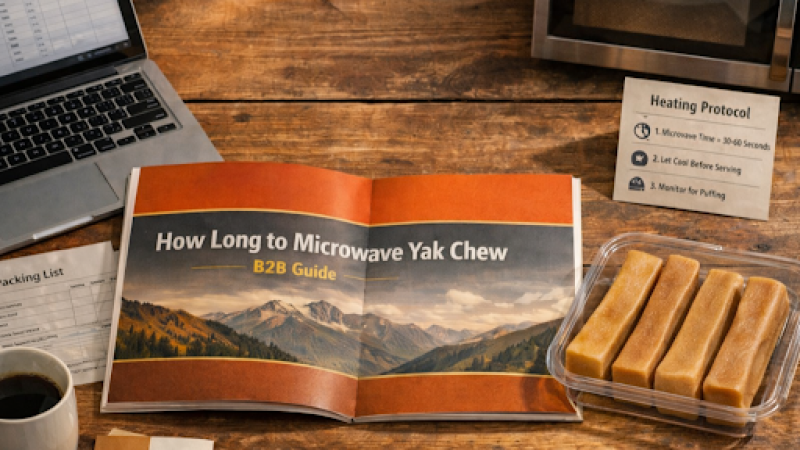
Yak chew is a hardened, long-lasting dog treat that can be safely transformed in the microwave into a light, puffed snack when it reaches its final “nub” stage. This guide explains exactly how long to microwave yak chew pieces-typically 45 to 90 seconds, depending on size and microwave wattage-and how moisture content and chew thickness influence the expansion process. When heated correctly, the dense cheese structure expands as internal moisture turns to steam, creating a brittle, airy texture that reduces choking risk compared to the original hard nub.
Proper preparation and timing are essential to avoid burning, uneven expansion, or overheating. Smaller pieces require shorter heating times, while larger nubs need closer to the full 90 seconds, with adjustments based on microwave power. Equally important is a 2-minute cooling period after microwaving, which ensures the chew reaches a safe temperature before being given to a dog. The process is designed to convert leftover chew pieces into a safer, more digestible treat while preserving their nutritional simplicity and chew-based enrichment value.
What Is a Yak Chew and Why Would You Microwave It?
Yak chews are hard, compressed dog treats made from yak milk, cow milk, salt, and lime juice. Microwaving transforms small, leftover yak chew pieces, called “nubs”, into light, airy, puffed snacks that are easier and safer for dogs to consume. The heat causes rapid moisture expansion inside the dense cheese matrix, creating a texture dogs find highly palatable.
What Are Yak Chews Made Of and How Are They Used?

Yak chews consist of 4 primary ingredients: yak milk (the primary protein source), cow milk, Himalayan salt, and food-grade lime juice. Yak milk is notably richer than conventional cow milk, containing 4.0–5.9% protein and 16–18% total solids per a 2023 NIH-indexed nutritional review. This high casein density is what gives yak chews their characteristic hardness and long chew duration.
Dogs use yak chews as long-duration chewing enrichment. Dogs lick, gnaw, and scrape the surface over periods ranging from 20 minutes to several hours, depending on chew size and the individual dog’s chewing style. The chew naturally wears down over time, producing a small, hard nub, typically under 1.5 inches, that poses a swallowing hazard if given back to the dog without processing.
Microwaving that leftover nub converts it from a choking risk into a puffed, brittle snack that crumbles easily and digests safely. This is the primary use case for microwaving yak chews.
What Should You Do When a Yak Chew Gets Too Small?
A yak chew nub at the end of its chewable life has 2 outcomes: microwave conversion or discard. The decision rests on 3 factors evaluated before heating: minimum weight threshold, structural integrity, and surface condition.
Microwave the nub when all 3 conditions are met:
- The piece weighs at least 0.25 oz (approximately grape-sized)
- The surface is firm and dry, with no sliminess or tackiness from extended salivary exposure
- No cracks run fully across the diameter of the piece
Discard the nub when any of these 3 conditions are present:
- The piece weighs under 0.25 oz and crumbles under gentle finger pressure before any heat is applied
- Visible mold, abnormal discoloration, or an off-odor beyond the neutral cheese baseline is present
- Fractures cross the full width of the piece, not along its length but through its entire cross-section, preventing uniform steam distribution and producing mixed-hardness fragments after puffing
Surface cracks running along the length of a nub are cosmetic and do not affect safe conversion. Cracks crossing the full diameter are structural and disqualify the piece from microwaving.
Retailers distributing YforYak products increase consumer confidence by pairing each sale with a simple nub lifecycle guide. Clear assessment guidance reduces product waste, extends perceived value through the chew’s complete use cycle, and lowers post-purchase support volume.
Why Do People Microwave Yak Chews for Dogs?
Dog owners microwave yak chew nubs for 3 practical reasons:
- Choking prevention: Nubs under 1.5 inches are too small for a dog to safely chew but too large to pass safely if swallowed whole; microwaving eliminates the hazard.
- Waste reduction: With pet services inflation running 42% above 2019 levels and pet store spending declining, today’s dog owners are increasingly cost-conscious, making waste reduction a practical priority (Bank of America Institute, 2025). Microwaving a yak chew nub into a second treat rather than discarding it reflects this broader consumer behavior shift.
- Digestibility improvement: The puffed structure breaks apart more easily during chewing, reducing hard fragment ingestion.
Pet nutrition educators commonly recommend microwaving nubs as standard practice rather than an optional add-on. The technique is specifically endorsed on packaging by several major yak chew brands, including Himalayan Dog Chew and WagMore BarkLess.
Is It Safe to Microwave a Yak Chew?
Microwaving a yak chew is safe when performed correctly. The process uses the moisture inside the compressed cheese to generate steam, which expands the protein matrix. No toxic compounds form during heating. The 3 critical safety conditions are: stopping before burning, cooling completely before serving, and confirming the puffed texture before offering it to your dog.
Does Microwaving Change the Safety of Yak Chews?
Microwaving does not introduce new allergens or toxic compounds into yak chews. The 4 original ingredients, yak milk, cow milk, salt, and lime, remain chemically unchanged at microwave temperatures between 165°F and 212°F (74°C–100°C). No harmful Maillard byproducts form at these temperatures within the 45–90 second window used for yak chew preparation.
The compositional profile of a correctly microwaved yak chew nub remains identical to the original chew. Protein content, fat content, and salt levels stay consistent. The physical structure transforms from dense and hard to porous and brittle, but the nutritional and safety profile does not degrade.
One documented change: microwaving reduces surface bacteria due to heat exposure, making the puffed chew marginally safer from a microbial standpoint than the raw nub. This is a minor benefit, not a primary reason to microwave.
Can You Microwave a Whole Yak Chew?
No. Microwaving a whole yak chew stick produces 3 problems: exterior scorching before the core heats, internal fracturing from uneven steam pressure, and a hard, unexpanded core that creates choking and dental fracture risk simultaneously.
A full-size yak chew stick measures 4 to 7 inches in length, depending on size grade. The core of a full stick lies well beyond the microwave’s effective heat penetration depth. The outer surface reaches and exceeds the expansion temperature while the interior remains cold and dense. No adjustment to wattage or heating time corrects this geometry problem.
Full sticks carry 3 to 6 times the moisture mass of a nub. That volume, distributed across an uneven cross-section, generates steam pressure in competing directions at the same time. The force fractures the stick into a mix of burned outer sections, partially puffed mid-sections, and hard, unexpanded core pieces, all at different temperatures within a single piece.
The nub format is the only geometry where the entire cross-section falls within the microwave’s effective penetration depth, producing uniform steam generation and controlled expansion. A full yak chew stick cannot replicate this result at any wattage or heating duration.
What Risks Should You Consider Before Microwaving?
3 real risks exist when microwaving yak chews incorrectly:
- Burning: Overheating beyond 90 seconds in a 1,000-watt microwave scorches the outer surface, producing acrid-smelling carbonized protein. A burned chew carries bitter compounds that dogs typically reject, but that cause gastrointestinal upset if consumed.
- Uneven expansion: Microwaving without a resting pause causes internal steam to remain trapped, creating hard pockets inside an otherwise puffed exterior. Dogs that bite through the soft outer layer encounter hard internal fragments.
- Serving while hot: The interior of a freshly microwaved yak chew reaches temperatures above 180°F (82°C). Serving without a 2-minute cool-down causes oral burns on the dog’s palate, tongue, and gum tissue.
None of these risks is inherent to the process itself. Each risk is directly avoidable through correct timing, monitoring, and cooling.
How Long Should You Microwave a Yak Chew?
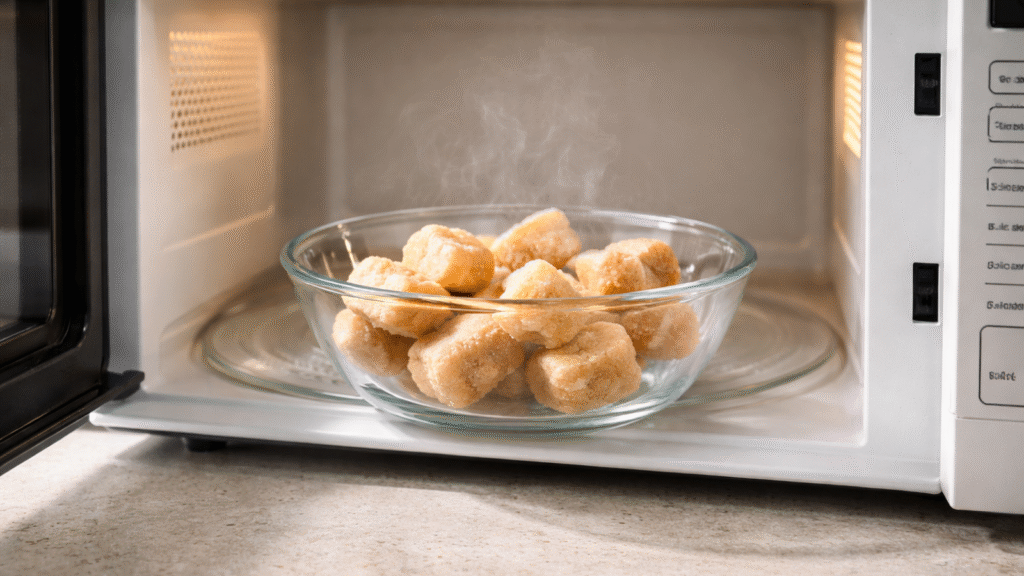
The ideal microwave time for a yak chew is from 45 to 90 seconds at full power (1,000 watts). Small nubs under 1 oz require 45–60 seconds. Medium nubs between 1 oz and 2 oz require 60–75 seconds. Large pieces over 2 oz require 75–90 seconds. Start at the lower bound and add 10-second increments as needed.
What Is the Ideal Microwave Time for Different Chew Sizes?
The table below defines 4 standard yak chew size categories and their corresponding microwave times at 1,000 watts:
| Chew Size | Weight Range | Microwave Time (1,000W) | Expected Expansion |
| Extra Small Nub | Under 0.5 oz | 30–45 seconds | 2x–3x original volume |
| Small Nub | 0.5 oz – 1 oz | 45–60 seconds | 3x–4x original volume |
| Medium Nub | 1 oz – 2 oz | 60–75 seconds | 3x–5x original volume |
| Large Piece | Over 2 oz | 75–90 seconds | 2x–4x original volume |
Large pieces expand less proportionally because the denser internal mass requires more sustained heat to fully convert moisture into steam. Extra small nubs risk over-expansion and burning above 45 seconds due to their lower total moisture content.
How Does Microwave Power Level Affect Timing?
Microwave wattage directly controls the rate of internal moisture conversion. A 700-watt microwave delivers 30% less energy per second than a 1,000-watt microwave, requiring proportionally longer heating times.
Apply these wattage-based multipliers to the baseline 1,000-watt times:
- 700-watt microwave: multiply baseline time by 1.4 (60 seconds becomes 84 seconds)
- 800-watt microwave: multiply baseline time by 1.25 (60 seconds becomes 75 seconds)
- 900-watt microwave: multiply baseline time by 1.1 (60 seconds becomes 66 seconds)
- 1,100-watt microwave: multiply baseline time by 0.9 (60 seconds becomes 54 seconds)
- 1,200-watt microwave: multiply baseline time by 0.85 (60 seconds becomes 51 seconds)
Most household microwaves manufactured after 2010 operate between 900 and 1,200 watts. The wattage is printed on the interior door frame or back panel label. Using the correct wattage multiplier prevents both under-heating (no puffing) and over-heating (burning).
How Do You Know When a Yak Chew Is Ready?
A correctly microwaved yak chew displays 4 observable signs:
- Volume increase of 2x–5x: The nub visibly expands within the first 30 seconds of heating.
- Light golden-yellow color: The surface transitions from the original dark tan to a pale, airy golden tone. Brown or dark brown indicates burning.
- Hollow, crispy sound: Tapping the cooled chew produces a hollow knock rather than the dense thud of the original hard piece.
- Crumbles under light finger pressure: The puffed chew breaks apart with minimal force. Hard resistance indicates incomplete expansion.
Stop the microwave immediately when the volume expansion plateaus. Continued heating after full expansion only burns the surface without improving texture.
What Factors Affect Yak Chew Microwaving Time?
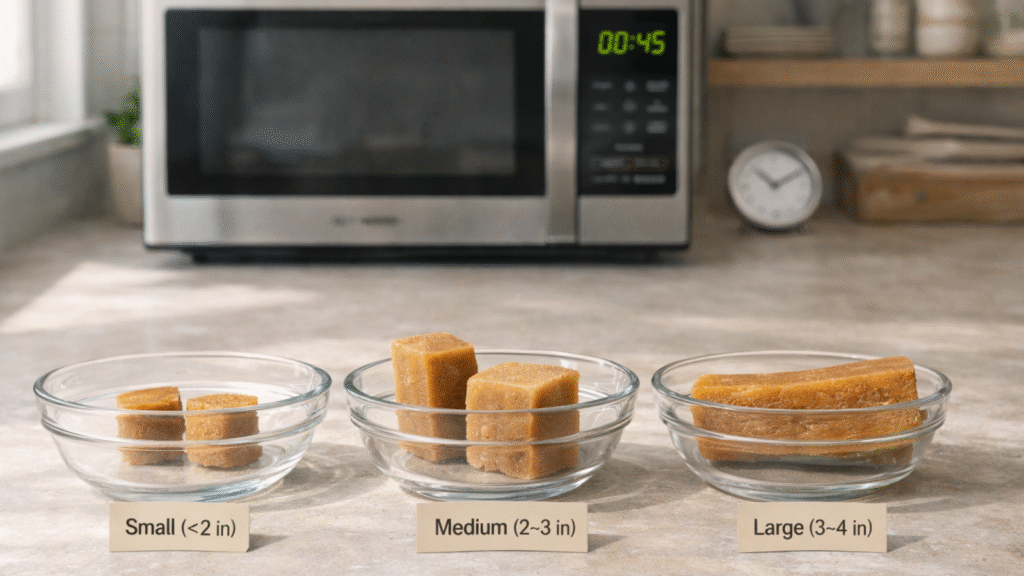
3 physical factors determine the actual microwave time needed for any individual yak chew: chew thickness, residual moisture content, and microwave wattage. These 3 variables interact; a thick chew with high moisture in a low-wattage microwave requires maximum heating time, while a thin, dry nub in a high-wattage microwave requires minimum time.
How Does Chew Thickness Change Cooking Time?
Chew thickness controls heat penetration depth. Microwave energy penetrates food to a depth of approximately 1 to 1.5 inches by exciting water molecules, which generate steam at roughly 212 degrees F, the mechanism that causes yak chew nubs to expand (University of Wisconsin Extension). A nub under 0.5 inches heats through entirely within 30–45 seconds; a 1-inch piece requires 60–75 seconds.
Thick pieces with uneven cross-sections, common in irregularly shaped yak chew nubs, heat unevenly. The thinner end reaches expansion temperature first, while the thicker end lags. Rotating the chew 90 degrees at the midpoint of the heating time corrects this unevenness.
How Does Moisture Content Influence Expansion?
Moisture content is the primary driver of expansion volume. Yak chews are manufactured with a moisture content of approximately 6–10%. Working with a consistent yak chew manufacturer & supplier ensures each production batch maintains this target moisture range, a quality variable that directly determines how reliably the nub expands during microwaving. A nub that has been actively chewed for multiple sessions has lower surface moisture than a freshly opened piece because dog saliva and ambient exposure partially dry the outer layers.
A drier nub expands less than a moister one under identical heating conditions. Dog owners who want maximum expansion from a dry nub: place the nub in a sealed plastic bag with 2–3 drops of water for 5 minutes before microwaving. This reintroduces surface moisture without oversaturating the chew, producing 20–30% greater expansion than dry heating alone.
How Does Microwave Wattage Impact Results?
Wattage determines energy delivery speed, not total energy available. A 700-watt microwave heating for 90 seconds delivers the same total energy as a 1,000-watt microwave heating for 63 seconds. The difference: lower wattage distributes that energy more slowly, allowing more even heat penetration into dense pieces.
For irregular or unusually thick yak chew pieces, a 700-watt setting produces more even puffing than a 1,000-watt setting at shorter duration, even when total energy is equivalent. Dog owners with adjustable power settings: use 70% power for 90–105 seconds on pieces over 1 oz rather than full power for 75 seconds. Even heat distribution produces a uniformly puffed chew without burned outer spots.
What Is the Step-by-Step Process to Microwave a Yak Chew?
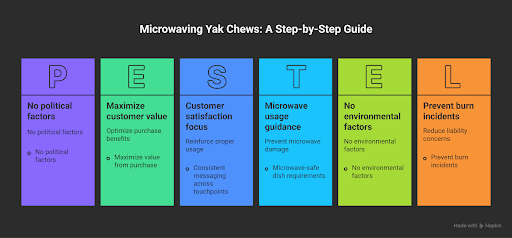
To microwave a yak chew correctly, follow this 6-step process: check nub size, place on a microwave-safe plate, heat using wattage-adjusted timing, watch for expansion, rest for 2 full minutes, and test texture before serving. Each step contributes directly to yak chew digestibility; the puffed structure is only as safe and digestible as the technique used to create it. Skipping any of these steps is the leading cause of burned, unevenly puffed, or dangerously hot chews.
How Should You Prepare the Yak Chew Before Microwaving?
Preparation requires 3 actions before the chew enters the microwave:
- Confirm the nub is under 2 oz: Pieces over 2 oz take 75–90 seconds and carry a higher burning risk. Split oversized pieces using a clean knife before microwaving.
- Inspect for mold or unusual odor: A properly stored yak chew nub has a neutral, faint cheese smell. Sour, ammonia, or rotten odors indicate spoilage. Discard any nub with visible discoloration (green, black, or fuzzy growth).
- Place on a microwave-safe plate lined with a paper towel: The paper towel absorbs excess moisture released during heating, preventing the chew from sitting in steam condensation. Avoid microwave-safe bowls; the chew expands and can stick to the bowl sides.
No soaking, scoring, or pre-heating preparation is necessary for standard nubs under 1 inch thick.
What Steps Ensure Even Puffing in the Microwave?
Even puffing results from 4 specific actions during the heating process:
- Set the microwave to the correct wattage-adjusted time: Use the multipliers from the wattage table above. Start 10 seconds below the maximum estimate.
- Do not open the microwave during the first 30 seconds: Early heat interruption prevents the initial internal steam buildup needed to start expansion.
- Rotate the chew 90 degrees at the halfway point: At 30 seconds into a 60-second cycle, pause and reposition. This corrects the uneven exposure caused by microwave hotspots.
- Watch through the microwave window for signs of expansion: Visible puffing indicates the process is working. Stop immediately if you observe smoke, dark browning, or a burning smell; these 3 signs indicate overheating regardless of remaining time.
How Should You Cool the Chew After Microwaving?
Cool the microwaved yak chew using this 3-step procedure:
- Remove from microwave immediately after heating ends: Do not leave the chew in the microwave’s residual heat environment.
- Place on a wire rack or elevated plate for 2 full minutes: Elevation allows hot steam to escape from all surfaces simultaneously. A flat surface traps bottom moisture and creates a damp, soft underside.
- Test temperature before serving: Touch the chew’s surface with a bare finger. The chew is ready to serve when the surface temperature matches the room temperature. Internal temperature lags surface temperature by 15–20°F (8–11°C), so a warm surface indicates a still-hot interior.
Never give a freshly microwaved yak chew to a dog before the 2-minute rest period expires.
What Mistakes Should You Avoid When Microwaving Yak Chews?
The 3 most common mistakes dog owners make when microwaving yak chews are: heating too long, failing to rotate mid-cycle, and serving before adequate cooling. Each mistake produces a distinct, identifiable problem: burned flavor, hard internal pockets, or oral burns that are entirely avoidable with the correct technique.
Why Do Yak Chews Burn or Fail to Puff Properly?
Burning occurs when microwave time exceeds the moisture-to-steam conversion window. Once all internal moisture converts to steam and escapes, continued microwave energy scorches the protein matrix. This typically happens after 90–100 seconds in a 1,000-watt microwave for pieces under 2 oz.
Failed puffing, where the nub heats but does not expand, results from 2 causes:
- Insufficient moisture: Extremely dry nubs have too little internal moisture to generate adequate steam pressure. The moisture-reintroduction method (2–3 drops of water in a sealed bag for 5 minutes) resolves this.
- Inadequate power: Heating at 30–50% power for normal durations does not generate enough concentrated heat to build internal steam pressure. Always use full power or the wattage-adjusted equivalent.
zed Text (replace with): “Nubs stored in humid environments absorb ambient moisture and puff readily. Nubs stored in dry climates or in open bags lose moisture and require moisture reintroduction before microwaving. Optimal yak chew storage conditions, including container type, humidity exposure, and shelf placement, determine how much residual moisture remains when the nub reaches the microwave. Dog owners who want maximum expansion from a dry nub: place the nub in a sealed plastic bag with 2–3 drops of water for 5 minutes before microwaving.
What Happens If You Overheat a Yak Chew?
An overheated yak chew displays 4 identifiable characteristics:
- Dark brown or black surface color: Indicates protein carbonization. The Maillard reaction at temperatures above 300°F (149°C) produces bitter compounds.
- Acrid, burned cheese smell: Distinct from the neutral odor of a correctly heated chew.
- Brittle, crumbling exterior with dense, rubbery interior: The outer layer burns while the interior core, insulated by the overheated exterior, fails to puff.
- Shrinkage rather than expansion: Severe overheating causes the protein matrix to contract rather than expand as moisture fully evacuates and carbonization begins.
An overheated yak chew warrants disposal. The bitter carbonized compounds cause gastrointestinal irritation in dogs, and the mixed hard/brittle texture creates unpredictable fragment sizes that increase choking risk.
How Can Uneven Heating Be Prevented?
Uneven heating stems from 3 sources: microwave hotspots, irregular chew geometry, and single-position heating. All 3 are addressable:
- Microwave hotspots: Rotating the chew 90 degrees at the midpoint of heating redistributes energy exposure. Placing the chew off-center on the turntable (2–3 inches from the center) also improves exposure uniformity on rotating-plate microwaves.
- Irregular chew geometry: Trim protruding thin edges with a clean knife before microwaving. Thin edges burn before the thicker main body reaches expansion temperature.
- Single-position heating: Heating large pieces in two shorter 40-second intervals with a 15-second rest between intervals allows internal heat to equalize before the second heating phase, producing more uniform steam generation throughout the mass.
Are There Alternatives to Microwaving Yak Chews?
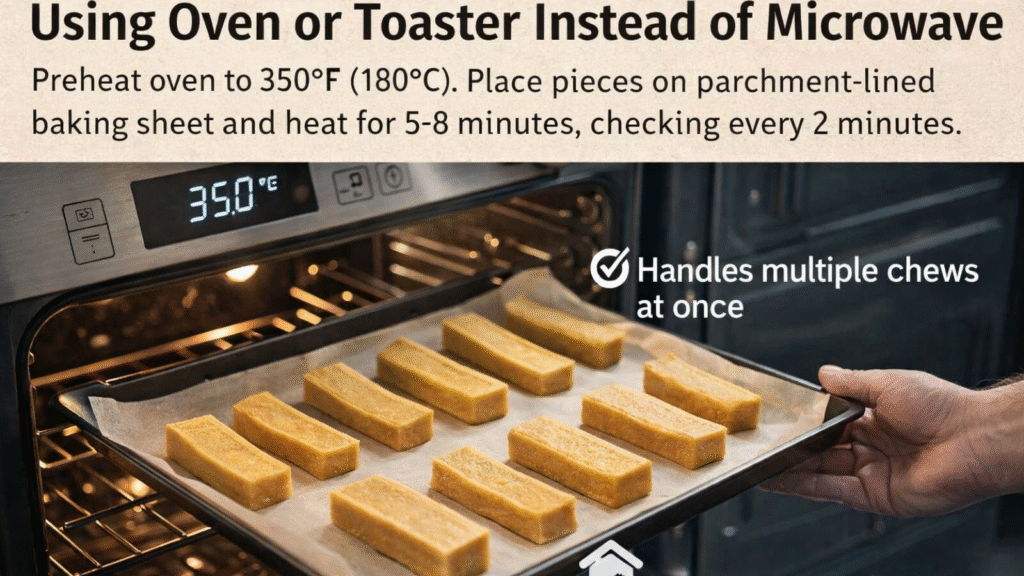
Yak chew nubs expand using 2 confirmed heat alternatives to microwave preparation: conventional oven baking and air frying. Both methods produce a puffed texture comparable to microwave results, though with different time requirements. Oven baking at 375°F (190°C) for 4–6 minutes produces the most even puffing. Air frying at 350°F (177°C) for 3–4 minutes delivers slightly crispier results with 20% faster cooking time.
Can Yak Chews Be Softened or Expanded Without a Microwave?
3 heat methods expand yak chew nubs without a microwave:
- Conventional oven: Preheat to 375°F (190°C), place nub on parchment-lined baking sheet, bake 4–6 minutes, rest 3 minutes before serving. Produces even puffing with the lowest burn risk of the 3 methods.
- Air fryer: Set to 350°F (177°C), place nub in basket without overlapping, heat 3–4 minutes. Monitor every 60 seconds. Rest 2 minutes before serving. Produces a slightly drier, crispier texture preferred by some dogs.
- Toaster oven: Set to 375°F (190°C), place the nub on the rack, and heat for 5–7 minutes. Less precise than a conventional oven; requires monitoring after 4 minutes.
Cold water soaking is not an effective alternative for creating a puffed texture. Soaking softens the surface of the yak chew nub but does not create the airy, expanded structure that heat generates. Soaked yak chews become sticky and chewy rather than light and brittle. Soaking is appropriate only for dogs with dental sensitivity who require a softer chew; it is not equivalent to microwaving for nub repurposing.
What Other Dog-Safe Treat Options Exist?
Dog owners seeking chew treat alternatives to yak chews have 5 commonly available options:
- Bully sticks: Single-ingredient beef pizzle chews. High protein, no additives, fully digestible. Appropriate for dogs of all sizes, with odor as the primary drawback.
- Collagen chews: Derived from beef hides using a different processing method than rawhide. Softer than yak chews with a comparable chew duration for medium-sized dogs.
- Antler chews: Naturally shed deer or elk antlers. High mineral density. Rated as extremely hard; not recommended for dogs with prior dental fractures or tooth sensitivity.
- Himalayan yak cheese sticks: Thinner, softer format of traditional yak chews. Lower choking risk from nubs due to smaller piece size. Nubs still benefit from microwaving.
- Freeze-dried raw treats: Made from single-protein sources (chicken, beef, salmon). Soft texture with no microwaving required. Lower chew duration, 2–5 minutes for most dogs, limits enrichment value compared to yak chews.
What Safety Considerations Matter for Dogs and Yak Chews?
Yak chew safety depends on 3 dog-specific factors: body weight relative to chew size, dental health history, and known dairy sensitivities. A correctly microwaved yak chew nub is appropriate for dogs over 10 lbs with no documented dairy allergy or lactose sensitivity and no prior dental fractures from hard chew treats.
How Do You Ensure the Chew Is Safe for Your Dog’s Size?
Size-matching a yak chew to a dog involves 2 measurements: the dog’s body weight and the chew’s hardness rating.
- Dogs under 10 lbs: Provide only pre-microwaved puffed pieces. Original hard yak chew pieces carry fracture risk for small-breed teeth. Puffed nubs are the appropriate format for this size category.
- Dogs 10–30 lbs: Small to medium original yak chews are appropriate. Nubs under 1.5 inches warrant microwaving before returning to the dog.
- Dogs 30–60 lbs: Medium yak chews are appropriate. Nubs under 2 inches warrant microwaving.
- Dogs over 60 lbs: Large and extra-large yak chews are appropriate. Nubs under 2.5 inches warrant microwaving.
Apply the thumbnail test before giving any chew to your dog: press your thumbnail firmly into the surface. If it does not yield at all, the chew is too hard and risks fracturing tooth enamel, per AAHA’s 2024 chew safety guidelines. AAHA specifically flags yak milk chews as a product category that may fail this test in its original form, precisely why microwaving the nub is the safer serving method.
In their original form, yak chews are too hard for dogs; they fail the thumbnail test and do not yield to thumbnail pressure. Microwaved puffed nubs pass the thumbnail test, which is one reason microwaving is clinically endorsed by veterinary dental professionals as the preferred way to serve yak chew remnants.
When Should You Supervise Your Dog with Microwaved Chews?
Supervision is required during a dog’s first 3 experiences with microwaved yak chew puffs. During these 3 initial sessions, monitor for 4 specific behaviors:
- Gulping large pieces: Some dogs swallow puffed pieces whole rather than chewing them. Switch to smaller pre-broken pieces for dogs who exhibit this behavior.
- Allergic reactions: Yak chews contain dairy proteins. Dairy-sensitive dogs carry an elevated risk of yak-chew stomach upset, a reaction that careful first-session monitoring is designed to detect. Signs of dairy sensitivity include itching, hives, vomiting, or soft stool appearing within 2 hours of consumption.
- Resource guarding: High-value treats trigger guarding behavior in some dogs. Introduce microwaved chews in low-stimulation environments away from other pets.
- Dental fragment production: Poorly puffed pieces with hard internal sections produce dental-fracture-risk fragments. Squeeze the entire chew before serving to confirm uniform brittleness.
After 3 supervised sessions with no adverse reactions, the dog’s chew style is documented, and supervision frequency is reduced to periodic monitoring.
How Should You Approach Yak Chew Preparation with Pet Care Services?
Professional pet care providers, veterinarians, veterinary dental specialists, and certified pet nutritionists provide 3 categories of guidance that improve yak chew preparation safety:size-appropriateness assessment, dental health clearance, and dietary compatibility evaluation.
Can Professional Pet Care Guidance Improve Yak Chew Safety?
Veterinary guidance improves yak chew safety in 3 specific contexts:
- Post-dental procedure recovery: Dogs recovering from dental procedures should have chew restrictions assessed by their veterinary dental specialist. The AAHA Dental Care Guidelines establish that chew selection is a core component of oral health management, making professional clearance before reintroducing hard chews an evidence-based recommendation. Veterinarians assessing reintroduction timing can reference the documented dental benefits of yak chews alongside each dog’s recovery progress to support clinical decision-making.
- Dairy sensitivity screening: Dogs with diagnosed environmental or food allergies warrant an ingredient review before introducing yak chews. Many adult dogs lose the lactase enzyme needed to fully digest dairy proteins after weaning. A 2025 veterinary review confirms this causes GI symptoms from dairy-derived treats like yak chews. Dogs with prior GI sensitivities or food allergies should be introduced to yak chews cautiously. A veterinarian or board-certified veterinary nutritionist confirms dietary compatibility based on the dog’s existing allergy profile.
- Weight management programs: Yak chews average 85–120 calories per ounce. Dogs on calorie-restricted diets require caloric accounting for all treats, including yak chew nubs. A certified pet nutritionist calculates safe treat calorie allocation within the dog’s daily intake plan.
Dog owners working with professional trainers also benefit from integration guidance: microwaved yak chew pieces serve as high-value training rewards when broken into pea-sized pieces, offering a nutrient-dense, minimally processed reward option.
What Are the Key Takeaways About Microwaving Yak Chews?
Microwaving a yak chew nub correctly requires matching 3 variables: chew size, microwave wattage, and cooling time, to produce a safe, puffed treat that dogs can enjoy without choking or dental injury risk.
The 6 essential facts every dog owner should retain from this guide:
- Microwave time ranges from 45 to 90 seconds at 1,000 watts, scaled by chew size.
- Lower wattage requires longer heating: multiply 1,000-watt times by 1.4 for 700-watt microwaves.
- A correctly puffed chew expands 2x–5x in volume, turns golden-yellow, and crumbles under light finger pressure.
- Always rest the chew for 2 full minutes after microwaving before serving.
- A correctly microwaved nub passes the thumbnail test: a raw yak chew does not.
- Dogs with dairy sensitivity, prior dental fractures, or under 10 lbs warrant veterinary clearance before yak chew introduction.
Microwaving converts a potential choking hazard into a high-value, digestible treat. With the correct technique, no yak chew nub requires disposal, and no dog misses out on the second life of their favorite chew. Retailers and distributors seeking a ready-to-serve alternative can explore our puffed dog chew bars, a pre-puffed format that removes the microwaving requirement for end consumers entirely.
Consult a licensed veterinarian before introducing new treats to dogs with known food allergies, dental conditions, or active medical treatment plans.