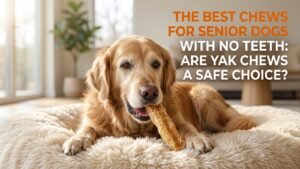
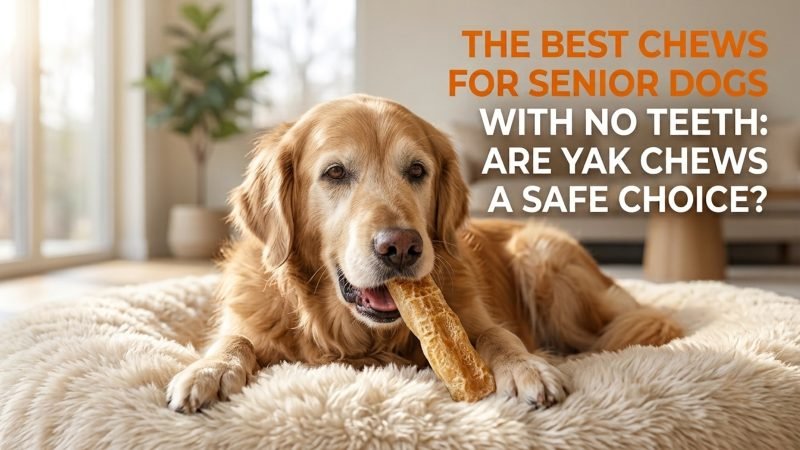
The best chews for senior dogs with no teeth are soft, compressible, and easy to dissolve, such as puffed yak chews, yak cheese nuggets, softened collagen chews, lick mats, frozen bone broth treats, and other gum-friendly alternatives. Many hard chews, including classic yak bars, antlers, rawhide, cooked bones, and very hard nylon chews, commonly present high risks of gum injury, choking, and tooth fracture for senior dogs with missing or weakened teeth; evaluate risk by chew hardness, the dog’s remaining teeth and jaw strength, and always supervise sessions.
Senior dogs with missing teeth still benefit from safe chewing for mental enrichment, comfort, and natural chewing behavior, but the right texture matters more than the brand. This guide explains the safest chews for senior dogs with no teeth, compares puffed and traditional yak chews, explores veterinarian-recommended alternatives, and shows how to choose the best option based on your dog’s gum health, remaining teeth, chewing style, and overall oral condition.
Why Do Toothless Senior Dogs Still Need Safe Chews?
Periodontal disease is strikingly common in dogs; primary-care visual exams find it in roughly 9% to 18% of dogs, but detailed exams performed under anesthesia put the true rate at 44% to 100%, according to a 2020 systematic review in the Journal of Small Animal Practice, and the disease grows more severe with each additional year left untreated.
Many senior dogs lose some or all of their teeth as a direct result, through extraction or natural attrition, well before what owners picture as “old age.” Small and toy breeds often reach that point earlier too, since crowded teeth and thinner jawbones give periodontal disease a faster path to the roots.
A toothless mouth doesn’t remove the need for oral engagement. Gums still carry nerve endings, saliva production continues, and the instinct to gnaw, lick, and mouth objects stays intact long after the teeth are gone. Safe chewing options give these dogs a legitimate outlet for that instinct without risking the tender tissue that now does the work teeth used to do.
How Can Gentle Chewing Support Daily Comfort?
Gentle chewing increases saliva flow and blood circulation to the gum tissue, which supports healing in dogs recovering from extractions and eases ongoing inflammation in dogs with chronic gum disease. Saliva itself carries mild antibacterial enzymes that help keep exposed gum tissue cleaner between meals.
Dogs process food and objects through shearing and gnawing rather than the side-to-side grinding motion humans use, so losing molars changes less about comfort-chewing than most owners expect. A predictable chew routine, offered at the same time each day, also gives an aging dog a sense of structure. Many owners notice this alone calms restlessness in the evening hours, when arthritis pain and mild cognitive decline tend to make senior dogs more unsettled.
Which Chew Features Matter Most Without Teeth?
Four features matter most once a dog has lost some or all of its teeth: softness, dissolvability, size, and shape. A chew needs enough give for the gums, not the enamel, to compress it. Press a thumbnail firmly into the surface: a visible indent means the texture works for a toothless mouth, while a chew that resists the press entirely is too dense.
Dissolvability determines what happens when a piece gets gummed off rather than bitten off cleanly. A chew that softens and breaks down in saliva carries a lower choking risk than one that stays rigid all the way through. Size stays small enough for a single mouthful, and shape avoids sharp edges or splinter-prone fiber, the two features responsible for most chew-related emergency visits. Serving temperature matters too: a chew straight from the refrigerator firms back up, undoing any softening it may have had beforehand, so always bring it to room temperature first.
Which Chews Are Safest for Dogs Without Teeth?
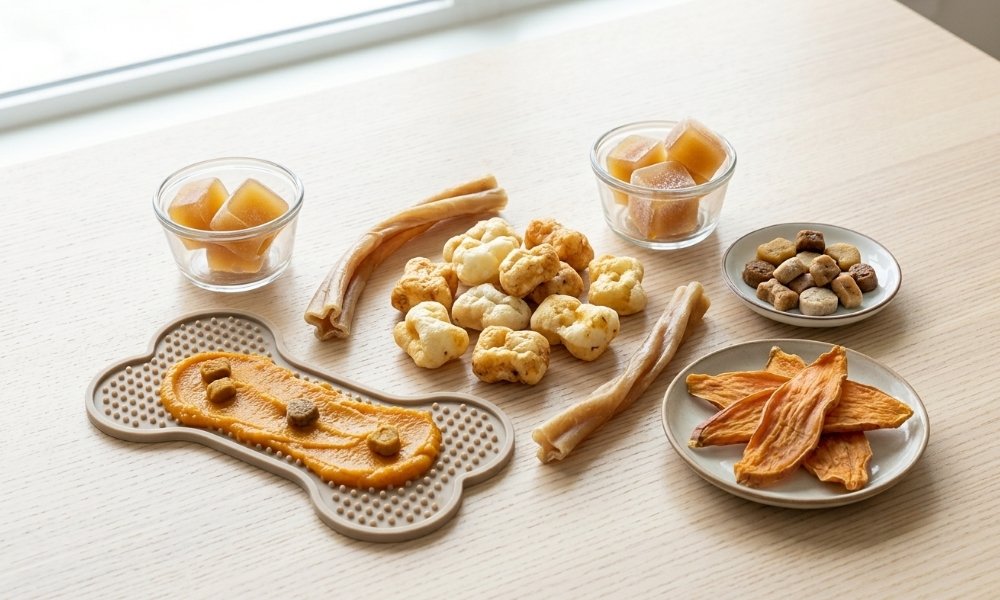
The safest chews for a toothless dog dissolve, compress, or lick away rather than requiring a bite-through motion. Three categories qualify. Soft dissolvable chews, such as puffed cheese treats or collagen sticks softened in water, break down under gum pressure alone. Lick-format items, such as frozen bone broth or a spreadable paste on a textured mat, need no biting mechanism whatsoever. Gummable proteins, soft enough to separate under tongue pressure alone, round out the list.
Rawhide, real bone, antler, and nylon chews fall outside every one of these categories, regardless of the size grading printed on the package, and belong on the avoid list for any dog missing a meaningful number of teeth.
What Soft Natural Options Are Worth Considering?
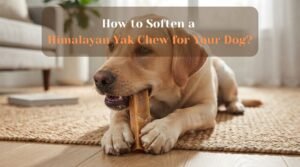
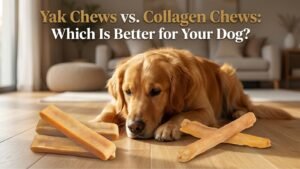
Puffed yak cheese nuggets, made by briefly microwaving a soaked end-piece, turn a dense chew into a light, airy texture that a toothless dog can gum apart without pressure. This comparison of puffed and regular yak chews breaks down exactly how the texture changes. Collagen sticks, unlike rawhide, soften within minutes of soaking and digest fully rather than requiring the body to break down intact fiber, and this yak chews vs. collagen chews breakdown covers how the two compare for sensitive mouths.
Sweet potato chews dehydrated to a pliable rather than brittle finish work well for dogs that prefer a lick-and-gum motion over active biting, and unsalted, plain rice cakes broken into small pieces offer a similar low-effort crunch. Frozen bone broth cubes and plain pumpkin puree spread thin on a textured mat round out the natural options, delivering flavor and engagement with zero bite-force requirement.
Which Hard Chews Should Senior Dogs Avoid?
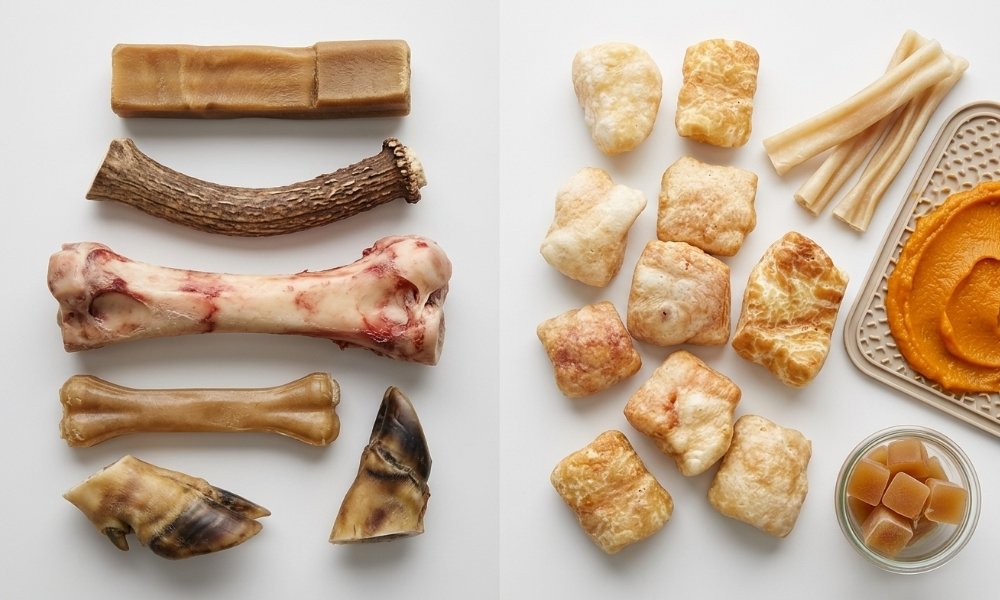
Six hard chews carry the highest fracture risk for a senior dog with compromised teeth or gums: deer and elk antlers, cooked or raw bones, nylon and hard plastic bones, ice cubes used as chews, cow hooves, and classic hard yak chew bars.
A University of Pennsylvania cadaveric study measuring the exact forces that fracture dog teeth found that dogs can generate voluntary bite forces of up to 1,394 Newtons, while the average dog premolar fractures under roughly 1,281 N, meaning many ordinary, healthy bites fall squarely in the danger zone for a hard chew. That warning applies with even greater force to a mouth that has already lost teeth or bone density around the roots, since the remaining structures have less reserve to absorb bite pressure than a younger, fully toothed jaw does.
Are Yak Chews a Safe Choice for Senior Dogs?
Puffed yak chews and yak cheese nuggets can be a safe choice for many senior dogs; classic hard yak chew bars are not, once a dog has lost significant teeth or bone density. The distinction comes down to processing, not branding. A classic bar retains the dense, smoke-dried structure that makes yak chews last for hours in a healthy adult mouth, exactly the quality that makes it inappropriate for a dog whose remaining teeth can no longer withstand that resistance.
Puffing or soaking breaks that dense structure down. The chew still carries the same four-ingredient composition, yak milk, cow milk, lime juice, and salt, but the finished texture compresses under gum pressure instead of demanding a bite. This is worth understanding fully, since why yak chews are considered so hard in their classic form explains exactly what puffing is neutralizing. Every senior dog’s starting point differs: a 9-year-old Labrador with three remaining molars and firm gums tolerates more than a 14-year-old Chihuahua recovering from a full-mouth extraction. Reviewing yak chews across life stages with your veterinarian before introducing any format is the safest first step for a dog that has never tried one.
Can Yak Chews Work for Every Toothless Senior?
No. A fully edentulous dog may be unable to compress firmer puffed chews and can be at greater risk of gum trauma from objects that remain firm; choose only proven compressible or lick-format options and test small supervised trials to confirm tolerance.
Two groups should skip yak chews entirely, regardless of format. Dogs with jaw or temporomandibular joint arthritis often experience pain with chewing; assess tolerance carefully, many such dogs prefer lick-format or very soft treats rather than sustained gnawing. Dogs recovering from extractions within the past two weeks still have gum sites healing closed. Understanding why yak chews rank among the hardest chews available makes clear why the classic bar format never belongs in this conversation, no matter how the packaging describes it. A dog with several remaining teeth, firm gums, and no history of oral pain remains the better fit for a puffed or softened option; a dog without those three qualifiers does better with a lick-based alternative instead.
What Risks Should Owners Understand First?
Three risks apply specifically to toothless and near-toothless dogs that don’t apply the same way to dogs with a full adult mouth.
First, gum trauma: repeated pressure against bare or thin gum tissue can bruise or split the surface, especially along the lower jaw, where bone begins to resorb after tooth loss. Second, a false sense of dental benefit: the plaque-scraping action that makes hard chews useful for younger dogs depends entirely on tooth-to-chew contact, so a toothless dog gets zero abrasive cleaning benefit no matter how long the session lasts. Third, whole-piece swallowing: a dog without molars to break a piece down further may gum off a chunk and swallow it largely intact, raising choking and obstruction risk well above what a fully toothed dog faces with the same product. A fourth, quieter risk deserves attention too: senior dogs move less and burn fewer calories, so a calorie-dense chew offered daily on top of regular meals adds up to unplanned weight gain over a few months.
How Can You Choose the Right Yak Chew?
Choosing the right yak chew for a senior dog starts with format, not size. Puffed nuggets and puffed bars pass the thumbnail softness test immediately after preparation; classic hard bars fail it by design, and no amount of soaking fully closes that gap.
Confirm the ingredient list stops at four items: yak milk, cow milk, lime juice, and salt, since any added flavoring or coating introduces a variable your dog’s digestive system doesn’t need while adjusting to a new texture. Buy from a trusted Himalayan yak chew producer that states its drying and puffing process clearly rather than a generic label, since inconsistent density between batches makes the softness test unreliable from one bag to the next.
Which Yak Chew Size Is Safest to Select?
Nugget-sized pieces of 15 to 30 grams work best for toothless and senior dogs under 15 kg (33 lbs), while larger seniors up to 30 kg (66 lbs) do well with a puffed bar broken into 2 to 3 smaller sections before serving.
Size scales to jaw width, not body weight alone: a heavy-bodied but narrow-jawed senior breed still needs the smaller nugget format regardless of what its weight chart suggests. Whole puffed bars expand during preparation and can present a mouthful too large for a dog with reduced jaw mobility to manage in one piece, even after puffing. Breaking any format into bite-sized sections before the first offering removes this variable entirely and costs nothing but a minute of prep time.
How Should You Introduce Yak Chews Slowly?
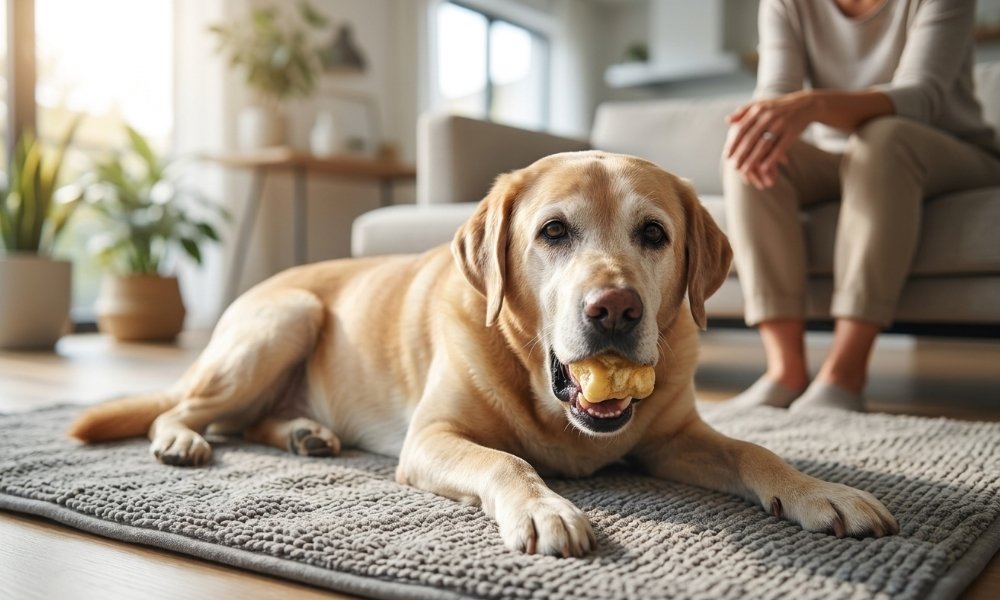
Start with a single puffed nugget and a 5-minute supervised session before offering anything larger. Watch how your dog handles the piece: gumming and repositioning it gently signals a good match, while dropping it repeatedly or pawing at the mouth signals the format is still too demanding.
Monitor for gastrointestinal signs for 24–72 hours after first introduction; seek veterinary advice if vomiting, diarrhea, or decreased appetite occurs. Increase session length gradually over 2 to 3 weeks, and never introduce a larger size and a longer session in the same week. Owners preparing their own puffed pieces at home can follow thisstep-by-step guide to puffing yak chews in the microwave to control texture consistently from one batch to the next.
What Benefits Can Yak Chews Still Provide?
Yak chews still deliver measurable nutritional and behavioral value once reformatted for a toothless mouth. The protein content stays intact through puffing, since heat expands the matrix rather than breaking down the casein inside it, giving seniors a lean protein source that supports muscle mass during a life stage when muscle wasting is common.
Yak chews are not completely hypoallergenic, but they remain among the better limited-ingredient options for dogs with common food sensitivities, since the four-ingredient formula avoids beef, chicken, wheat, soy, egg, and the artificial additives found in most commercial treats. Dogs with a genuine dairy intolerance still can’t tolerate them; puffing changes texture, not the underlying milk protein. The low odor profile also matters more for senior dogs that spend more time resting indoors, close to family members, than they did as younger, more active dogs.
How Can Chewing Support Mental Enrichment?
According to the original Waltham Petcare Science Institute trial published in Animals, 20 dogs left alone with a long-lasting chew spent significantly more total time engaged with it than with a treat-dispensing toy or a smart feeding device (p < 0.01), while also showing lower arousal and calmer, more positive emotional responses throughout the session.
The same underlying mechanism explains why licking works even without a bite-capable mouth. Repetitive licking activates the parasympathetic nervous system, the physiological state associated with resting and digesting, which lowers heart rate and eases stress hormone output. A toothless senior gets this benefit from gumming a puffed treat or working a lick mat just as reliably as a younger dog gets it from an hour with a classic bar. The enrichment value lives in the repetitive motion itself, not in how much mechanical resistance the object provides.
Can Yak Chews Help Reduce Boredom Safely?
Puffed yak treats reduce boredom safely when offered as one part of a senior dog’s routine, not as an all-day, unsupervised activity. A 10 to 15-minute session, 2 to 3 times a week, gives most seniors meaningful engagement without overloading a digestive system that already processes food more slowly with age. For a fuller answer, see this guide on how often you should give your dog a chew.
Boredom in older dogs often stems from reduced mobility rather than a genuine lack of stimulation options, so pairing a puffed chew session with a short sniff-focused walk or a slow-scatter feeding addresses more of the underlying cause than the chew alone ever could. A chew works best as one tool among several, not the whole toolkit.
What Alternatives Exist to Traditional Yak Chews?
Three categories of alternatives exist for seniors who can’t manage yak chews in any format. VOHC-sealed water additives, oral gels, and dental wipes work directly on the gum line and any remaining tooth surfaces without requiring bite force, making them the only category here that still delivers a measurable plaque-control benefit to a senior dog that only has a few teeth left.
Frozen bone broth and lick mats provide the behavioral and calming benefit of chewing through licking alone, with no mechanical demand on the mouth whatsoever. For dogs with at least a few functional teeth remaining, this yak chews vs. bully sticks comparison helps identify a middle-ground chew that asks less of the mouth than a classic bar while still offering a genuine gnaw-and-work experience.
Which Soft Treats Offer Similar Engagement?
Soft training treats with a pliable, fudge-like texture offer the same repetitive engagement as a chew without any bite-force requirement. Look for treats that compress under light finger pressure, the same standard used for the thumbnail test on chews, since this texture translates directly to what a toothless dog’s gums can manage.
Snuffle mats loaded with soft treats add a scent-search component that occupies a senior dog’s attention longer than the eating itself takes, stretching a two-minute treat into a ten-minute activity. Puzzle feeders designed for nose or paw manipulation, rather than mouth manipulation, extend engagement further for dogs whose gums tire quickly, and they double as a slower, calmer way to serve an entire meal.
When Are Veterinary Dental Diets Better?
Veterinary dental diets work best for seniors who still have a functional set of chewing teeth, since the kibble’s fiber-matrix structure depends on tooth-to-kibble contact to scrape plaque away at the gumline. Hill’s Prescription Diet t/d, one of the few diets carrying the Veterinary Oral Health Council seal for both plaque and tartar control, demonstrates this mechanism clearly: the oversized kibble resists shattering, so a tooth stays in contact with it longer during each bite.
VOHC’s current accepted-products roster for dogs, updated in November 2025, confirms Hill’s Prescription Diet Canine t/d still holds its Plaque and Tartar Seal, awarded only after independent trials showed at least a 15% reduction in plaque or tartar score in each trial and a 20% average across both, a bar most over-the-counter dental treats never clear. A fully edentulous dog gets none of this mechanical benefit, since there’s no tooth surface left to scrape. Dental diets remain the better choice over any chew, yak, or otherwise, specifically for seniors retaining several teeth in one section of the mouth but not others.
How Can You Help Prevent Chewing Injuries?
Supervision during every session prevents the majority of chewing injuries in senior dogs. Limit sessions to 10 to 15 minutes, remove any piece once it shrinks to a size that fits fully inside the mouth, and inspect the remaining piece for hard, unsoftened cores before the next offering.
Store yak chews somewhere the dog can’t access independently. This yak chew storage guide covers how to keep chews fresh and out of reach between sessions, since an unsupervised toothless dog that manages to gum off a large piece has no mechanical way to break it down further before swallowing.
Which Warning Signs Mean You Should Stop?
Five signs call for stopping a chewing session immediately: pawing at the mouth, visible bleeding from the gums, repeatedly dropping the chew after picking it up, reluctance to let you touch the head or muzzle, and a sudden change in appetite at the next meal.
Any one of these signs on its own warrants stopping that session. Blood combined with reluctance to eat warrants a same-day veterinary call rather than a wait-and-see approach. Dogs conceal oral pain effectively as a survival instinct inherited from wild canines, so the absence of obvious crying or yelping never rules out an injury that needs attention.
When Should You Ask Your Veterinarian?
Ask your veterinarian before introducing any chew format to a dog that has recently lost teeth, has a diagnosed dental condition, or has never had a yak chew at any life stage. Senior dogs benefit from a dental exam twice yearly rather than the once-yearly schedule appropriate for younger adults, since periodontal disease and bone loss both progress faster once a dog passes 7 to 8 years of age.
Bring a specific question to that visit rather than a general one. Ask whether your dog’s remaining teeth and gum condition support a puffed chew, a dental diet, or a non-chew alternative, since the answer changes based on findings a home inspection can’t replicate, including bone density visible only on a dental X-ray.
How Should You Match Chews to Your Dog?
Matching a chew to a senior dog comes down to four factors: remaining tooth count, gum condition, chewing style, and supervision availability.
A dog with several teeth and firm gums that gnaws steadily is the best candidate for a puffed yak nugget. A dog with few or no teeth and a tendency to gulp rather than gnaw is the best candidate for a lick-based alternative instead. Owners who can’t supervise every session default to the lowest-risk option in the household, regardless of what a healthier dog in the same home can safely manage. No single chew format fits every dog at this life stage, which is exactly why format selection matters more than brand loyalty when shopping for a senior dog.
Can YforYak Dog Chews Fit Senior Needs?
YforYak’s puffed nuggets and yak cheese powder fit senior needs more reliably than the classic hard bar format, which the company doesn’t recommend for dogs with significant tooth loss. The puffed nugget starts as the same four-ingredient chew, yak milk, cow milk, lime juice, and salt, then goes through a heat process that collapses the dense structure into a texture gums can manage without teeth.
Yak cheese powder offers a third option. Stirred into a senior dog’s regular food, it delivers the same protein and flavor profile with zero chewing requirement, useful for dogs whose gums can’t yet tolerate any solid piece. Dhurba Raj Regmi, YforYak’s founder, built the company’s production standards in Tokha, Kathmandu, around ISO 9001 certification, FDA facility registration, and HACCP compliance, the same batch consistency that makes the softness test reliable from one puffed nugget to the next. Owners weighing puffed nuggets and yak cheese powder against a full bar for a senior dog can use this guide to choose the best dog chew by size, age, and chewing style for a clearer side-by-side breakdown of how each format actually performs.
What Should You Remember About Safe Chewing?
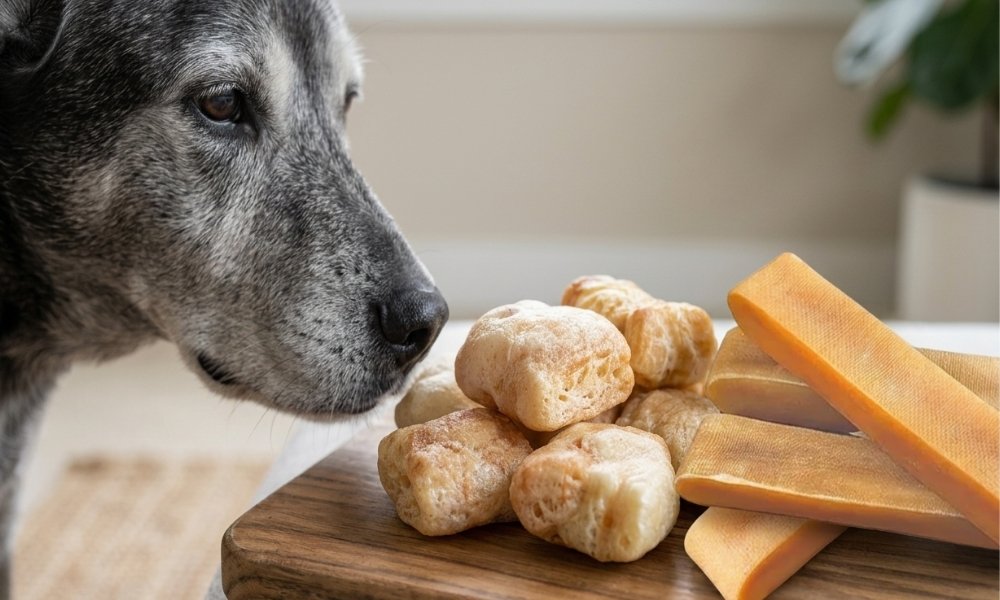
Format matters more than brand for any senior dog with significant tooth loss. Puffed yak chews and yak cheese nuggets can work well; classic hard bars cannot, and a fully toothless dog with tender gums often does better with a lick-based alternative than with any chew at all.
Test softness before every session, supervise the full session, and stop at the first sign of gum irritation or reluctance. A veterinarian who has examined your dog’s mouth gives a more reliable answer than any general guideline, including this one, since tooth count and gum condition vary from one senior dog to the next. Safe chewing at this life stage is less about finding the single best product on the market and more about matching the right format to the mouth your dog actually has left.