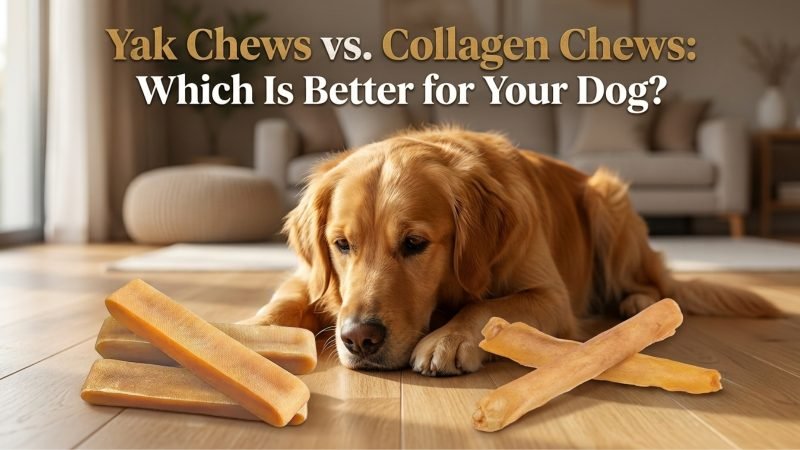
Choosing between yak chews and collagen chews isn’t about finding the “best” dog chew; it’s about finding the safest and most suitable option for your dog’s age, chewing style, dental health, and digestive needs. While both are natural alternatives to rawhide, they differ significantly in hardness, durability, digestibility, nutritional profile, and overall chewing experience. A chew that works perfectly for an aggressive adult chewer may not be the right choice for a puppy, senior dog, or pet with sensitive teeth or a delicate stomach.
This guide compares yak chews vs. collagen chews across every factor that matters, including ingredients, manufacturing process, chewing longevity, dental benefits, joint support, safety risks, cost, and ideal dog profiles. You’ll also learn when each chew is the better choice, how to reduce choking and tooth-fracture risks, and what to look for before buying, so you can confidently choose the chew that matches your dog’s individual needs rather than relying on marketing claims.
What Are Yak Chews?
Yak chews are hardened dairy chews made by curdling yak and cow milk with lime juice, pressing the curds into dense blocks, and drying them for weeks until rock-hard. Also sold as Himalayan chews or churpi (sometimes spelled chhurpi), they originated centuries ago in Nepal, Tibet, and Bhutan as a shelf-stable human snack before being adapted into a long-lasting dog chew. Yak chews are widely popular, long-lasting natural chews in the US, often marketed alongside bully sticks and collagen sticks.
How Are Yak Chews Made?

Manufacturers make yak chews through a four-step traditional process:
- Combine yak milk with cow milk; pure yak milk alone is too scarce to produce chews at scale, and heat it with lime juice, which curdles the milk into curds and whey.
- Press the curds into dense blocks or sticks to squeeze out moisture.
- Salt lightly, then dry the blocks for several weeks in cold, low-humidity mountain air; some producers add a light smoking step.
- Cut the fully hardened blocks into sizes for small, medium, and large dogs.
This slow drying is what makes yak chews shelf-stable without refrigeration or added preservatives. Most brands list a best-by date of 12 to 18 months, and an unopened, properly stored bar lasts two to four years.
What Ingredients Are in Yak Chews?
Many traditional-style yak chews are made from a short list of ingredients, commonly yak milk, cow milk, lime or citrus juice, and sometimes salt, though some commercial versions may include skim milk, enzymes, or minor variations. Some recipes skip the salt entirely. That short ingredient list results in a nutrient profile that more closely resembles a dairy product than a processed treat. Yak chews typically contain 50–65% crude protein, thanks to raw yak milk, which a peer-reviewed dairy science analysis of yak milk protein composition found contains 46.2–58.4 g of protein per liter, with casein accounting for most of that protein. They also contain 1–4% fat, provide meaningful amounts of calcium, and deliver approximately 200–315 calories per chew, depending on size. Because yak chews are made using a traditional drying process, they are naturally grain-free, gluten-free, and free from artificial preservatives, colors, and flavorings.
Why Are Yak Chews Considered Natural?
Yak chews earn a “natural” label by skipping industrial processing: no chemical tanning, no artificial hardening agents, and no preservatives beyond salt and drying. That sets them apart from rawhide, which manufacturers commonly treat with bleaching or hardening chemicals before it reaches a shelf. “Natural” describes the production method here, not a safety guarantee. A natural chew still demands the right size and active supervision, since hardness and swallowed chunks are the real risk factors, not the ingredient list. For a full breakdown of everything that goes into a traditional recipe, see what Himalayan yak chews are actually made of.
Which Dogs Benefit Most From Yak Chews?
Yak chews work best for adult dogs with healthy teeth and a moderate-to-strong chewing drive who need a long-lasting, low-odor project. Their density rewards dogs that gnaw steadily rather than dogs that try to crack a chew in one bite. Many owners appreciate their near-zero smell compared with bully sticks or trachea chews, and owners managing grain or gluten sensitivities often value the short ingredient list. Yak chews are a poor match for senior dogs with worn or loose teeth, dogs recovering from dental work, and dogs with a diagnosed milk-protein allergy; the underlying dairy protein remains even after most of the lactose is removed during production.
What Are Collagen Chews?
Many collagen chews are formulated to be single-ingredient treats made from beef corium—the soft inner connective-tissue layer of beef hide—dried into a firm but flexible stick, but many products marketed as collagen chews also contain additional ingredients. They get confused with rawhide constantly, but the two come from different layers of the same hide and behave very differently once a dog starts chewing. Rawhide comes from the tough outer layer used in the leather industry; collagen chews come from the layer beneath it, which is naturally elastic and far easier for a dog’s stomach to break down.
How Are Collagen Chews Produced?
Producers clean the corium, then slowly bake or dehydrate the sheet at a controlled low temperature until it firms into a chewable stick, braid, or ring. This is a mechanical and thermal process, not a chemical one, a meaningful difference from conventional rawhide, which is often treated with bleach or hydrogen peroxide to whiten and stiffen it. Because the corium starts soft and pliable, the finished chew keeps some flexibility even after drying, which is the main reason it behaves so differently in a dog’s mouth and stomach than a hardened yak chew or a bone.
What Ingredients Are in Collagen Chews?
A pure collagen stick contains one ingredient: beef corium, or occasionally chicken or fish skin. That simplicity is the entire selling point, so check the label carefully; some products marketed as “collagen chews” are actually flavored treats bulked out with cane molasses, corn starch, potato flour, glycerin, or preservatives like potassium sorbate. Those additive-heavy versions still contain collagen, but they no longer function as a limited-ingredient chew. Look for a label listing “beef corium” or “collagen” as the sole ingredient rather than trusting the product name alone.
Why Are Collagen Chews Popular?
Collagen chews rode the same wellness wave that made collagen supplements popular for people, paired with a genuine safety advantage over rawhide. Owners moving away from rawhide want a chew that breaks down in the stomach instead of swelling into an undigested mass, and collagen delivers that while staying gentler on teeth than bones, antlers, or yak cheese. The marketing emphasis on joint, skin, and coat support also gives collagen a “functional treat” identity that a plain chew toy doesn’t carry.
Which Dogs Benefit Most From Collagen Chews?
Collagen chews suit puppies with a full set of adult teeth, senior dogs, and light-to-moderate chewers who want a gentler texture than yak cheese or bully sticks. Dogs recovering from dental procedures or living with early periodontal disease tolerate the pliability better than a hard chew. Active and aging dogs also benefit from the structural protein itself, since natural collagen production declines with age. Collagen is a poor fit for dogs with a confirmed beef allergy, unless you choose a fish-based version, and for determined power chewers who finish a stick in one sitting and immediately want another.
How Do Yak Chews and Collagen Chews Compare?
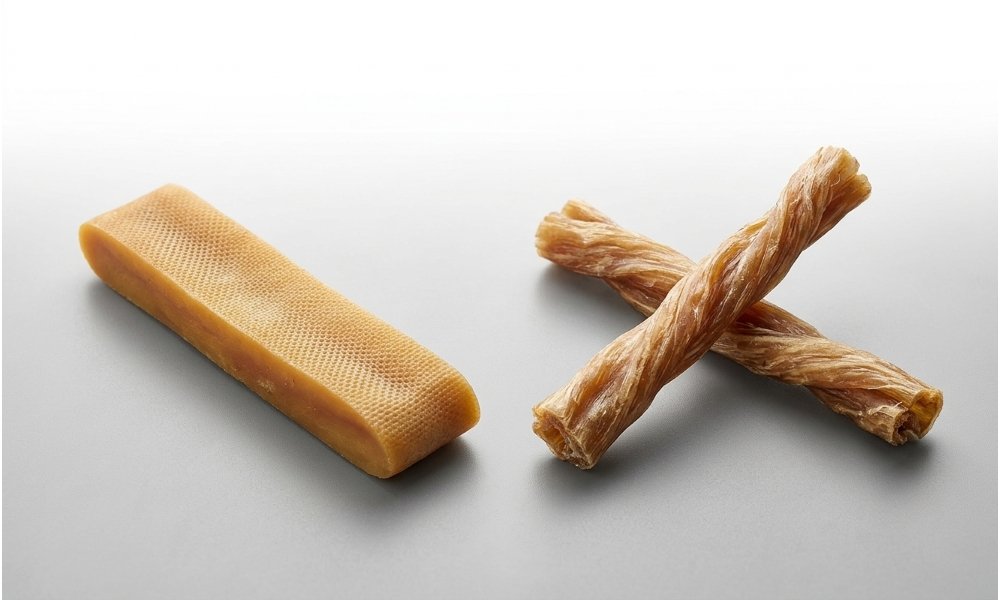
Yak chews win on durability and odor control; collagen chews win on digestibility and gentleness. The table below lines up both chews across the factors that matter most before you buy.
| Factor | Yak Chews | Collagen Chews |
| Main ingredient | Yak and cow milk | Beef corium (hide) |
| Texture | Extremely hard | Firm but pliable |
| Crude protein | Roughly 50–65% | Typically 85–95% |
| Odor | Virtually none | Noticeable, meaty |
| Digestion | Slower, dense | Faster, more pliable |
| Best matched to | Adult power chewers | Puppies, seniors, gentle chewers |
| Tooth-fracture risk | Higher | Lower |
| End-of-chew move | Microwave into a puff | Discard once small |
Neither column is safer across the board; each chew simply trades hardness for digestibility in the opposite direction.
Which Chew Lasts Longer?
A single yak chew typically outlasts a single collagen stick by days, not minutes. Both chews hold a dog’s attention for a comparable 30 to 50 minutes in one active sitting, but that number hides an important difference: a yak chew’s extreme hardness means most dogs wear it down gradually, so the same piece often comes back out for repeat sessions across several days or even weeks. A collagen stick more often gets fully consumed within one to three sittings because it’s soft enough to break down completely. A chew that keeps reappearing points to yak; a chew that’s done and gone quickly points to collagen. For a detailed breakdown of how long yak chews last across different dog sizes and chewing styles, this guide to yak chew longevity by dog size and chewing style covers realistic timelines session by session.
Which Option Is More Digestible?
Collagen chews are more digestible than yak chews, though both digest more easily than rawhide. A 2024 Frontiers in Animal Science review of dog-treat categories found rawhide-family chews show dry-matter digestibility ranging from just 35% to as high as 96%, the widest variability of any treat type studied. Corium is a natural connective tissue that digestive enzymes break down efficiently into absorbable peptides. Yak cheese is also a digestible dairy protein rather than an indigestible material, but digestibility isn’t the same question as safety: the real risk with yak chews comes from a dog biting off a large, still-hard chunk and swallowing it before it has time to soften, which can cause an obstruction regardless of how digestible the ingredient technically is. Collagen’s pliability lowers that specific risk, since it’s harder to break off a rock-hard, swallow-sized shard in the first place.
Which Chew Is Better for Aggressive Chewers?
Yak chews hold up longer against aggressive chewers, but only when the dog’s teeth can handle the hardness. Veterinarians commonly recommend a simple fingernail test: press a thumbnail into the chew’s surface, and if it leaves no dent, the chew is hard enough to risk cracking a tooth in a determined chewer. Many yak chews fail that test by design; that’s exactly why they last so long. Collagen chews pass the fingernail test more consistently and make the safer pick for a strong chewer with any history of dental sensitivity, even though they won’t survive as many sessions.
How Do They Differ in Texture?
Yak chews start bone-hard and wear down into a softened, gummy nub near the end; collagen chews stay semi-firm and pliable from the first bite. A dry yak chew feels closer to aged parmesan than a typical treat, while a collagen stick has some give the moment your dog picks it up and grows noticeably tackier once saliva softens the outer layer. That difference affects handling, too: a softened collagen stick sticks to carpet and fabric, while a yak chew stays relatively clean until it’s nearly gone.
How Do They Compare in Flavor?
Yak chews carry a mild, cheesy, faintly smoky smell that’s barely noticeable to people; collagen chews have a stronger, meaty beef scent that dogs find highly rewarding. That contrast flips depending on who’s judging: dogs often show more immediate enthusiasm for a collagen stick’s smell, while owners sensitive to “dog treat odor” in the house tend to prefer yak cheese. Picky eaters who ignore a plain yak chew will frequently engage right away with a collagen stick for that reason.
Which Chew Offers Better Health Benefits?
Both chews support dental health through mechanical chewing action, and collagen adds joint and skin support that yak cheese doesn’t offer in the same way. The sections below break down dental value, nutrition, stomach sensitivity, and ingredient purity individually, since “healthier” depends on which specific benefit matters most for your dog.
Which Supports Dental Health Better?
Yak chews may help remove plaque more aggressively because of their hardness, while collagen chews provide gentler, more frequent dental contact with a lower risk of tooth fractures. This distinction is especially important because a peer-reviewed study on dental chew efficacy found that approximately 80% of dogs over the age of two show signs of oral pain or inflammation associated with periodontal disease. Neither one carries the VOHC’s current list of Seal-accepted dental products, the panel of veterinary dentists that awards its Seal only to products with clinically demonstrated plaque or tartar reduction in controlled trials. That does not mean they are dentally useless; the physical scraping motion of prolonged mechanical chewing genuinely provides a plaque-reducing benefit, even though neither product has been clinically validated through controlled studies like VOHC-listed dental chews. Dogs with any existing dental disease fare better on the collagen side of this comparison.
Which Provides More Nutritional Value?
Yak cheese functions more like a food than collagen does, delivering a complete dairy protein with a full amino acid profile. At the same time, Collagen is a concentrated structural protein that is not a complete protein source on its own (it is low in tryptophan). However, it still provides valuable functional amino acids such as glycine, proline, and hydroxyproline. Yak chews run roughly 50 to 65 percent crude protein with meaningful calcium and very little fat. Collagen is rich in glycine, proline, and hydroxyproline, but a USDA Agricultural Marketing Service technical review of gelatin confirms it contains no tryptophan at all and is also deficient in isoleucine, threonine, and methionine, which is why it isn’t a balanced standalone protein source the way casein-based yak cheese is. One nuance most owners miss: the collagen in a hide-based chew is Type I, the kind found in skin and connective tissue. The joint-specific research behind “collagen for joints” mostly points to Type II collagen, sourced from cartilage. A chew stick still delivers real benefits, but when joint support is the priority, check whether the product specifically lists undenatured Type II collagen (UC-II). An MDPI Animals review of joint disease and UC-II in dogs estimates that at least 15 million U.S. dogs already live with osteoarthritis, the condition UC-II research actually targets.
Which Is Better for Sensitive Stomachs?
Collagen chews are generally easier on sensitive stomachs because they’re more pliable and digest faster than dense yak cheese. Yak chews are naturally low in lactose, which helps dogs with lactose sensitivity specifically, but their density can slow gastric emptying in a dog with a generally sensitive stomach. A diagnosed milk-protein allergy rules out yak chews entirely, regardless of lactose content, since low-lactose isn’t the same as dairy-free, and sourcing from a quality-controlled Himalayan yak chew producer that tests milk at intake is one way to ensure ingredient consistency across batches.
Which Option Contains Fewer Additives?
Yak chews stay more consistently additive-free across brands, since the traditional three-to-four-ingredient recipe is close to a category standard. Collagen chews vary more by product: a single-ingredient collagen stick is just as clean, but plenty of “collagen chew” treats on the same shelf add molasses, starches, or preservatives for flavor or texture. Read the ingredient panel rather than the front-of-package name for either chew, and treat a long ingredient list as a signal to keep looking. This guide to what makes Himalayan yak chews unique in the market explains which production standards actually separate quality chews from generic lookalikes.
What Safety Factors Should You Consider?
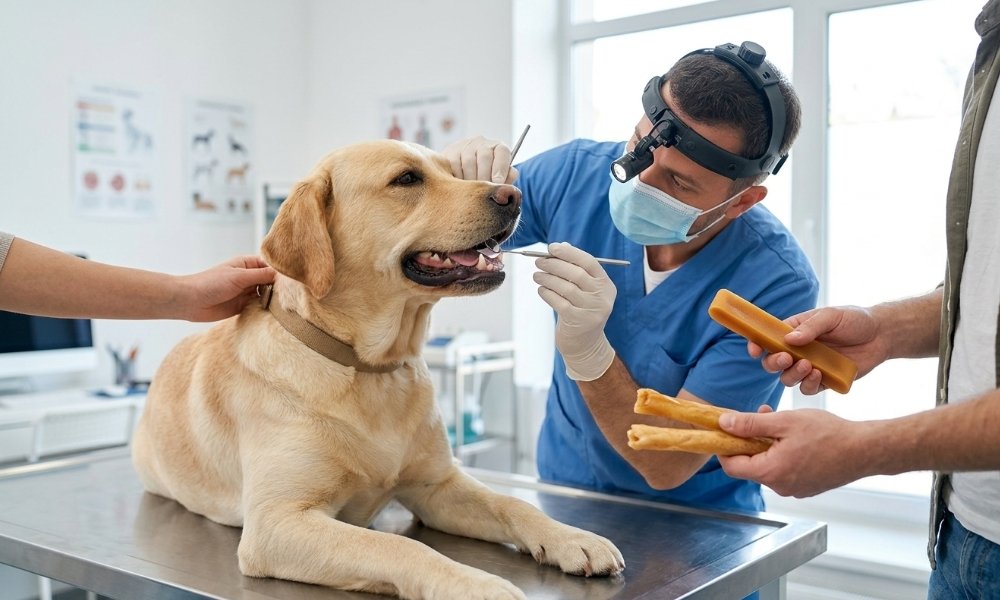
Every chew safety conversation comes down to four factors: hardness matched to the dog’s teeth, size matched to the dog’s mouth, active supervision, and knowing when to take the chew away. Yak chews and collagen chews carry different weights on that hardness factor, but the supervision and sizing rules stay identical for both.
Are Yak Chews Safe for Puppies?
Yak chews aren’t appropriate for puppies with baby teeth. Most safety guidance recommends waiting until a puppy has a full set of adult teeth, typically around six months, before introducing any hard chew. Veterinary client-education guidance on puppy teething confirms that by 6 months of age, normally all permanent teeth have erupted and all deciduous teeth are gone. Reserve full hard bars for closer to 12 months, once the adult jaw and bite strength are established. This complete guide on whether Himalayan yak chews are safe for puppies covers age thresholds and format choices in more detail. A puppy’s developing teeth and jaw aren’t ready for a chew that fails the fingernail test, and a quick vet check is worth it whenever you’re unsure if a specific puppy is ready.
Are Collagen Chews Safe for Puppies?
Collagen chews are often considered safer than hard chews for puppies and may be appropriate from around six months once adult teeth are in, but they should still be introduced gradually, under supervision, and with veterinary guidance, especially for puppies with unknown chewing behavior or dental concerns. Puppies may be more sensitive to new foods and chews due to immature digestive systems and unknown individual tolerance, so introduce any new chew gradually and watch the first few sessions closely. Remove any piece small enough to swallow whole, exactly as you would for an adult dog.
What Size Chew Should You Choose?
Pick a chew large enough that your dog cannot fit the entire piece in its mouth or bite off large chunks. Size is a safety decision, not just a value decision. Match the size to your dog’s weight using the manufacturer’s chart as a starting point, then watch the first session to confirm the fit. Thickness matters as much as length for narrow-jawed and small-breed dogs: a chew that’s too thick causes jaw fatigue, while one that’s too thin invites gulping.
How Can You Reduce Choking Risks?
Reduce choking risk with four habits: supervise every session, apply the fingernail test before handing over a hard chew, remove any piece once it’s small enough to fit fully in your dog’s mouth, and keep fresh water nearby. Watch specifically for gulping behavior; a dog that swallows large pieces without working them down isn’t a good candidate for either chew type. Call your veterinarian immediately if your dog vomits, retches without producing anything, refuses food, or seems unusually lethargic after a chewing session. In a 2025 Kasetsart University veterinary hospital study of 261 dogs with gastrointestinal foreign bodies, dried chew treats were the second most common cause of esophageal obstruction, after bones. In the meantime, this guide on what to do if your dog swallowed a yak chew gives step-by-step guidance on how to assess the situation before your vet call.
Which Chew Delivers Better Value?
Yak chews cost more upfront but stretch across more chewing time; collagen chews cost less per piece but need to be chewed more frequently. Real value depends less on sticker price than on how fast your specific dog goes through each type.
Which Chew Lasts Longer Per Purchase?
One yak chew commonly replaces several collagen sticks in total chewing time, since a single piece carries a moderate chewer across multiple days instead of one sitting. A household buying collagen sticks for a fast chewer often restocks weekly, while the same dog might work through one yak chew over a similar stretch. That difference changes the smartest way to shop: buy yak chews individually or in small counts, and buy collagen sticks in bulk multi-packs to bring the per-stick cost down.
Which Option Is More Cost-Effective?
Cost-effectiveness comes down to cost per hour of chew time, not price per piece. A single large Himalayan yak chew commonly retails from $8 to $15, or roughly $2.00 to $2.50 per ounce when bought in bulk. Collagen sticks typically price well below that per piece, especially in 50-count or larger multi-packs, though a fast chewer who finishes one in a single sitting often needs several per week. Track how long each chew actually lasts with your dog over one or two purchase cycles, then divide the price by the chewing hours; that number tells you more than sticker price alone. If the price gap between the two chew types is itself a deciding factor, this explanation of why yak chews cost more than most alternatives walks through exactly where those extra dollars go.
How Should You Choose Between Yak and Collagen Chews?
Choose a yak chew for an adult dog with healthy teeth, a strong chewing drive, and a need for long, low-odor engagement; choose a collagen chew for a puppy, senior dog, gentle chewer, or any dog with dental sensitivity. Four questions settle most decisions:
- Age and teeth: Puppies under six months and dogs with dental disease belong on the collagen side by default.
- Chewing style: Dogs that gulp rather than gnaw need the softer, more pliable option regardless of age.
- Health goals: Collagen adds joint and skin support that yak cheese doesn’t offer, so it edges ahead when that’s the priority.
- Household priorities: Indoor odor tolerance points strongly toward yak cheese when it’s the deciding factor.
Many households rotate both: collagen for daily lower-stakes chewing, yak cheese for longer independent sessions when a dog is calm, healthy, and directly supervised. For households comparing even more alternatives beyond collagen, this yak chews vs. other dog chews comparison covers bully sticks, rawhide, antlers, and more in a single guide.
Can YforYak Dog Chews Help Your Dog?
If a yak chew fits your dog’s profile from the guide above, sourcing matters as much as the ingredient list. YforYak manufactures Himalayan yak chews in Kathmandu, Nepal, using the traditional yak milk, cow milk, lime juice, and salt recipe inside FDA-registered, HACCP- and GMP-certified facilities, and the company sources milk directly through yak-herding communities in the Himalayas.
That production standard addresses two of the biggest concerns raised throughout this guide: consistency and traceability. Beyond the classic hard chew bar, YforYak also produces puffed bars and puffed nuggets, a genuinely softer format built for the puppies, seniors, and gentle chewers this guide flags as poor candidates for a full hard bar. That range means a young or cautious dog can start on a puffed nugget and, with veterinary guidance, graduate to a full bar only once chewing habits prove steady and controlled under supervision.
Before choosing a size, check YforYak’s chew lineup to match a bar, nugget, or puffed option to your dog’s weight and chewing style, and review the sizing and safety FAQ for any remaining questions about your particular dog.

What Are the Key Takeaways About Yak Chews vs Collagen Chews?
Yak chews and collagen chews both make strong, natural alternatives to rawhide; the right pick depends on your dog’s teeth, chewing style, and stomach, not brand loyalty. Keep these points in mind:
- Yak chews last longer per piece and produce almost no odor, but their hardness raises the risk of tooth fracture in aggressive chewers.
- Collagen chews digest faster and suit puppies, seniors, and sensitive stomachs, including senior dogs with missing or worn teeth who can’t safely handle a hard yak bar but need to be replaced more frequently.
- Neither chew carries the VOHC dental seal, though both may provide mechanical plaque-scraping benefit through prolonged chewing.
- Puppies need a softer format of either chew until their adult teeth and jaw strength are established, generally around six months.
- Supervision, correct sizing, and the fingernail hardness test matter more to safety than which chew you pick.
Introduce any new chew gradually, watch the first few sessions closely, and check with your veterinarian if your dog has an existing dental or digestive condition. Match the chew to the dog in front of you, and both yak chews and collagen chews earn a permanent place in the treat drawer.