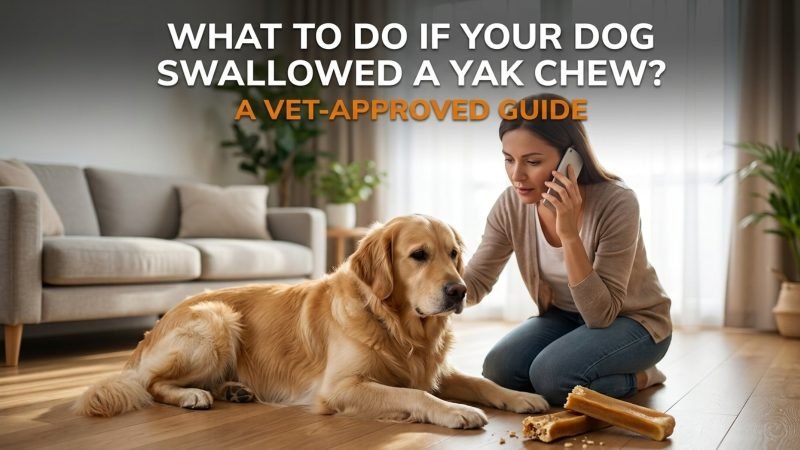
A dog that swallowed a yak chew does not always need emergency treatment. Still, the risk depends on the size of the swallowed piece, your dog’s size, and whether symptoms such as choking, repeated vomiting, abdominal pain, gagging, lethargy, or pale gums develop. Small fragments may pass naturally, often within a few days, but transit time varies by the dog and fragment size. Lack of passage within 48–72 hours or any worsening symptoms warrants veterinary re-evaluation. Contact your veterinarian as soon as possible for guidance, monitor your dog closely, and seek emergency treatment immediately if severe symptoms appear.
Yak chews, also called Himalayan dog chews or churpi, are durable cheese-based dog treats that can become a choking hazard or intestinal obstruction if swallowed whole. This vet-approved guide explains what to do immediately after your dog swallows a yak chew, how to recognize emergency warning signs, when home monitoring is appropriate, how veterinarians diagnose and treat blockages, recovery expectations, and the safest ways to prevent future swallowing incidents through proper chew sizing, supervision, and timely removal of small end pieces.
How Serious Is Swallowing a Yak Chew?
Swallowing a yak chew ranges from a harmless non-event to a surgical emergency, and the size of the piece relative to your dog’s size is what decides which. A pea-sized fragment in a 70-pound Labrador usually passes without issue. A two-inch chunk in a 12-pound terrier is a different situation entirely. Density matters too. Yak chews soften with saliva and stomach acid, but that process takes hours, not seconds, so a freshly swallowed piece stays hard and rigid on its way down.
Which Signs Need Immediate Veterinary Care?
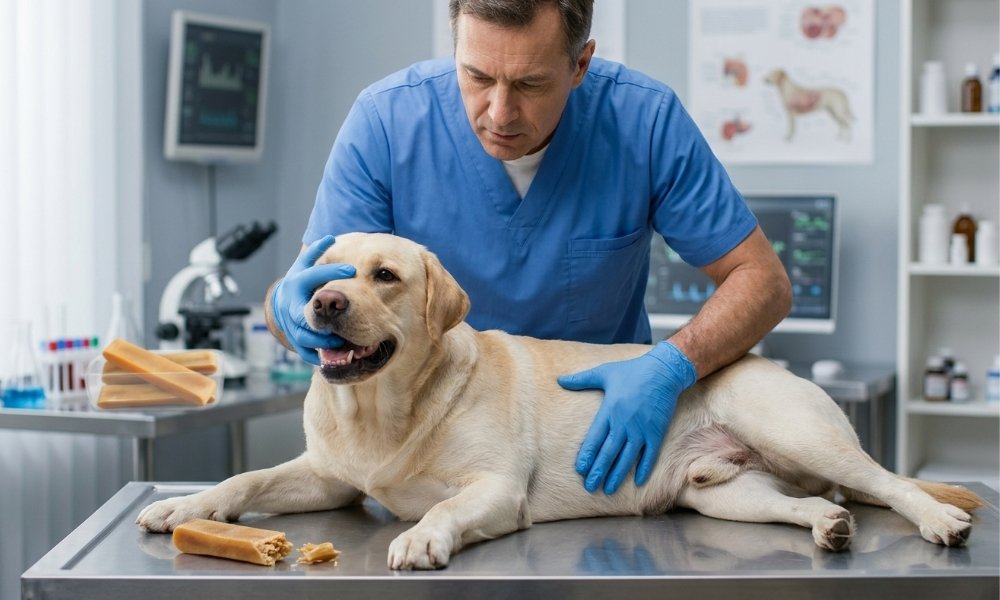
Repeated vomiting, gagging with nothing coming up, pale or blue-tinged gums, a swollen or painful belly, and sudden collapse all call for immediate veterinary care. Any single sign on this list justifies a same-day visit:
- Repeated vomiting or retching
- Gagging or choking sounds with nothing produced
- Pale, white, or blue-tinged gums
- A tense, swollen, or painful abdomen
- Sudden lethargy or collapse
- Ongoing distress or restlessness that doesn’t settle
Call your regular vet or the nearest emergency clinic the moment any of these appear. Waiting to see if they pass on their own is the one mistake that turns a manageable situation into a dangerous one.
When Can You Monitor Your Dog at Home?
Home monitoring is reasonable only when the swallowed piece was small relative to your dog’s size, your dog swallowed it without choking, and your dog is acting completely normal within the first hour. Normal means eating, drinking, moving, and behaving as usual, with no gagging, drooling, or sensitivity around the belly. Even then, call your vet before deciding to watch and wait. A quick phone assessment takes a few minutes and catches anything you might miss.
What Should You Do Right Away?
The first ten minutes matter more than the next ten hours. Three things need to happen, in order: stay calm, note exactly what happened, and call your vet. Jumping straight to panic, or straight to a home remedy, is where most owners go wrong.
Should You Stay Calm and Observe First?
Yes. A brief, calm observation period, not a frantic search of your dog’s mouth, is the right first move. Dogs read stress from their owners, and a distressed person chasing a distressed dog around the kitchen raises the odds of a bite or of pushing a swallowed piece further down. Watch your dog’s breathing and posture for two or three minutes. Reach into the mouth or throat only if the piece is clearly visible and your dog is calm enough to allow it safely.
What Information Should You Give Your Vet?
Your vet needs five details: your dog’s weight, the size of the piece swallowed, how long ago it happened, whether your dog gagged or choked at the time, and any symptoms since. Mentioning the chew’s brand and size helps too, since density and hardness vary between products. If you have an unchewed piece from the same bag, a quick photo gives your vet a size reference in seconds.
What Risks Can Swallowing Cause?
Swallowing a yak chew carries three main risks: a gastrointestinal blockage, digestive tract irritation, and choking. All three trace back to the same cause: the chew’s hardness and size relative to your dog’s digestive tract.
Can It Lead to a Blockage?
Yes, a gastrointestinal blockage is the primary risk, and it happens when a piece is too large to pass through the stomach or intestines. This is what vets call an intraluminal obstruction, meaning the object sits inside the digestive tract rather than pressing on it from outside. A complete blockage prevents food, fluids, and gas from moving normally through the digestive tract. Without prompt veterinary treatment, it can quickly become life-threatening due to dehydration, intestinal damage, perforation, or sepsis. A partial blockage is less dramatic but still needs treatment, since symptoms tend to build gradually rather than announce themselves all at once.
Could It Damage the Digestive Tract?
Yes, hard edges can scrape or irritate the esophagus, stomach lining, or intestinal wall as the piece moves through, even without a full blockage. That irritation is one of several ways yak chews upset a dog’s stomach, typically showing up as vomiting, reduced appetite, or mild diarrhea over the following day or two. One genuine advantage of a yak chew is that it isn’t a linear foreign body like string or thread. A swallowed string can saw through the intestinal wall as the gut contracts around it, while a solid chew fragment is far more likely to simply get stuck than to cut through tissue.
Is Choking Still a Concern?
Yes, choking is a real risk that’s separate from blockage, especially with the small end piece, often called the nub, that’s just the right size to swallow whole. A piece too big to fit down the esophagus can lodge in the throat instead of continuing into the gut. This is exactly why vets recommend removing or softening a chew once it wears down, rather than letting a dog finish the last piece unsupervised.
How Will a Vet Diagnose the Problem?
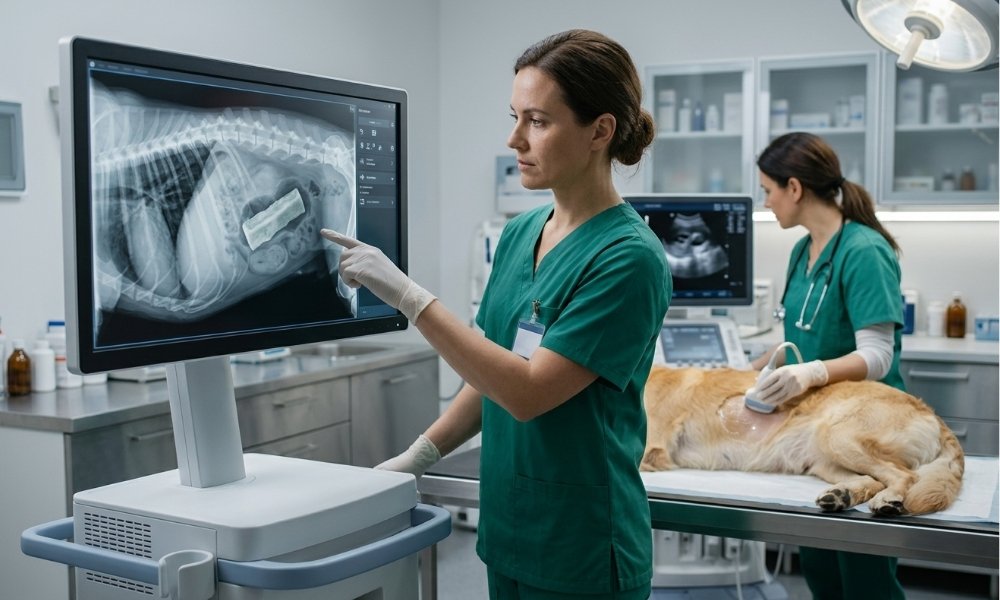
Diagnosis starts with a physical exam and a detailed history, then moves to imaging if a blockage seems likely. Your vet will ask what happened before ever touching your dog’s abdomen.
What Tests Might Be Recommended?
Vets commonly use abdominal X-rays, abdominal ultrasound, and blood work to check for a blockage and assess your dog’s overall condition. Blood work checks hydration, electrolyte balance, and signs of infection. X-rays are less reliable for a yak chew than for a metal or bone object, since dense dairy material doesn’t always show up clearly against the surrounding soft tissue. When an X-ray is inconclusive, ultrasound or a contrast study often fills the gap. A 2025 comparison of CT, X-ray, and ultrasound in dogs and cats with confirmed gastrointestinal foreign bodies found plain X-rays caught only 1 of 6 confirmed blockages (17%), and in that case, exploratory surgery becomes both the diagnostic tool and the treatment.
When Is Emergency Treatment Needed?
Emergency treatment becomes necessary when imaging confirms a complete blockage, when there’s any sign of a perforated intestine, or when your dog is dehydrated and systemically unwell. In a 2024 Chulalongkorn University study of 61 surgically treated dogs, most cases of septic peritonitis traced back to a leaking gastrointestinal tract, and only 52.46% of dogs survived to hospital discharge, which is why a painful, distended abdomen paired with repeated vomiting gets treated the same day rather than scheduled as a routine follow-up.
What Treatments Are Available?
Treatment ranges from at-home monitoring for small pieces to surgery for a complete blockage, and the right choice depends on the piece’s size, its location, and how your dog is responding. No single treatment fits every case.
Can the Chew Pass Naturally?
Yes, many small fragments pass naturally without treatment, although passage may take anywhere from one to several days depending on the dog’s size, digestive motility, and the size of the swallowed fragment. Larger dogs with smaller pieces have better odds of a natural pass than small dogs with large pieces. Your vet may recommend a follow-up X-ray a day or two later to confirm the piece has actually moved, since a normal-looking stool doesn’t always mean the object came out.
When Is Surgery Necessary?
Surgery becomes necessary when a piece is lodged and can’t move forward or back, when the intestine shows signs of perforation, or when your dog’s condition is getting worse instead of better. The procedure is called an enterotomy when the intestine is opened, or a gastrotomy when the stomach is opened, and it’s performed under general anesthesia. If the object is still in the stomach, some vets try endoscopy first: a camera-guided retrieval that avoids opening the abdomen and typically means a same-day recovery instead of a multi-week one.
How Long Does Recovery Usually Take?
Endoscopic removal usually has your dog back to normal within a day or two, while surgical removal typically takes two to four weeks for a full recovery. The first 72 hours after surgery are the most closely watched, followed by about a week of strict activity restriction. Stitches usually come out around day 10 to 14, with food gradually returning to normal over the two weeks after that. Surgery for a blockage is often lifesaving: a 2022 multicenter study of 72 dogs treated for GI foreign bodies found 100% survival when the object was removed from the stomach, 94% survival after a standard enterotomy, and 33% survival in the smaller share of cases that required enterectomy. Cost varies by complexity and location, but commonly falls between $1,500 and $8,000 in the United States, so ask for a written estimate before agreeing to a procedure.
Which Symptoms Mean an Emergency?
Repeated vomiting, a swollen or painful abdomen, pale gums, extreme lethargy, and collapse mean this is an emergency, not a wait-and-see situation. These signs mean your dog’s body is struggling to compensate, and that window closes faster than most owners expect.
When Should You Visit an Emergency Vet?
Visit an emergency vet any time these signs appear outside your regular clinic’s hours, or whenever your dog’s condition is visibly worsening. Don’t wait for morning if your dog is in obvious distress overnight. A same-day exam that finds nothing seriously wrong costs far less, in money and in stress, than a delayed one that finds a complication.
What Warning Signs Should Never Be Ignored?
Unproductive retching, a hard or bloated belly, no bowel movements for over a day, and sudden unresponsiveness should never be written off as your dog just having an off day. These are critical indicators of a complete gastrointestinal obstruction or perforation, requiring immediate, emergency surgical intervention.
How Can You Prevent It From Happening Again?
Prevention comes down to three habits: choosing the right size, supervising every session, and removing the chew before it becomes small enough to swallow whole. None of these require giving up yak chews altogether.
What Size Yak Chew Is Safest?
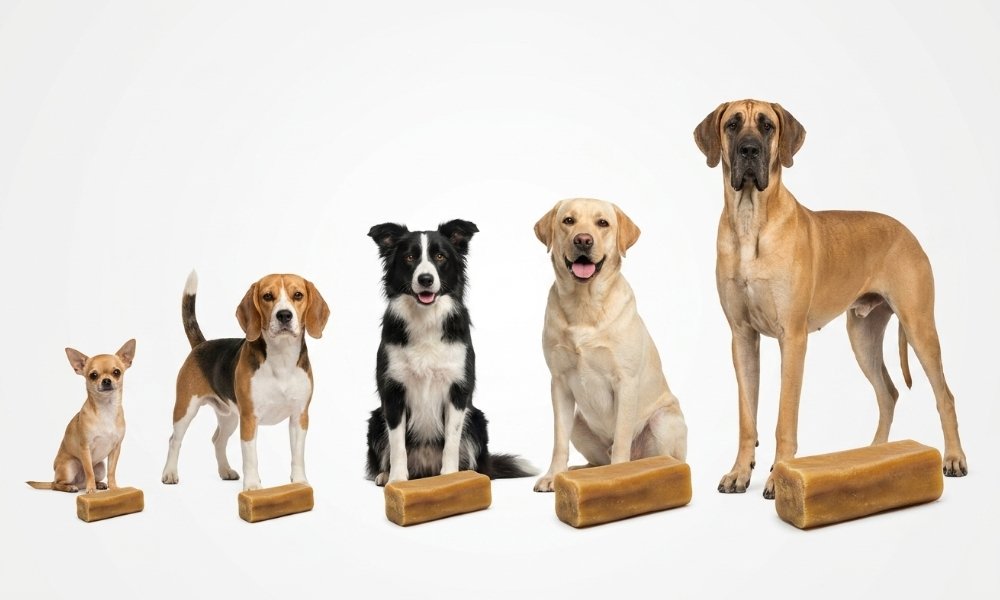
Choose a yak chew that is larger than your dog’s snout and wide enough that it cannot be swallowed whole. Also, match the chew to your dog’s weight, chewing strength, and chewing style. A chew shorter than the snout prevents your dog from safely gripping the treat with their paws. Without the ability to hold it securely, dogs are forced to shift the entire chew into the back of their mouth to reach their heavy chewing teeth, dramatically increasing the risk that it slips down the throat or is swallowed whole. Weight is a reasonable starting point for sizing, though jaw strength and chewing style matter just as much as scale weight:
| Dog’s weight | General size category |
| Under 15 lbs | Extra small |
| 15-30 lbs | Small |
| 30-50 lbs | Medium |
| 50-75 lbs | Large |
| Over 75 lbs | Extra large |
Treat this table as a starting point, not a fixed rule. A strong, determined chewer usually does better sized up rather than sized to exact weight. Working with a reliable Himalayan yak chew manufacturer that labels weight and size clearly on every bag takes most of the guesswork out of this step.
When Should You Remove Small Pieces?
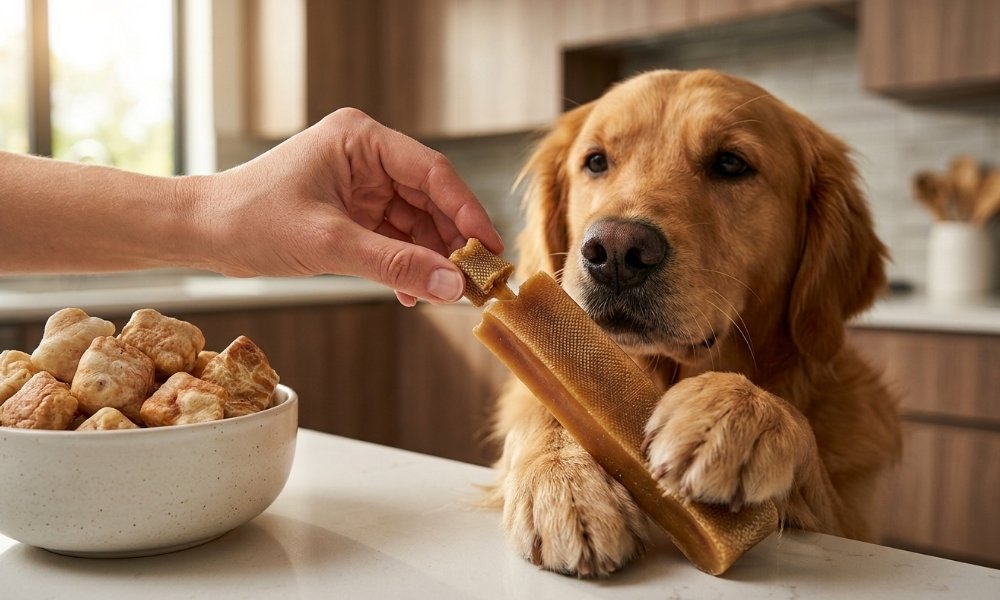
Remove the chew the moment it’s worn down to a size small enough to fit entirely inside your dog’s mouth, typically once it’s down to around two inches. This end piece, often called the nub, is the single biggest choking risk in the whole chewing session. Rather than throwing the nub away, soak it in water for five to ten minutes, then microwave it in short bursts until it puffs into a crunchy, bite-sized treat that’s no longer a swallowing hazard. Our full guide to puffing yak chews in the microwave covers exact timing by chew size and microwave wattage.
How Should You Supervise Chewing?
Supervision means staying in the room and paying attention, not just being home. Limit sessions to 15 to 30 minutes, and separate dogs in multi-dog households so one doesn’t gulp a chew to keep the other from getting it. Store unfinished chews somewhere dry between sessions. A chew left out to soften unsupervised is both a bacterial growth risk and an easy target for a bored dog.
Are Yak Chews Safe for Dogs?
Yak chews can be appropriate for many healthy adult dogs when correctly sized and closely supervised, but like all hard chews, they carry risks including tooth fractures, choking, and gastrointestinal obstruction. Safety here depends far more on how the chew is given than on the chew itself. The same chew that’s a great fit for a food-motivated Labrador who gnaws patiently can be a poor fit for a terrier that treats every chew like a puzzle to solve as fast as possible.
Which Dogs Should Avoid Yak Chews?
Puppies under six months, dogs with fractured or diseased teeth, aggressive gulpers that swallow before chewing, and dogs with a prior history of intestinal blockage are poor candidates for yak chews. For a full breakdown of age guidelines and warning signs, see our guide on whether yak chews are safe for puppies. Senior dogs need individual assessment too, since jaw arthritis and worn enamel change the risk calculation with age. Dairy sensitivity matters as well. Yak chews are naturally low in lactose because of how the whey is drained during production, but low lactose isn’t the same as hypoallergenic. Some dogs react to milk proteins rather than lactose itself. Any breed can develop a food allergy or dairy intolerance, so dogs with known food allergies or previous reactions to dairy should avoid yak chews unless approved by their veterinarian.
What Makes Yak Chews Different?
Yak chews sit in the middle of the hardness spectrum: softer and less fracture-prone than antlers or nylon bones, harder and longer-lasting than bully sticks, and more digestible than rawhide. For a closer look at that comparison, see our full breakdown of yak chews vs. bully sticks. That middle position is exactly why sizing and supervision matter more here than with softer alternatives. A yak chew gradually softens as saliva breaks it down, unlike a nylon or hard plastic chew, which stays rigid from the first bite to the last, and unlike rawhide, which can pull apart into stretchy strips rather than firm, easy-to-monitor chunks.
What Mistakes Should Dog Owners Avoid?
The two most common mistakes are inducing vomiting without a vet’s direction and trying a home remedy instead of calling for guidance. Both usually come from a good instinct (wanting to fix it fast) applied the wrong way.
Should You Make Your Dog Vomit?
No, not without your vet’s explicit direction, since making a dog vomit at home carries real risks of its own, including aspiration and further injury from a hard-edged piece coming back up. Timing matters too. Do not induce vomiting without direct veterinary instruction. Whether vomiting is appropriate depends on the object swallowed, how long ago it happened, and your dog’s condition; clinicians generally consider emesis primarily when the object is non-corrosive, located in the stomach, and ingestion was recent. When veterinarians elect to induce vomiting, they use veterinary-grade drugs with monitored administration; success and timing vary by drug and patient, so expect the vet to advise based on your dog’s specific case.
Can Home Remedies Make It Worse?
Yes, oil, butter, bread, and over-the-counter laxatives can all make things worse by masking symptoms, triggering pancreatitis, or simply delaying the diagnosis your dog actually needs. None of them soften a chew fragment enough to matter, and all of them use up time your dog might not have. If part of the chew is still visible hanging from your dog’s mouth or throat, resist the urge to pull. Call your vet instead. Pulling on a lodged piece can cause more damage than leaving it for a professional to remove safely.
What Questions Do Owners Ask Most?
The three questions owners ask most after this happens are whether the chew will simply pass, how long that takes, and whether to keep feeding their dog normally. Straight answers to each, below.
Can My Dog Poop Out a Yak Chew?
Yes, in most cases, especially when the swallowed piece is small relative to your dog’s size, and your dog is showing no symptoms. Checking stool for remnants over the next few days can offer some reassurance, though a normal-looking stool doesn’t guarantee the whole piece came out. Larger pieces and smaller dogs shift the odds toward needing help rather than waiting it out.
How Long Will It Take to Pass?
A swallowed piece may pass naturally within one to several days, although larger fragments may take longer or require veterinary treatment if they become lodged. If nothing has shown up in your dog’s stool within that window and symptoms appear, that’s your cue to call your vet rather than keep waiting.
Should My Dog Keep Eating Normally?
Contact your veterinarian before offering additional food or treats. If your dog is vomiting, choking, or may need sedation or surgery, your veterinarian may advise temporarily withholding food and possibly water until your dog has been examined. If a gastrointestinal blockage is present, additional food or water may worsen vomiting or complicate treatment, which is why veterinary guidance should be sought before feeding. Once your vet rules out an obstruction, they may recommend a temporary bland diet of boiled chicken and rice. A total loss of appetite is itself a warning sign worth reporting, not something to wait out. If surgery becomes a possibility, your vet will give specific instructions on withholding food and water ahead of anesthesia, so always check with them before deciding either way.
How Can Yak Chews Be Used Safely?
Used safely, a yak chew is a sized-right, supervised, time-limited chew that gets replaced before it becomes small enough to swallow. Every safety practice in this guide comes back to those conditions.
Can YforYak Dog Chews Reduce Risks?
Choosing a chew from a brand that publishes clear weight-based sizing and keeps density consistent from bag to bag makes the safety steps in this guide easier to apply, and that’s the standard we build YforYak chews around. A chew that varies wildly in hardness from batch to batch makes it harder to judge softening time, session length, or when a piece has crossed over into nub-sized risk. Consistent sourcing and simple, labeled ingredients also make it easier to rule out a food-related cause if your dog ever reacts to a chew. No chew, from any brand, removes the need for correct sizing and supervision. The goal is to make the habits in this guide easier to follow, not to replace them. If you’re shopping for a correctly sized, consistently made option, browse our Himalayan yak chew bars, built around the same weight-based sizing this guide recommends.
What Are the Key Guide Takeaways?
A swallowed yak chew is rarely a crisis on its own, but it always deserves a quick call to your vet and a few hours of close attention. The key points from this guide:
- Small piece, calm dog, normal behavior: monitor at home with your vet’s guidance.
- Repeated vomiting, pale gums, a swollen belly, or collapse: treat it as an emergency.
- Never induce vomiting without your vet’s explicit direction.
- Size every chew at least an inch longer than your dog’s snout.
- Remove or puff the nub before it’s small enough to swallow.
- Supervise every chewing session, even when your dog has never had a problem before.
When in doubt, the call to your vet costs a few minutes. Waiting it out on a swallowed yak chew can cost a lot more.