Natural dog chews provide more than simple entertainment. They help satisfy a dog’s instinct to chew, reduce boredom, encourage healthy chewing habits, and contribute to dental hygiene by mechanically removing plaque during regular use. Modern dog owners can choose from a wide range of natural chews, each made from different materials and offering distinct benefits in durability, digestibility, nutrition, safety, and environmental impact. Selecting the right chew depends on factors such as a dog’s age, chewing strength, dental health, dietary sensitivities, and whether the goal is an edible reward or a long-lasting reusable chew.
Among the most popular natural options, yak chews and coffee wood chews stand out for their durability and minimal processing, yet they serve different purposes. Yak chews are protein-rich Himalayan cheese chews designed to be gradually consumed, while coffee wood chews are dense wooden sticks intended for repeated gnawing over an extended period. Understanding how these two natural chews compare across safety, lifespan, dental benefits, cost, sustainability, and suitability for different dogs helps owners choose the option that best matches their pet’s chewing style and long-term enrichment needs.
What Are Yak Chews?
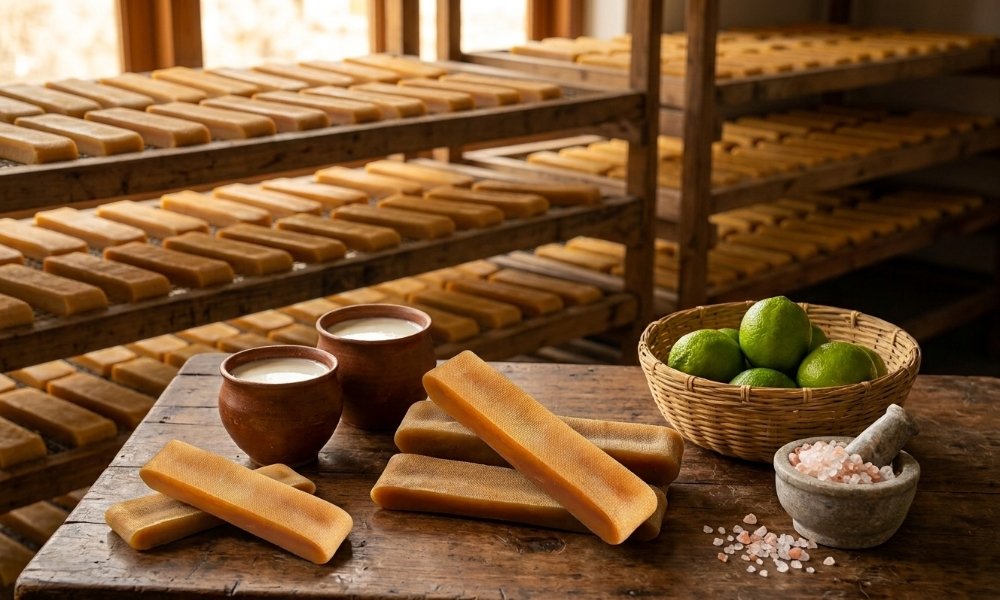
Yak chews are a hardened cheese made from yak milk, cow milk, lime juice, and salt, dried for weeks until they reach the density of a chew toy. Dog owners also know them as Himalayan chews or churpi, the traditional name for this cheese across Nepal, Tibet, and Bhutan.
What Are Yak Chews Made From?
The recipe uses three or four ingredients depending on the brand: yak milk, often blended with cow milk, plus lime juice and salt. Producers blend in cow’s milk because the supply of pure yak milk is seasonal and limited at high altitudes. Lime juice works as the coagulant, separating curds from whey the same way it does in human cheesemaking. A finished chew runs high in protein and low in fat. A peer-reviewed chhurpi processing study found protein content reaching 74% and fat around 5% on a dry-weight basis, and it contains no grain, gluten, or artificial preservatives.
Curing and drying reduce lactose to very low levels, making yak chews more tolerable than fresh milk for many dogs with lactose sensitivity. However, they still contain milk proteins, so dogs with a true dairy allergy may still react. A systematic review of confirmed canine food allergy cases found that dairy was responsible for approximately 17% of confirmed food allergies in dogs, making it the second most common food allergen after beef. Although some yak chew manufacturers report minimal adverse reactions in practice, dogs with a diagnosed milk-protein allergy should avoid dairy-based chews. Thisguide on whether yak chews are hypoallergenic for dogs covers the distinction between lactose sensitivity and true dairy allergy in more depth.
How Are Yak Chews Produced?
Production starts with fresh milk, heated and curdled with lime juice. Workers press the curds to force out whey, traditionally under stone weights, though many facilities now use mechanical presses that apply steady, measured pressure instead. The pressed blocks get cut into bars or nuggets, then dried for one to several weeks.
Drying speed is the detail most buying guides skip, and it is the one that most affects how a chew behaves in a dog’s mouth. Slow drying at low temperatures produces even density from the center of a bar to its surface. Fast, high-heat drying can leave a hard shell over a softer core, so a chew feels consistent on the shelf and then crumbles unevenly once a dog works past the surface. This is exactly the kind of process detail worth checking with a reputable Himalayan yak chew manufacturer before buying, since a quality bar holds under 10 to 15 percent residual moisture and resists denting under a thumbnail.
Why Do Dogs Enjoy Yak Chews?
Dogs enjoy yak chews for the reason people enjoy hard cheese: the flavor. Unlike a plain wood or nylon chew, yak cheese tastes like food from the first bite to the last, which keeps a dog returning to it instead of losing interest halfway through. The dense texture also demands sustained jaw effort, which burns off the restless energy that often turns into chewed furniture or shoes.
Low odor is the secondary draw, this one for the humans in the house. Yak chews generally have very low odor compared with many other animal-based chews, but they are not completely scentless; bully sticks are notably stronger-smelling, especially when first opened.
What Are Coffee Wood Chews?
Coffee wood chews are chew sticks cut from the branches and trunks of retired coffee trees, dense enough to resist splintering the way an ordinary yardstick does. They contain no coffee bean, caffeine, or added flavoring, only the wood itself.
What Is Coffee Wood?
Coffee wood comes from Coffea trees, most often the robusta variety grown in Vietnam. USDA’s 2026 Vietnam Coffee Annual Report forecasts the country’s Robusta output at 31.4 million bags for the 2026/27 marketing year, cementing its position as one of the world’s largest coffee exporters. A coffee tree’s bean production declines after roughly two decades. A 2025 coffee-renovation scoping study (trees over 20 years old flagged for replanting) classifies trees past that age as due for heavy pruning or replanting, noting that roughly 80% of surveyed farms are overdue for this cycle, at which point farmers prune a tree back hard or replace it to keep a plantation productive. The wood removed during that cycle becomes chew material instead of waste.
The fibers in coffee wood run tighter and closer together than in most native hardwoods found in North America or Europe. That density produces coffee wood’s two defining traits: it is noticeably heavier than a similarly sized stick from a backyard tree, and it wears down in soft, thin fibers rather than splitting into hard shards.
How Are Coffee Wood Chews Made?
Manufacturing coffee wood chews is mostly subtractive, not additive. Producers clean the harvested branches, cut them to size, and shape them into sticks, knots, or pretzel forms, often rounding the ends to remove sharp corners. Most brands skip chemical treatment entirely and rely on the wood’s natural density for durability rather than a coating or hardener.
A few manufacturers pair the wood with a natural fiber like coconut husk rope, giving a dog two textures in one chew. Beyond that, there is little processing between a coffee farm and a finished stick: no baking, no smoking, and no additives to list on the packaging.
Why Are Coffee Wood Chews Popular?
Coffee wood chews built their popularity on a story that happens to be true: they turn an agricultural byproduct into a dog chew instead of landfill or firewood. That sustainability angle appeals to owners who also think about where a rawhide chew’s cattle hide came from.
The practical case holds up just as well. Coffee wood carries zero caffeine, since the stimulant lives in the bean and fruit, not the wood. It skips the common allergens found in wheat- or soy-based treats, which makes it a default option for dogs on elimination diets. And because the fibers fray instead of splintering, it earns a reputation as one of the gentler hardwood options for dogs that still need serious durability.
How Do Yak Chews and Coffee Wood Chews Compare?
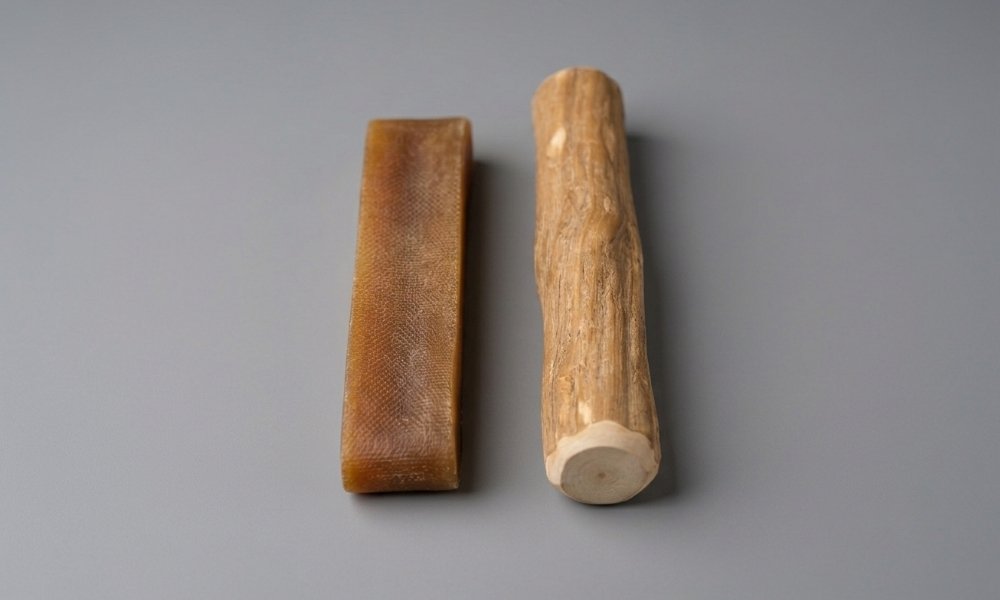
Yak chews and coffee wood chews are both hard, long-lasting chews, but they differ in how they get used up: one is eaten, the other is worn down. The table below lines up the practical differences before the sections that follow break each one down individually.
| Factor | Yak Chews | Coffee Wood Chews |
| Primary material | Hardened yak and cow milk cheese | Dense coffee tree wood |
| How it gets used | Eaten down to nothing over several sessions | Worn down slowly, rarely fully consumed |
| Typical hardness | Very hard, softens somewhat with saliva | Very hard, fibers fray rather than splinter |
| Usable life | Hours to a few days per chew | Several weeks to a couple of months per chew |
| Odor | Virtually odorless | Mild, neutral wood scent |
| Calorie content | Yak chews are protein-rich and moderate in fat (around 5% fat by some studies), so they are energy-dense relative to wood chews and should be counted as part of the daily treat allowance | Effectively zero calories |
| Typical price position | Higher per unit | Lower per unit |
The biggest takeaway here is the usage pattern, not the price row. A coffee wood chew priced close to a yak chew can still cost less per week, simply because one dog finishes a yak chew in an afternoon while gnawing on the same coffee wood stick for a month.
Which Chew Lasts Longer?
Coffee wood lasts longer in the sense that matters for a calendar: weeks to months of repeated sessions, against hours to a few days for a single yak chew. That comparison undersells yak chews a little, since they were never meant to last the way a toy lasts. A yak chew is built to be consumed, one gnawing session at a time, until nothing recognizable remains.
Within a single sitting, the two sit closer together than the weeks-versus-hours framing suggests. A determined chewer can work through the outer layer of either one in a similar stretch of active chewing. The real gap shows up a month later, when the coffee wood stick is still in the toy basket, and the yak chew is long gone.
Which Option Is More Durable?
Coffee wood holds its structural shape longer because it never softens the way a dairy-based chew does. Saliva breaks down surface fibers gradually, but the core stays dense for the life of the stick. Yak chews soften from the outside in during a session, which is part of why they eventually get consumed rather than merely worn.
Neither sits at the very top of the durability scale. Brands selling coffee wood typically keep a harder option, like antler or briar root, in reserve for the small share of dogs that chew through anything short of that. The same logic applies to yak chews: a bar that satisfies a moderate chewer for two days can disappear in twenty minutes with a large, motivated power chewer. Durability depends on the dog at least as much as the material.
Which Chew Costs More?
Yak chews typically carry a higher sticker price than a similarly sized coffee wood chew, largely because dairy ingredients and import logistics from the Himalayas cost more than harvesting a byproduct of coffee farming. This breakdown of why yak chews are so expensive walks through each cost driver individually. Per unit, coffee wood is the budget option.
Sticker price is not the cost per week, though. Because a coffee wood chew survives many sessions across a month or two, its effective weekly cost often lands lower than the raw price gap implies. A yak chew finished in two days needs replacing every two days for a dog that chews that fast. Owners who track chew spending by the season, not the bag, usually find the price gap narrows or reverses.
Which Chew Is Better for Dog Safety?

Both chews carry real, manageable risks rather than being simply safe or unsafe, and the risk profile differs by type: yak chews raise hardness and choking concerns, while coffee wood raises a smaller splinter risk. The sections below cover each, then a shared list of practices that apply no matter which one ends up in your dog’s mouth.
Are Yak Chews Safe for Dogs?
Yak chews are safe for most healthy adult dogs once the size matches the dog and someone supervises the session. The hardness that makes them long-lasting is the same property that creates risk. A cadaveric biomechanics study on tooth-fracture forces found that dogs’ overall tooth-fracture prevalence runs 20–27% and flagged chewing on hard treats and toys as a growing contributor, meaning a dog with existing dental disease or a breed known for forceful biting can chip or fracture a tooth on a chew this dense.
Two specific patterns account for most real incidents. The first is the end piece: once a yak chew wears down to a one- or two-inch nub, it becomes small enough to swallow whole, and some dogs try exactly then. The second, less discussed pattern involves a dog that chunks off large pieces and swallows them instead of gnawing gradually, a behavior seen more in fast, food-motivated chewers than slow, methodical ones. It can cause vomiting or, less often, a blockage that needs a vet visit. If this happens, this guide on what to do if your dog swallowed a yak chew covers the warning signs to watch for and when a vet visit is necessary. Neither risk is a reason to avoid yak chews outright. Both are reasons to watch how your specific dog chews, not just what the packaging recommends.
Are Coffee Wood Chews Safe?
Coffee wood chews are safe for most dogs and carry a lower splinter risk than a stick pulled from the backyard, though lower is not zero. The tightly bonded fibers fray into soft strands under normal gnawing, which is why splinter-free claims hold up in typical use. An unusually forceful bite, or a dog that cracks a chew sideways in its back teeth instead of gnawing the end, can still shear off a harder fragment.
The bigger safety issue is less about the wood and more about what owners assume. Coffee wood is a chew toy, not a treat, and it is not meant to be swallowed. Fine fibers that flake off during normal use pass through most dogs without incident, but a dog that tries to eat large pieces of the stick is doing something the product was never designed for.
What Safety Tips Should Owners Follow?
A short set of habits reduces risk with either chew type:
- Match the chew size to your dog’s weight and jaw strength, and size up for aggressive chewers.
- Apply the thumbnail test before handing over any hard chew: if you cannot leave a small dent, a veterinary dentist would call it too hard for routine use.
- Supervise every session, especially the first few with a new chew.
- Remove the end piece once a yak chew shrinks to a swallowable size, or follow this method for puffing yak chews in the microwave to turn a plain, additive-free nub into a softer treat instead.
- Cap active chewing at 30 to 60 minutes per session to limit cumulative wear on the teeth.
- Introduce any new chew gradually, in short sessions, before daily use.
- Talk to your vet before offering either chew to a dog with diagnosed dental disease, a known milk allergy, or a habit of swallowing large pieces.
None of these steps removes risk completely. They shift the odds meaningfully in your dog’s favor, which is the most any chew can promise.
Which Chew Is Better for Dental Health?
Both chews clean teeth mechanically through the friction of gnawing, not through any active ingredient, and neither has independent clinical data behind that claim. The next three sections cover how each works and where the real differences, modest as they are, sit.
How Do Yak Chews Support Teeth?
A yak chew cleans teeth through friction. As a dog gnaws, the hard surface scrapes against enamel and gumline, dislodging soft plaque before it hardens into tartar. That scraping works best along the back teeth, where dogs naturally position a hard chew during sustained gnawing.
The tradeoff sits inside the same mechanism. A chew hard enough to scrape tartar effectively is also hard enough to stress a tooth that bites down wrong on it, the same physics behind most hard-chew fractures a veterinary dentist sees.
How Does Coffee Wood Help Teeth?
Coffee wood works more like floss than a scraper. As surface fibers fray under a dog’s teeth, they thread between tooth and gumline, pulling away softer plaque without the concentrated scraping force of a solid cheese bar. The action also exercises jaw and gum tissue through repeated, lower-intensity chewing rather than short bursts of hard biting.
That gentler mechanism is why coffee wood suits a broader range of ages and dental conditions than a hard yak bar, even though neither one out-cleans the other in any measurable, published sense.
Which Option Cleans Teeth Better?
Neither yak chews nor coffee wood chews have VOHC acceptance for plaque or tartar reduction; the Veterinary Oral Health Council (VOHC), which is run by the American Veterinary Dental College, has accepted only dental diets and specific treats from major pet food companies. VOHC’s official January 2026 accepted-products list includes no natural bone, wood, or cheese chews. That is not a knock against yak or coffee wood chews. It is a reminder that “helps clean teeth” and “clinically proven to reduce plaque by a set percentage” are different claims, and most natural chew marketing blurs the two.
In mechanical terms, a yak chew’s harder surface likely scrapes more tartar per minute of chewing, while coffee wood’s gentler action adds up over a longer stretch of total chewing time. Daily brushing outperforms both, and nothing here changes that.
Which Dogs Benefit Most From Each Chew?
Age, chewing style, and dental history matter more than brand loyalty when matching a dog to either chew. The breakdown below covers puppies, adult dogs, and aggressive chewers, the three groups with the most at stake in the choice.
Are Yak Chews Better for Puppies?
Hard yak bars are not a good match for puppies, for developmental reasons rather than a marketing preference. A puppy’s adult teeth are not fully in until roughly six to seven months of age, and the enamel on those new teeth keeps hardening for a while after that. A chew dense enough for an adult dog can put uneven pressure on teeth that are not ready for it.
Puffed yak chews are softer than hard bars and are intended for puppies after the main teething phase, seniors, or dogs with dental issues, but they should still be sized appropriately and supervised, as they remain edible and can be swallowed in chunks. This safety guide on Himalayan yak chews for puppies breaks down age thresholds and format choices in more detail. Even then, supervise the first few tries and size the piece so it cannot be swallowed whole.
Are Coffee Wood Chews Better for Adult Dogs?
Not exclusively. Most coffee wood brands set their minimum age around six months, roughly the same threshold as puppies losing their last baby teeth, which means coffee wood spans a wider age range than a hard yak bar rather than being reserved for adults. Its moderate hardness, firm enough to last, soft enough to fray instead of crack, works for many dogs from late puppyhood through the senior years.
Where adult dogs do have an edge is jaw strength and bite consistency. A fully grown dog applies steadier, more controlled pressure than a still-coordinating puppy, which lowers the odds of the off-angle bite that shears a wood fragment. Coffee wood is not an adult-only chew, but adult dogs get a more predictable, lower-risk experience from it than puppies or dogs with uncoordinated bite mechanics do.
Which Chew Suits Aggressive Chewers?
Both hold up to aggressive chewing better than most natural alternatives, which is exactly why both get marketed to owners of powerful chewers. A dense yak bar and a coffee wood stick both outlast the soft treats and thin rawhide that a serious chewer destroys in minutes.
Neither sits at the absolute top of the durability scale. Brands selling coffee wood usually reserve a harder tier, like antler or briar root, for dogs that chew through everything else, and a yak bar that satisfies a moderate chewer for two days can vanish in one aggressive session with a large, motivated dog. For genuinely extreme chewers, this guide to the best yak chews for aggressive chewers matters more than the marketing tier: size up, supervise closely, and replace the chew before it wears down to a swallowable size, regardless of material.
What Are the Pros and Cons of Yak Chews?
Yak chews earn their popularity through flavor, nutrition, and low mess, and lose points on hardness, price, and puppy suitability. Both sides matter when deciding if they fit your dog.
What Are the Main Advantages?
The core advantages cluster around three qualities owners consistently ask for:
- Long chewing sessions from a single piece, thanks to dense, slow-softening cheese.
- High protein and low fat, useful for dogs on a calorie-controlled diet who still need enrichment.
- Minimal ingredients, typically just milk, lime juice, and salt, with no grain, gluten, or synthetic preservatives.
- Low odor and no sticky residue, unlike rawhide or bully sticks.
- Full digestibility over time rather than indefinite gnawing, so nothing lingers half-chewed for months.
Reduced lactose during curing also makes yak chews tolerable for many dogs with milder dairy sensitivities, though not for dogs with a true milk protein allergy.
What Are the Potential Drawbacks?
The same properties that make yak chews appealing create their limits:
- Hardness that raises real fracture risk for aggressive chewers and dogs with existing dental disease.
- A choking hazard at the end-piece stage that needs active management, not occasional attention.
- Unsuitability for puppies in hard-bar form, since developing teeth cannot safely handle that density.
- Milk protein that rules them out for dogs with a diagnosed dairy allergy.
- A higher price per unit than most wood-based or nylon alternatives.
- Calorie density that adds up quickly if the chew becomes a daily habit rather than an occasional one.
None of these drawbacks is unique to yak chews. They are the standard tradeoffs of any hard, edible chew, concentrated in a product that markets itself as gentler than it actually is during its last few sessions.
What Are the Pros and Cons of Coffee Wood Chews?
Coffee wood earns points on sustainability, cost, and splinter resistance, and loses them on flavor and true digestibility. Here is how that plays out in practice.
What Are the Biggest Benefits?
Coffee wood’s advantages cluster around durability and a clean ingredient story:
- A byproduct origin that turns aging coffee trees into a chew instead of waste.
- Zero caffeine and no common food allergens, suited to dogs on restricted or elimination diets.
- Fibers that fray under normal chewing rather than splitting into sharp shards.
- A usable life measured in weeks or months rather than days.
- A lower price per unit than most edible hard chews.
- Suitability across a wide age range, from roughly six months through the senior years, given its moderate hardness.
The sustainability story is not just marketing polish. Coffee farming produces a genuine surplus of retired wood every year, and repurposing it keeps that material out of a landfill or a bonfire.
What Are the Possible Disadvantages?
The drawbacks are smaller in severity but still worth naming:
- A non-edible design, so any piece a dog manages to swallow counts as a foreign object, not a digestible treat.
- A real, if reduced, splinter risk for unusually forceful or off-angle chewers.
- Fiber shedding, which means some mess on floors and furniture during active sessions.
- A neutral, plain flavor that leaves food-motivated dogs less interested than a cheese-flavored alternative.
- Occasional bark or rough spots on the outer layer of a batch are worth a quick check before first use.
Most of these are manageable with basic supervision. The flavor issue is the one owners cannot fix, though plenty of dogs gnaw happily on plain wood regardless.
How Should You Choose Between Yak Chews and Coffee Wood Chews?

The right choice depends on your dog’s age, chewing style, and dental history more than on either product’s marketing. The next three sections turn that into a usable framework.
What Factors Matter Most?
Seven variables decide the right fit for a given dog: age and tooth development, how hard and how fast the dog typically bites, any existing dental disease, food allergies versus simple sensitivities, whether you want a chew that gets fully consumed or one that lasts as a reusable toy, how much indoor mess you can tolerate, and budget measured per week rather than per bag.
Weigh dental history first. A dog with any diagnosed tooth damage should get a vet’s input before either chew enters the rotation, regardless of how the other factors line up. Chewing style does the next most work, which is worth its own section.
How Does Your Dog’s Chewing Style Affect the Choice?
Dogs generally fall into one of three chewing styles, and style matters more than breed. Gentle gnawers, dogs that work steadily without much force, do well with either chew and rarely run into trouble. Power chewers, dogs that bite down hard and fast, need careful size-matching and closer supervision on both, since that pattern produces most fractures and splinters.
The third style is the one owners underestimate: chunkers, dogs that bite off pieces and swallow them rather than gnawing gradually. That behavior fits poorly with a hard edible chew like yak cheese, since large swallowed chunks can cause vomiting or a blockage, and it fits coffee wood no better, since the entire point of that chew is gnawing, not eating. A chunker is often better served by a softer chew entirely, no matter what either product’s marketing promises.
When Should You Switch Chew Types?
A few concrete signals mean it’s time to change the rotation. Visible wear on a tooth, or any sign your dog favors one side of its mouth while chewing, means stop and call your vet before offering either chew again. A chew that disappears too fast is undersized for that dog’s strength, not a reason to buy more of the same size.
Life stage transitions are the other trigger. A puppy crossing into its adult teeth around six to seven months can typically move from puffed formats toward harder ones, gradually. A senior dog developing worn or loose teeth usually needs to move the other direction, from a hard yak bar or firm coffee wood stick toward puffed yak, softer chews, or supervised gumming rather than serious gnawing. This guide to the best chews for senior dogs with no teeth walks through exactly what that transition should look like.
How Can You Find the Right Natural Dog Chew?
The right natural chew comes down to matching material, hardness, and size to the specific dog in front of you, not to whichever product has the most persuasive packaging. Start with the factors covered above: age, chewing style, dental history, and allergy profile. From there, look for a producer that discloses a full ingredient list, explains its hardness and sizing standards, and gives clear guidance on supervision and end-piece safety instead of burying that information under marketing copy.
A short ingredient list is a genuine quality signal in this category. So, if a size chart is tied to your dog’s actual weight rather than vague labels like “small” or “large” with no pound range attached, this guide to choosing the right yak chew size for your dog’s breed and age shows what that sizing standard should look like. If a brand cannot answer basic questions about how its chews are dried, cured, or tested for hardness, treat that as a real gap, not a minor detail.
Can YforYak Dog Chews Meet Your Dog’s Needs?
For owners who have read this far and landed on yak chews as the better fit, YforYak produces Himalayan yak chews built on the traditional recipe: yak milk, cow milk, lime juice, and salt, with no fillers, binding agents, or artificial flavoring at any stage. We follow the slow-dry method described earlier in this guide rather than fast industrial dehydration, aiming for even density from the center of a bar to its surface instead of a hard shell over a softer core.
The lineup spans more than one hardness level. Standard bars and nuggets suit adult dogs with typical to strong chewing habits, while puffed bars and puffed nuggets, made by heating the cheese until it expands, give puppies past the teething stage, senior dogs, and dogs recovering from dental work a softer option with the same flavor. Sizing guidance ties each product to a dog’s weight range rather than a generic label, and every batch runs through FDA- registered, HACCP-, and GMP-certified facilities.
None of that replaces the judgment covered earlier in this guide. Check your dog’s dental history, size the chew correctly, and supervise the first few sessions with anything new.
What Should You Remember About Yak Chews vs Coffee Wood Chews?
Yak chews and coffee wood chews solve the chewing problem from two different directions, and that difference should drive your decision more than price or packaging. A yak chew is a dense, flavorful cheese that a dog finishes over several sessions and then needs replacing. A coffee wood chew is a tough, neutral-tasting stick that a dog gnaws on for weeks without ever really finishing it.
Neither is safe nor unsafe in the abstract. Both carry real risk when the size is wrong, the dog’s chewing style is forceful or unpredictable, or supervision lapses during the first few sessions with something new. Both carry real benefit when matched correctly to a dog’s age, teeth, and habits.
If your dog gnaws steadily and enjoys food-flavored chews, a yak chew is likely the better fit, with a puffed version in reserve for puppies, seniors, or dental recovery. If your dog needs something that survives weeks of determined chewing without daily replacement, or has allergies that rule out dairy, coffee wood earns its keep. Many households end up keeping both in rotation and letting the dog’s mood decide which one comes out of the basket on a given day.