
Yak chews are not completely hypoallergenic, but they are among the best limited-ingredient dog chews for dogs with common food allergies. Traditional Himalayan yak chews contain only yak milk, cow milk, lime juice, and salt, avoiding major canine allergens such as beef, chicken, wheat, soy, egg, and artificial additives. Because they are dairy-based, they are not suitable for dogs with a confirmed milk or casein allergy, even though they are often a safe alternative for dogs allergic to other common proteins.
This guide explains whether yak chews are truly hypoallergenic, how their ingredients compare with those of other dog chews, which dogs benefit most from them, and when they should be avoided. You’ll also learn about food allergies versus food intolerances, ingredient safety, nutritional value, dental benefits, potential risks, proper sizing, safe introduction, storage, veterinary recommendations, and how yak chews compare with rawhide, bully sticks, antlers, and synthetic chews so you can choose the safest chew for your dog’s specific allergy profile.
What Makes a Dog Chew Hypoallergenic?
A hypoallergenic dog chew avoids the proteins most often linked to canine food allergies, primarily beef, dairy, chicken, wheat, and lamb. Manufacturers achieve this through short ingredient lists, single-named protein sources, and the removal of fillers, dyes, and artificial flavor enhancers that introduce additional allergen exposure.
What Does “Hypoallergenic” Mean for Dogs?
“Hypoallergenic” has no legal or regulatory definition for dog products, so the term describes a chew that avoids common allergens rather than one guaranteed to be allergen-free. Neither the FDA nor the American Association of Feed Control Officials (AAFCO) defines “hypoallergenic” for pet food or treats; under FDA’s pet food claims guidance, a disease-prevention promise like this would instead have to clear the agency’s new-animal-drug review before it could appear on a label.
A food allergy occurs when a dog’s immune system mistakes a specific protein for a threat and mounts a response, producing symptoms such as itching, skin infections, or gastrointestinal upset. A food intolerance produces similar symptoms through a different mechanism that does not involve the immune system, the way lactose intolerance causes digestive upset without an allergic reaction. The two terms confuse dog products because a chew marketed as “hypoallergenic” can still trigger a true intolerance even when no immune-mediated allergy exists.
Which Ingredients Commonly Trigger Food Allergies in Dogs?
Five protein sources account for most diagnosed canine food allergies: beef, dairy, chicken, wheat, and lamb. A widely cited 2016 review of confirmed cutaneous adverse food reactions in dogs, Mueller et al.’s 2016 BMC Veterinary Research review, attributes 34% of cases to beef, 17% to dairy, 15% to chicken, 13% to wheat, and 5% to lamb, with soy (6%), corn (4%), egg (4%), pork (2%), and fish and rice (2% each) accounting for the remainder.
Exposure frequency drives much of this ranking. Beef and chicken appear in most commercial dog foods, so dogs encounter these proteins earliest and most often, raising the odds of developing an allergic response over time. True food allergies affect a small share of the overall dog population: Olivry and Mueller’s 2017 CAFR prevalence review puts confirmed cases at 1% to 2% of dogs seen for any reason, rising to 8%–62% among dogs already diagnosed with allergic skin disease, still well below the prevalence of environmental allergies such as flea or pollen sensitivity.
How Do Hypoallergenic Dog Chews Differ From Regular Dog Chews?
Regular dog chews often combine multiple protein sources with flavor coatings, dyes, and preservatives, while hypoallergenic or limited-ingredient chews restrict the formula to one or two named ingredients. Each additional ingredient in a regular chew introduces another potential allergen, particularly when a label lists generic terms like “meat flavor” or “animal digest” instead of a specific named protein.
A limited-ingredient chew narrows that exposure by design. Yak chews illustrate the approach with a three- or four-ingredient recipe; bully sticks use a single named protein; some dental chews rely on a sole novel protein such as duck or venison. The narrower the formula, the easier it becomes to identify a problem ingredient if a reaction occurs.
Are Yak Chews Naturally Hypoallergenic?
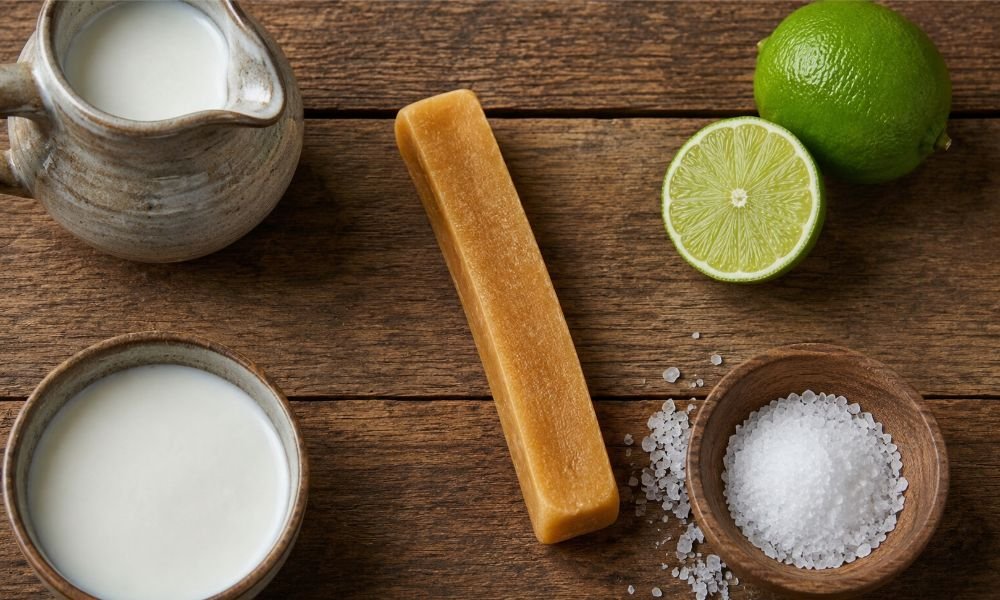
Yak chews are not allergen-free, but they qualify as a limited-ingredient chew built from yak milk, cow milk, lime juice, and salt. The recipe excludes beef, chicken, wheat, soy, and egg, the ingredients responsible for most diagnosed canine food allergies outside of dairy, while remaining a dairy-based product itself.
What Ingredients Are Traditional Yak Chews Made From?
A traditional yak chew contains three or four ingredients: yak milk, cow milk, lime juice, and salt. Producers curdle the milk with lime juice, a natural acid that coagulates the milk proteins, then press the resulting curd to remove whey and shape it into bars.
The pressed blocks dry slowly over several weeks in cold, low-humidity mountain air, producing a dense, hardened cheese with a long shelf life. This process originates in the Himalayan regions of Nepal, Tibet, and Bhutan, where herders have made the same hard cheese, known as churpi or chhurpi, as a portable, protein-rich food for centuries before it entered the dog chew market.
Why Are Yak Chews Considered a Limited-Ingredient Dog Chew?
A limited-ingredient chew restricts its formula to the fewest possible components, and a three- or four-ingredient yak chew contains far fewer potential triggers than a typical commercial dog treat. Many mass-market treats list ten or more components, including multiple protein blends, flavor enhancers, preservatives, and coloring agents, each adding a separate variable for a dog with a sensitive system.
VCA Animal Hospitals notes an important distinction: retail limited-ingredient products are not manufactured under the strict cross-contamination protocols that veterinary prescription diets follow. A retail yak chew can still list only milk, lime juice, and salt while sharing production equipment with other treats, so a dog on a strict elimination trial requires a veterinarian-directed diet rather than a retail “limited-ingredient” label alone.
Can Dogs With Food Allergies Eat Yak Chews?
Dogs with allergies to beef, chicken, wheat, soy, or eggs may tolerate traditional yak chews better than many other treats, because the classic recipe usually excludes those ingredients. Dogs with a confirmed milk or dairy-protein allergy should avoid yak chews because traditional yak chews are dairy-based.
A dog in the middle of a veterinary elimination-diet trial requires a stricter standard than a simple allergen check. Diagnosing a food allergy depends on removing every ingredient outside a single prescribed diet for 8 to 12 weeks, so introducing any treat, including a yak chew, during that window compromises the trial’s results regardless of how few ingredients it contains.
Are Yak Chews Free From Common Dog Allergens?
Yak chews exclude beef, chicken, wheat, gluten, soy, egg, and corn, accounting for the allergens behind most confirmed canine food-allergy cases outside of dairy. They do not exclude dairy. Yak chews are low in lactose after curing, but they still contain milk proteins, so they are not suitable for dogs with a milk-protein allergy.
| Allergen Category | Present in Yak Chews? |
| Beef | No |
| Chicken | No |
| Wheat / Gluten | No |
| Soy | No |
| Egg | No |
| Dairy (milk protein) | Yes |
| Lactose | Trace amounts only |
This profile makes yak chews a reasonable option for the majority of dogs with a confirmed allergy to one of the top non-dairy triggers, while ruling them out for any dog with a diagnosed dairy or casein allergy.
Which Dogs Can Benefit From Yak Chews?
Yak chews suit adult dogs with healthy teeth, moderate to aggressive chewing styles, and sensitivities to beef, chicken, wheat, soy, or egg. They suit very young puppies, dogs with worn or fragile teeth, and dogs with a diagnosed dairy allergy less well, since each of these groups faces a specific risk that the chew’s hardness or dairy content creates.
Are Yak Chews Suitable for Dogs With Sensitive Stomachs?
Yak chews suit many dogs with sensitive stomachs because the curing process removes most lactose and the recipe avoids fillers, binders, and artificial flavoring. The dense texture also slows consumption compared with richer, higher-fat treats, reducing the digestive load a dog processes in one sitting.
Individual tolerance still varies. Introducing the chew in short 10- to 15-minute sessions and watching for loose stool, gas, or vomiting over the following 24 hours confirms how a specific dog’s digestive system responds before extending the chewing time.
Can Puppies Eat Yak Chews?
Hard yak chew bars are unsuitable for puppies until their adult teeth finish calcifying, a process that completes at roughly 6 to 7 months of age. A puppy that gnaws a dense, hard chew before then risks micro-fractures in enamel that has not yet fully hardened.
Puffed or soaked yak chews offer a softer alternative for younger pups, since puffing reduces bite resistance by roughly 60% to 70% compared with the original hard bar. Breed size and individual development still vary, so introducing yak chews to puppies safely comes down to a veterinarian confirming the right timeline for a specific puppy.
Are Yak Chews Safe for Senior Dogs?
Senior dogs with worn enamel or periodontal disease fare better with puffed or soaked yak chews than with the original hard bar. Years of chewing, combined with age-related dental disease, leave many older dogs with teeth less able to withstand a dense chew without fracturing.
The softened puffed format still delivers mental stimulation and gentle jaw exercise, two benefits that matter for cognitive engagement in aging dogs. Picking the right senior dog chews with no teeth keeps that engagement safe. However, a veterinary dental exam before introducing any hard chew still identifies existing fractures, loose teeth, or periodontal disease that would make even a soft format inappropriate.
Which Dog Breeds May Benefit Most From Yak Chews?
Large, strong-jawed breeds such as Labrador Retrievers, Mastiffs, and German Shepherds benefit from a yak chew’s density during extended chewing sessions, while breeds with a documented predisposition to food allergies benefit from its narrow allergen profile. The two groups overlap less than owners might expect, since chewing strength and allergy predisposition involve separate biological factors.
A 2026 Applied Sciences review of companion-animal food allergy found that more than a third of diagnosed cases cluster in just four breeds: German Shepherd, Labrador Retriever, Golden Retriever, and West Highland White Terrier, reinforcing that the chew’s narrow ingredient list matters more than its hardness for these dogs. For these breeds, the chew’s narrow ingredient list matters more than its hardness, while power-chewing breeds without allergy history value the duration and density a yak chew provides over a softer alternative.
What Are the Benefits of Yak Chews Beyond Allergy Concerns?
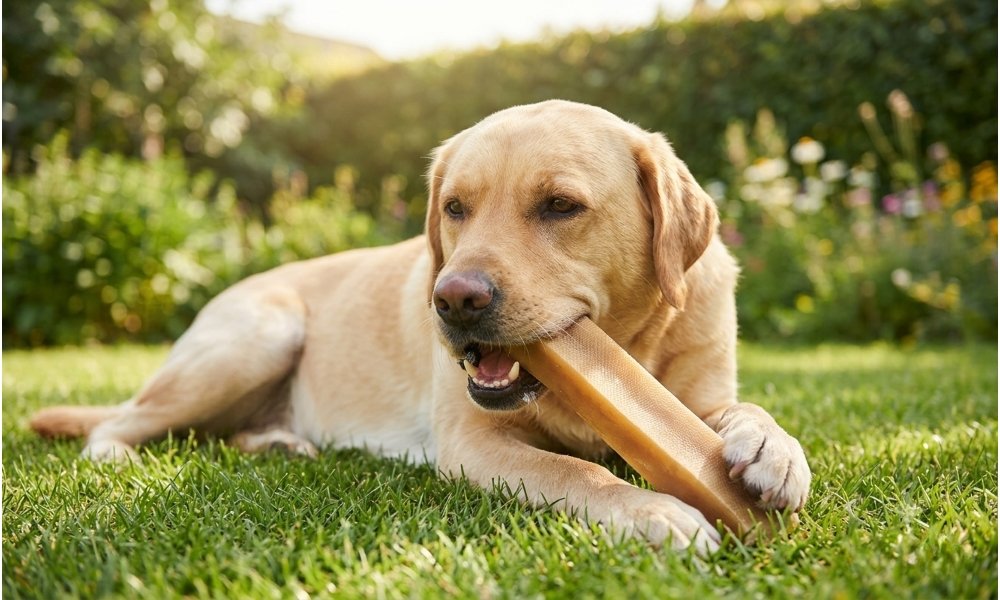
Beyond their limited-ingredient profile, yak chews scrape plaque during chewing, last considerably longer than rawhide or bully sticks, deliver concentrated protein and calcium, and redirect a dog’s natural chewing instinct away from furniture and shoes. These benefits apply to most healthy adult dogs regardless of allergy status.
How Do Yak Chews Support Dental Health?
Chewing a dense yak chew mechanically scrapes plaque and tartar from the tooth surface with every bite, supporting oral hygiene between brushings. The abrasive action works through friction rather than any active ingredient, so the dental benefit depends entirely on sustained gnawing rather than quick consumption.
This mechanical cleaning does not replace brushing or professional veterinary cleanings: Cornell University College of Veterinary Medicine reports that 80% to 90% of dogs over age 3 have some degree of periodontal disease, with severity increasing with age and hitting smaller breeds hardest.
Why Are Yak Chews Long-Lasting?
A yak chew’s density comes from weeks of slow drying that reduces moisture content to roughly 10% to 15%, creating a hard block that softens only gradually under saliva and chewing pressure. This structure separates yak chews from faster-consumed treats and gives a single chew enough durability to provide engagement across multiple sessions.
A correctly sized yak chew typically holds a moderate to aggressive chewer’s attention for 30 to 60 minutes per active session, with the same chew often returning to use across several days or weeks. Bully sticks are often consumed faster than yak chews, especially by larger or more aggressive chewers, making the yak chew’s per-session cost lower over time despite a higher upfront price.
Do Yak Chews Provide Nutritional Benefits?
Yak chews typically deliver 50% to 70% crude protein and under 4% crude fat by weight, alongside calcium and phosphorus drawn from the milk base. Guaranteed analysis values vary somewhat by brand and milk ratio. Hence, sourcing from an established Himalayan yak chew manufacturer helps keep that protein-dense, low-fat profile consistent from batch to batch.
This profile makes yak chews calorie-dense relative to their size, with most chews supplying somewhere in the range of 270 to 370 kilocalories per 100 grams. As a treat rather than a balanced meal, a yak chew fits best within WSAVA’s treat-feeding guidance, which caps treats at no more than 10% of a dog’s total daily calorie intake, a limit that matters most for smaller or less active dogs.
How Can Yak Chews Help Reduce Boredom and Destructive Chewing?
Chewing satisfies an instinctive behavioral need in dogs, and a long-lasting yak chew gives that need an appropriate outlet instead of furniture, shoes, or baseboards. Dogs chew to relieve stress, explore their environment, and, in puppies, manage teething discomfort, and an unmet chewing drive frequently redirects toward household items.
The extended duration that makes yak chews effective for dental health also makes them useful during crate time, alone time, or any period requiring independent engagement. A chew that lasts through a multi-hour work call or a kenneled afternoon addresses the behavioral need directly, rather than only managing the aftermath of destructive chewing.
Are There Any Risks or Limitations of Yak Chews?
Yak chews carry three main risks: dairy-protein allergy in sensitized dogs, choking or fracture risk from incorrect sizing, and excessive hardness for dogs like puppies, seniors, or those with existing dental disease. Correct sizing, active supervision, and timely removal of small end pieces address each of these risks directly.
Can Dogs Be Allergic to Dairy-Based Yak Chews?
Yes. Yak chews remove most lactose during curing but retain the milk proteins casein and whey, the actual triggers in a true dairy allergy. A dog already diagnosed with a milk-protein allergy reacts to yak chews despite their low lactose content because lactose intolerance and dairy allergy involve two different biological mechanisms.
Dairy ranks as the second most common canine food allergen, implicated in roughly 17% of confirmed cases according to the 2016 allergy review referenced earlier in this guide. A dog with this specific diagnosis requires a chew built from a different base entirely, regardless of how few other ingredients a yak chew contains.
What Should You Watch for When Introducing a New Chew?
Reactions to a new chew typically surface within 24 to 48 hours and include itching, skin redness, paw licking, ear inflammation, vomiting, loose stool, or excessive gas. A dog showing any of these signs after a first yak chew session warrants stopping the chew and consulting a veterinarian before trying it again.
Physical chewing problems present differently from allergic reactions. A cracked tooth typically shows up as reluctance to chew on one side, dropped food, visible bleeding at the gumline, or sudden disinterest in a previously favorite chew, and any of these signs calls for an immediate veterinary dental exam.
How Can You Choose the Right Yak Chew Size?
The correct yak chew size exceeds the dog’s muzzle length and stays too thick to fit between the back molars, preventing the chew from being swallowed whole. A chew that meets both conditions forces controlled gnawing rather than a single bite-and-swallow action.
Sizing tiers generally follow body weight, with small chews suited to dogs under roughly 15 to 20 pounds, medium chews for the 20- to 50-pound range, large chews for 50 to 75 pounds, and jumbo or extra-large chews for dogs above 75 pounds. Aggressive chewers benefit from sizing one tier larger than their weight range alone would suggest, since stronger jaw force wears down a chew faster regardless of body size.
When Should You Stop Giving Your Dog a Yak Chew?
Remove a yak chew once the remaining piece becomes small enough to fit entirely inside the dog’s mouth, since that size creates a genuine choking and swallowing risk. Waiting until the piece looks “almost gone” rather than removing it at this threshold accounts for a large share of chew-related emergencies.
A chew also warrants immediate removal at the first sign of an allergic reaction, dental discomfort, or sharp, splintered edges, though splintering occurs far less often with yak chews than with cooked bones or some rawhide products. Rather than discarding a small end piece, soaking and microwaving it into a softer puff, covered later in this guide, puts the remaining material to safe use instead of waste.
How Do Yak Chews Compare With Other Hypoallergenic Dog Chews?
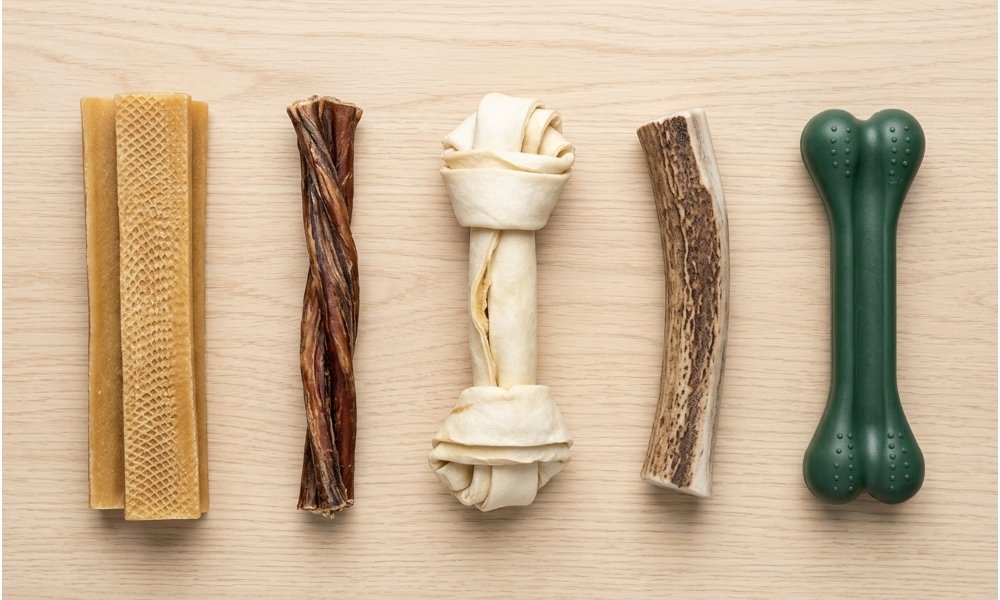
Yak chews sit between bully sticks and antlers on the hardness scale, fully digest unlike rawhide, and rely on four named ingredients rather than rawhide’s chemical processing or synthetic chews’ plastic and rubber compounds. Each alternative carries a distinct allergen, digestibility, and dental-risk profile worth matching to a specific dog’s needs.
The table below summarizes how the five most common chew categories compare across the factors that matter most for an allergy-prone dog.
| Chew Type | Primary Ingredient(s) | Main Allergen Risk | Digestibility | Hardness / Dental Risk |
| Yak chews | Yak milk, cow milk, lime juice, salt | Dairy / casein | Fully digestible; softens with saliva | Extremely hard; high fracture risk for all dogs, including healthy adults |
| Rawhide | Processed cattle hide | Beef: processing chemicals | Poorly digestible; can swell into a dense mass | Soft to chewy; choking risk from large swallowed pieces |
| Bully sticks | Beef muscle (pizzle) | Beef | Fully digestible | Soft to firm; low fracture risk |
| Antlers | Shed deer or elk antler | Minimal protein-allergen risk | Poorly digestible if swallowed in pieces | Very hard; highest fracture risk |
| Synthetic / nylon | Nylon, rubber, or plastic polymers | None from food; additive risk in low-quality versions | Non-digestible | Hard; risk of sheared shards |
No single category wins across every factor. Yak chews offer the best balance of digestibility and duration for dogs without a dairy allergy, while the other categories each trade away one advantage to gain another.
Are Yak Chews Better Than Rawhide for Sensitive Dogs?
Rawhide undergoes chemical processing such as bleaching and preservative treatment, then swells into a dense mass that resists digestion if a dog swallows a large piece. Yak chews use a fixed four-ingredient recipe and break down through saliva and stomach acid, giving sensitive dogs a more predictable allergen profile and a lower blockage risk when sized correctly.
Rawhide sourcing also varies more than yak chew sourcing, since hides can come from mixed or unlabeled origins and pass through several processing facilities before reaching a retail shelf. This variability makes a consistent allergen profile harder to guarantee, a problem the yak chew’s short, traceable ingredient list largely avoids.
How Do Yak Chews Compare With Bully Sticks?
Bully sticks consist of a single beef-based ingredient, making them unsuitable for the 34% of food-allergic dogs that react to beef specifically, while yak chews avoid beef entirely. Yak chews also last considerably longer per session and carry a much milder odor, since bully sticks are a dried meat product with a stronger natural scent.
Bully sticks offer a softer texture in exchange, suiting dogs with weaker jaws, dental sensitivity, or a preference for faster, more immediate chewing satisfaction. A bully stick also tends to be more calorie-dense per minute of chewing, since most dogs consume a 6-inch stick within a single session rather than spreading consumption across days. Weighing yak chews against bully sticks side by side helps match the right chew to a dog’s jaw strength, allergy profile, and chewing pace.
What About Antler Chews and Synthetic Chews?
Antlers are mineral-dense, extremely durable, and carry essentially no food-protein allergen risk, but their hardness raises the risk of tooth fracture above that of a yak chew. Antlers supply calcium, phosphorus, and zinc from bone rather than protein, so they avoid the dairy, beef, and poultry concerns relevant to food-allergic dogs entirely.
Synthetic chews made from nylon or rubber avoid food allergens by design, since they contain no animal or plant protein at all. Lower-quality synthetic chews can contain BPA or phthalates, and any synthetic chew creates a choking hazard if a dog shears off a hard fragment rather than gnawing it down gradually.
Which Type of Chew Is Best for Dogs With Allergies?
The best chew for an allergic dog depends on the dog’s specific confirmed trigger rather than a single universal answer. A dog with a beef allergy does well on a yak chew, an antler, or a synthetic chew, while a dog with a dairy allergy does well on a bully stick, an antler, or a synthetic chew.
| If the Dog’s Confirmed Allergen Is… | Suitable Chew Options |
| Beef | Yak chews, antlers, synthetic chews |
| Dairy | Bully sticks, antlers, synthetic chews |
| Chicken | Yak chews, bully sticks, antlers, synthetic chews |
| Wheat/gluten | Yak chews, bully sticks, antlers, synthetic chews |
Every option on this list still requires a full label check against the dog’s specific diagnosis, since formulations and added flavorings vary by brand even within a single chew category.
How Can You Safely Introduce Yak Chews to Your Dog?
Introducing a yak chew safely starts with a short supervised session, the correct size for the dog’s weight, and close attention to chewing behavior and any digestive or skin changes over the following 24 to 48 hours. Each step reduces a distinct risk, from allergic reaction to choking to dental injury.
How Should You Offer a Yak Chew for the First Time?
A first yak chew session works best, limited to 10 to 15 minutes in a calm, supervised setting with fresh water nearby. This shorter window lets a dog’s digestive system register the new ingredient without immediately committing to hours of continuous chewing.
Extending the duration gradually over the following days, while keeping to roughly one chew per day, allows a dog to adjust without overwhelming its digestion or jaw muscles. A calm environment also reduces the gulping behavior that excitement or competition with another dog can trigger during a first encounter with an unfamiliar chew.
How Should You Supervise Your Dog While Chewing?
Active supervision means staying in the room, watching for large pieces breaking off, and intervening before the dog swallows anything bigger than a bite-sized fragment. A chew left with an unsupervised dog, including one left in a crate, removes the ability to intervene if a problem develops.
Checking the chew periodically for sharp edges, monitoring for changes in chewing pattern, and removing the chew the moment it becomes small enough to swallow whole prevents the majority of chew-related emergencies. The Veterinary Oral Health Council and the American Veterinary Medical Association both recommend this level of supervision for any chew or chew toy, not yak chews specifically.
How Should You Store Yak Chews?
Properly stored yak chews keep for roughly 12 to 18 months or longer in an airtight container kept cool and dry, away from direct moisture. Exposure to humidity softens the chew and creates conditions for mold growth, shortening its usable life well below that range.
Refrigeration extends freshness without harming the chew, but freezing changes its texture and is not recommended. A fresh chew stays firm and slightly hard with a mild, naturally cheesy aroma, while a spoiled chew develops a sour smell, visible mold, unusual discoloration, or a texture that turns unexpectedly soft, sticky, or crumbly.
What Should You Do With Small Leftover Pieces?
The full process for puffing yak chews in the microwave is simple: soak the leftover piece in water for about five minutes, then microwave it for 30 to 90 seconds until it expands into a crunchy, fully edible puff. Trapped moisture inside the dense cheese converts to steam under heat, expanding the structure the same way heat expands a kernel of popcorn.
The resulting puff offers a softer texture suited to puppies, senior dogs, or picky eaters, and it puts the entire chew to use rather than discarding the final piece. Cooling the puff completely before serving avoids a burn risk, and the same supervision rules that apply to the original hard chew still apply to the puffed version.
How Can You Identify High-Quality Yak Chews?
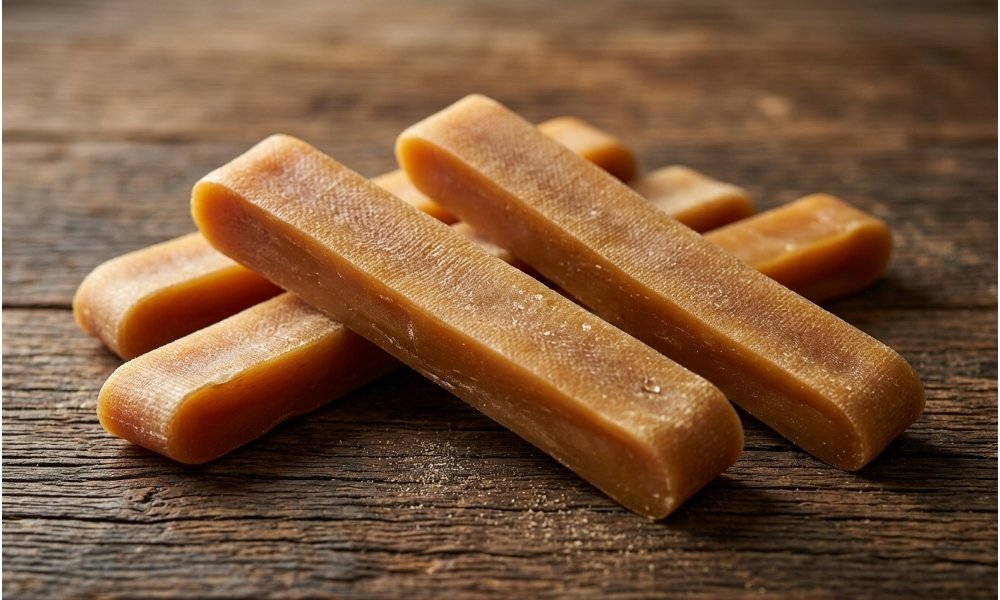
A high-quality yak chew lists three or four named ingredients with no binding agents, shows consistent density and color throughout the bar, and comes from a manufacturer that documents its sourcing, drying process, and facility certifications. Each of these markers points to a traditionally produced chew rather than a faster, lower-cost imitation.
What Ingredients Should You Look For?
A high-quality yak chew label lists only yak milk, cow milk, lime juice, and salt. A formula limited to these four ingredients indicates a traditionally cured chew rather than one padded with filler to compensate for a lower milk content.
| Look For | Avoid |
| Yak milk | Tapioca starch, rice flour, or potato starch |
| Cow milk | Separately listed “smoke flavor” or artificial flavoring |
| Lime juice | Added sugar |
| Salt | Artificial colors or dyes |
Binding agents such as starches signal a diluted formula, since an authentic chew needs no additional binder to hold its shape once properly pressed and dried.
Why Does Manufacturing Quality Matter?
Raw milk carries inherent risks from bacteria such as Salmonella, Listeria, and Staphylococcus, which proper manufacturing addresses through Hazard Analysis and Critical Control Points (HACCP) protocols and documented pathogen-reduction steps. A facility without these controls in place introduces a food-safety risk that has nothing to do with allergens but matters just as much for a dog’s health.
Drying method affects safety as much as texture. Slow, low-temperature drying produces even density from one end of a bar to the other, while fast industrial dehydration can leave a hard crust over a soft, unpredictable core, a structural flaw that creates unpredictable fracture behavior during chewing.
How Can You Tell if a Yak Chew Is Authentic?
An authentic yak chew shows even color and density from end to end, resists indentation under a thumbnail, and carries a mild, naturally cheesy smell rather than an artificial or chemical odor. This combination of texture, hardness, and scent is difficult to fake with shortcut manufacturing methods.
Moisture content below roughly 10% to 15% indicates a properly dried, traditionally cured block, while a chew that feels noticeably softer at its center than at its surface suggests accelerated drying that left internal moisture trapped. Weight also matters: a genuine chew feels dense and solid rather than light, hollow, or crumbly when handled.
What Certifications or Quality Standards Should You Consider?
Meaningful quality standards for yak chews include Hazard Analysis and Critical Control Points (HACCP) certification, Good Manufacturing Practices (GMP) compliance, and ISO 9001 certification. Note that while FDA facility registration is legally required to sell in the US under FDA’s Food Safety Modernization Act rules for animal food, which also mandate Current Good Manufacturing Practice controls, it is a mandatory administrative step rather than a seal of quality or safety. These standards address food-safety controls during production rather than the allergen content of the finished chew, which depends on the ingredient list itself.
A label claim alone does not confirm a certification’s validity. Requesting specific certificate numbers and the issuing body’s name directly from a manufacturer, rather than relying on packaging claims, confirms whether a stated certification is current and verifiable.
How Should You Choose Yak Chews for Dogs With Allergy Concerns?
Choosing a yak chew for an allergy-prone dog comes down to matching the dog’s confirmed allergen against the chew’s four-ingredient label, sizing it correctly, and sourcing it from a manufacturer that documents its ingredients and production process clearly. These three checks apply regardless of which brand ultimately supplies the chew.
Can YforYak Dog Chews Help Dogs Needing Limited-Ingredient Chews?
YforYak manufactures Himalayan yak cheese dog chews in Kathmandu, Nepal, using the traditional process of curdling yak and cow milk with lime juice, pressing the curd, and slow-drying it into a hardened bar. The company’s stated recipe contains the same three or four ingredients described throughout this guide, with no added binding agents or fillers.
YforYak’s product range extends beyond the standard chew bar to puffed chew bars, nuggets, puffed nuggets, and a dehydrated yak cheese powder marketed as a meal topper, giving owners softer formats suited to puppies, seniors, or picky eaters alongside the original hard chew. The company states that its facilities operate under FDA, HACCP, and GMP standards; buyers confirm the current status of any specific certification by requesting documentation directly from the manufacturer. As with any yak chew, YforYak’s products remain dairy-based, so they fit dogs avoiding beef, chicken, wheat, soy, or egg rather than dogs with a confirmed dairy allergy.
What Are the Key Takeaways About Whether Yak Chews Are Hypoallergenic for Dogs?
Yak chews are not allergen-free, but their three- or four-ingredient recipe makes them one of the more limited-ingredient chews available, avoiding beef, chicken, wheat, soy, and egg while remaining a dairy-based product. That single distinction determines whether a yak chew fits a specific dog’s allergy profile.
The findings throughout this guide narrow down to six points:
- Yak chews exclude beef, chicken, wheat, soy, and egg, the proteins behind most diagnosed canine food allergies outside of dairy.
- Yak chews remain a dairy product; dogs with a confirmed dairy or casein allergy require a different chew regardless of the recipe’s simplicity.
- “Hypoallergenic” carries no legal definition for pet products, so the ingredient label matters more than the word itself.
- Correct sizing, active supervision, and prompt removal of small end pieces address the chew’s main physical risks.
- Puppies under roughly 6 months and senior dogs with dental disease do better with puffed or soaked formats than with the original hard bar.
- A veterinary elimination-diet trial remains the only reliable way to confirm a dog’s specific food allergy, rather than relying on a “hypoallergenic” label alone.
A yak chew earns its place in an allergy-conscious household by what it leaves out, not by a marketing claim. Checking the label against a dog’s confirmed allergen remains the deciding factor every time.