
Himalayan yak chews are made from yak milk, usually blended with cow milk, curdled with lime juice, seasoned with a pinch of salt, then pressed and dried for weeks until rock-hard. The ingredient list rarely runs past four items. That simplicity is the entire point: fewer inputs mean fewer places for fillers, preservatives, or mystery additives to hide. This guide breaks down every ingredient, walks through the traditional Himalayan production process, and covers the nutrition and safety profile so you know exactly what you’re handing your dog.
Yak chews go by several names: Himalayan yak chews, yak cheese chews, chhurpi, or simply “yak chew”, and all of them describe the same product: a hardened dairy cheese, developed centuries ago in Nepal, Tibet, and Bhutan as a shelf-stable human food, later adapted into one of the longest-lasting chews available for dogs.
Why Are Himalayan Yak Chews Made From Yak Milk?
Yak milk is used because it is naturally higher in fat, protein, and calcium than cow milk, which produces a denser curd and a harder finished chew. Herding communities across the high Himalayas also had ready access to yaks long before dairy cattle became common at altitude, so yak milk became the base ingredient in the region’s hardest traditional cheese.
What Makes Yak Milk Different From Cow Milk?
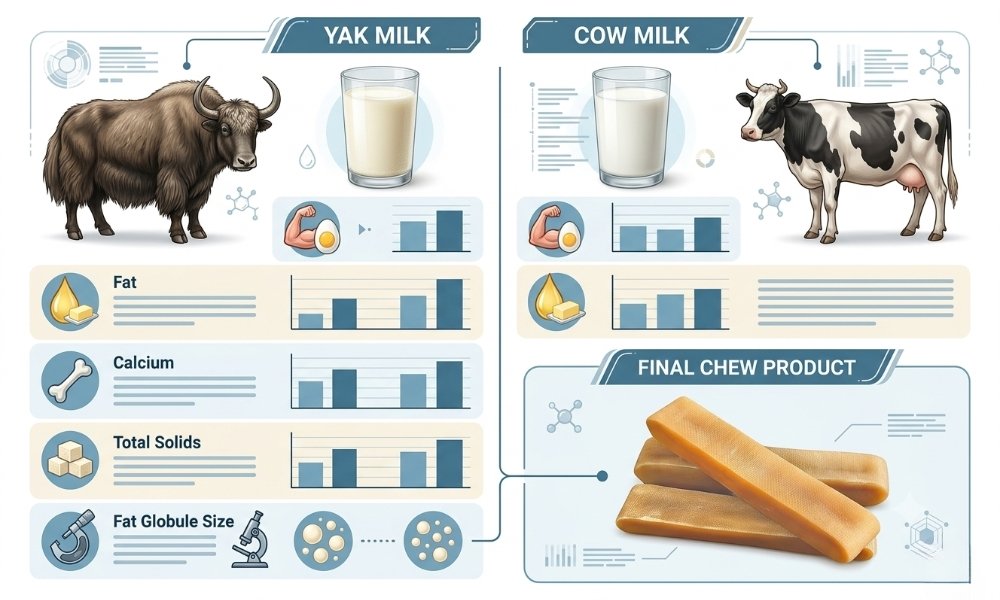
Yak milk is not simply “stronger” cow milk; it has a measurably different composition. According to the FAO Dairy Production and Products: Milk Composition page, yak milk carries 15% to 18% total solids, 5.5% to 9% fat, and 4% to 5.9% protein, figures that sit above typical cow milk and place yak milk closer to buffalo milk in richness.
Three structural differences matter most once that milk goes into cheesemaking:
- Fat globule size: Per a Journal of Dairy Science study on yak milk coagulation, yak milk fat globules average 4.39 μm across, about twice the diameter of Holstein cow milk fat globules, while yak casein micelles carry higher concentrations of calcium and phosphorus (26.0 and 19.9 millimoles per liter, respectively) than bovine micelles (23.0 and 11.9 millimoles per liter).
- Casein micelle minerals: Yak casein micelles carry higher concentrations of calcium and phosphorus, around 26.0 and 19.9 millimoles per liter, respectively, than bovine micelles, which average closer to 23.0 and 11.9 millimoles per liter. More micellar calcium means stronger bonding between protein strands as the curd sets.
- Total solids: Yak milk’s higher solids content leaves less water to press out, so a yak-milk curd starts denser before drying even begins.
| Trait | Yak Milk | Cow Milk |
| Fat content | 5.5%–9% | ~3.5%–4% |
| Protein content | 4.0%–5.9% | ~3.2%–3.5% |
| Total solids | 15%–18% | ~12.4% |
| Fat globule diameter | ~4.4 μm | ~3.9 μm |
Yak milk figures reflect average raw milk composition reported by international sources; cow milk values are typical ranges that vary by breed, season, and region.
These aren’t cosmetic differences. They explain why a yak-milk chew holds its shape through an hour of chewing while a cow-milk-only version tends to soften and crumble faster.
Why Is Yak Milk Used for Dog Chews?
Yak milk is used for dog chews because it survives the long drying process intact and produces a bar dense enough to last through repeated chewing sessions rather than a single sitting. A lower-solid milk source dries into something closer to a brittle, crumbly wafer than a dense stick.
Yaks (Bos grunniens) are domesticated at elevations above 3,000 meters across Nepal, Tibet, and parts of Bhutan, regions where traditional hard chhurpi recipes have long been developed. A 2023 Journal of Ethnic Foods article by researchers at Banaras Hindu University describes chhurpi as the hardest cheese known in the world, made by coagulating milk from yaks, cow-yak hybrids (chauris), cows, and buffaloes. In real-world production, most commercial yak chews blend yak milk with cow milk rather than relying on yak milk alone, largely because pure yak milk supply is seasonal and limited, yaks breed and lactate on a seasonal cycle at altitude, unlike dairy cattle, which produce milk year-round at lower elevations.
Demand for this format has scaled quickly. According to NepalConnect’s reporting on Department of Customs data, chhurpi exports reached 2,265 tonnes worth NPR 3.99 billion in the first 11 months of fiscal year 2024/25, with the United States absorbing the large majority of that volume. Dog-chew exports now sit close to tea in total export value, making yak-chew chhurpi one of Nepal’s fastest-growing agricultural export categories, a shift that traces directly back to yak milk’s density holding up to the longer, unsupervised chewing sessions common in Western households.
What Ingredients Are in Himalayan Yak Chews?
A traditional Himalayan yak chew contains three to four ingredients: yak milk, cow milk in most blended recipes, lime juice, and salt. Nothing else is required to turn liquid milk into a chew that sits on a shelf for months without refrigeration. If a bag lists anything beyond yak milk, cow milk, lime juice, and salt, such as added flavoring, coloring, or a named preservative, it is a flavored variant rather than the traditional recipe.
Is Cow Milk Also Included?
Yes, most Himalayan yak chews include cow milk alongside yak milk. Producers blend the two for consistency and cost, since pure yak milk supply is seasonal and tied to high-altitude herds. Cow milk contributes its own protein and calcium; it simply doesn’t replicate yak milk’s larger fat globules or higher mineral density on its own. Chews labeled “100% yak milk” typically cost more and tend to come from smaller-batch producers, while yak-cow blends remain the market standard. Neither version is inferior on safety grounds; the blend ratio mainly affects hardness and how long a chew lasts per session.
Is Lime Juice Used in Production?
Yes, lime juice is the coagulating agent that separates milk into curds and whey. When the citric acid in lime juice meets hot milk, it disrupts the casein proteins holding the milk together, causing them to clump into solid curds while the liquid whey drains away. It’s the same basic chemistry behind paneer and ricotta, applied at a tougher, longer-dried scale. Some producers substitute vinegar, but lime juice remains the traditional acid in Himalayan chhurpi-making and leaves only a faint tang in the finished bar. Only a small amount of lime juice is used, typically well under 1% of the total weight, so it functions primarily as a processing aid rather than a flavoring ingredient.
Is Salt Added to Yak Chews?
Yes, a small amount of salt goes in during curdling. Salt does two jobs here: it draws additional moisture out of the curd through osmosis, and it lowers water activity enough to discourage bacterial growth through the weeks-long drying process that follows. It’s the same principle used in curing meats and aging hard cheeses. Reputable producers add salt in trace amounts relative to the volume of milk, not as a flavor additive, so a finished chew isn’t a meaningful sodium source in a dog’s diet when given as an occasional chew rather than a daily staple.
How Are Himalayan Yak Chews Made?
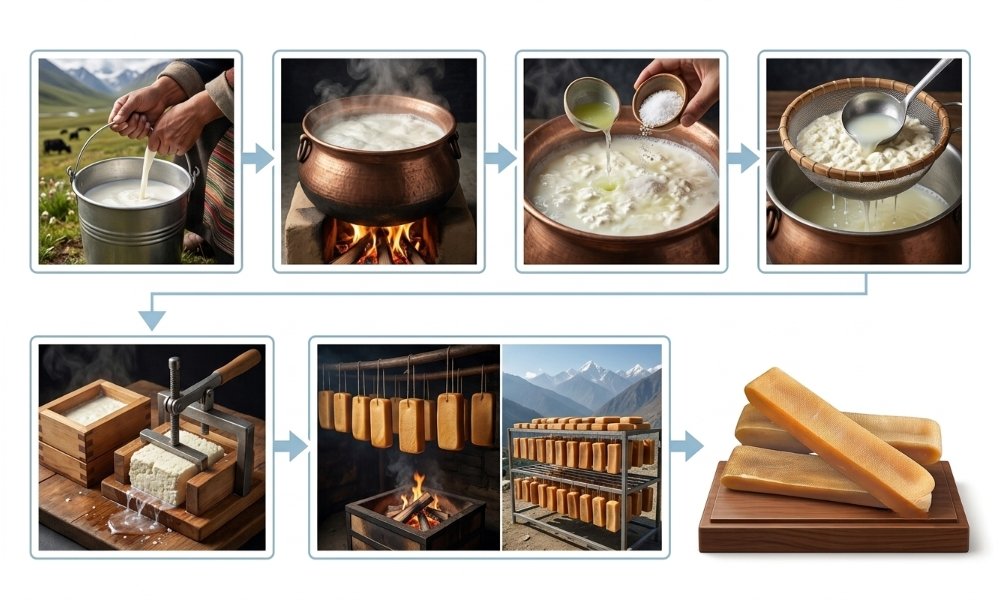
Himalayan yak chews are made by boiling milk, curdling it with lime juice and salt, pressing the curds into blocks, and drying them for weeks until hard. The process has changed little since it was developed by Himalayan herding communities generations ago; commercial producers, including YforYak, an FDA-registered Himalayan yak chew manufacturer based in Kathmandu, have scaled up the equipment but kept the core sequence intact.
How Is the Cheese Prepared?
Preparation starts with raw yak and cow milk collected from herds and brought to a processing point, since most high-altitude farms have no on-site refrigeration. The milk is brought to a rolling boil, which pasteurizes it, before lime juice and salt are stirred in. Curds begin forming within minutes as the proteins coagulate around the acid and the added minerals. Workers gather the curds by hand, drain the whey through cloth, and press the remaining solids into dense blocks or sticks, often using nothing more than a weighted board rather than industrial equipment, since chhurpi production still leans heavily on manual labor. A single dense chew consumes far more raw milk by weight than the finished piece, since most of the liquid volume leaves as whey during pressing and continues evaporating throughout drying.
Because so much of this work is still done by hand across small dairy cooperatives in eastern hill districts like Ilam and Panchthar, minor batch-to-batch variation in shape, color, and thickness is normal. It reflects a handmade process, not a quality defect.
How Are Yak Chews Dried and Hardened?
Pressed blocks are cut into stick-sized pieces, then dried using a combination of wood smoke and open mountain air. This process commonly runs from several weeks up to three or four months, depending on batch size, humidity, and the hardness grade a producer is targeting. Smoking removes moisture faster than air-drying alone and adds the faint smoky note that distinguishes traditional chhurpi from a plain dried cheese. Producers check pieces for consistent hardness throughout, since uneven drying leaves a hard shell around a softer core, a defect that only becomes obvious once a dog has chewed partway through the bar.
Why Does the Drying Process Matter?
Drying matters because moisture content directly determines shelf life, digestibility, and how long a chew lasts under a dog’s teeth. Well-dried chhurpi typically finishes under 14% moisture; Nepal’s Department of Food Technology and Quality Control has proposed this as a mandatory limit in its draft chhurpi quality standard, which also requires at least 60% crude milk protein on a dry-weight basis for high-fat chhurpi. That low a moisture level leaves bacteria and mold with little water to grow in, which is what lets a finished chew sit at room temperature for months without refrigeration or added preservatives. Under-dried chews soften faster, spoil sooner, and wear down in a fraction of the time. This is also why rushed, high-heat drying is a shortcut rather than an improvement: it can crust the outside of a bar while the interior stays underdried, producing something that looks finished before it actually is.
Are Himalayan Yak Chews Natural?
Yes, authentic Himalayan yak chews are preserved through low moisture content rather than through added chemical preservatives. Salt and lime juice work as processing aids during production, not as ongoing preservatives. Once drying finishes, the chew’s low water content does the preservation work on its own.
Do They Contain Artificial Additives?
No, a traditional yak chew contains no artificial colors, flavors, or texturizers. The finished bar’s tan-to-golden color develops naturally during smoking and drying, not from added dye. Flavored variants do exist on the market: chicken, peanut butter, or blueberry coatings, for example, but these are coatings applied to the base chew rather than part of the traditional recipe itself. If you want the closest thing to a single-ingredient dog chew, the plain, unflavored bar is it.
Are They Free From Preservatives?
Yes, properly dried yak chews don’t need chemical preservatives like BHA, BHT, or sodium benzoate, because their moisture content is already too low to support the microbial growth those preservatives are designed to prevent. It’s the same principle that keeps beef jerky, aged hard cheeses, and dried fruit shelf-stable without chemical additives. Stored in a cool, dry container, a properly dried chew commonly stays fresh well past its best-by date, often 12 to 18 months, sometimes longer, which is really a direct reflection of how thoroughly the moisture was removed during production rather than anything added afterward. What most people overlook is that this same low moisture is what makes the chew hard enough to raise the chewing-strength considerations covered next; the property that removes the need for preservatives is also what makes sizing and supervision genuinely important.
Are Himalayan Yak Chews Safe for Dogs?

Yak chews are safe for most adult dogs with healthy teeth when sized correctly and supervised, though their hardness makes them unsuitable for some dogs and chewing styles. Unlike rawhide, they’re fully digestible rather than swallowed in stretchy, partially dissolved strips, which removes one common source of digestive blockages. Hardness, not digestibility, is the main variable to manage.
Which Dogs Benefit Most?
Adult dogs with strong, healthy teeth and a moderate chewing style benefit most, since they get a long chewing session without the constant refilling that softer treats require. Dogs coming off rawhide sensitivity or grain allergies often do well too, given the short, dairy-based ingredient list. Dogs with mild separation anxiety or a high chew drive also tend to benefit, since a long, repetitive gnawing session has a genuinely calming effect for many dogs, alongside the dental upside. Puppies can generally start once their adult teeth are in, around six months old, using a size scaled down to their jaw. Senior dogs with otherwise healthy teeth can do well too, since steady gnawing gives an aging jaw gentle, low-impact activity; a dog with diagnosed periodontal disease needs a veterinarian’s clearance first. One caveat worth knowing: the curing process reduces lactose, but it does not remove milk proteins like casein and whey. A dog with a diagnosed dairy protein allergy, as opposed to simple lactose intolerance, is not a safe candidate for yak chews, since lactose-free is not the same as allergy-safe. YforYak’s hypoallergenic yak chew guide breaks that distinction down in more depth. Extremely aggressive power-chewers and dogs with existing dental disease, worn enamel, or a history of tooth fractures are the dogs least suited to a hard chew of any kind, yak-based or otherwise, and are better served by a softer option or a puffed, air-expanded format instead of the dense original bar. Our full picks for best yak chews for aggressive chewers cover sizing and hardness grades for exactly this group.
What Safety Tips Should Owners Follow?
A few consistent practices keep chewing sessions safe:
- Match size to body weight: Undersized chews are far more likely to be swallowed whole than oversized ones.
- Supervise every session, especially the first few, to see how your dog handles the texture.
- Remove the chew once it’s small enough to fit fully in your dog’s mouth, since that’s the point where choking risk rises sharply.
- Try a simple fingernail test before handing over a new bar. Per AAHA’s chew-safety guidance, if you can’t press a thumbnail into the surface enough to leave an indentation, the chew is hard enough to potentially fracture teeth.
- Puff the leftover nub in the microwave for 30 to 60 seconds instead of discarding it or letting your dog finish it whole; this expands the piece into a light, fully soft treat. YforYak’s guide on how to puff yak chews in the microwave breaks down timing ranges and tips for different chew sizes.
- Keep fresh water nearby, since dense chewing sessions go better with hydration available.
How Nutritious Are Himalayan Yak Chews?
Himalayan yak chews are a high-protein, low-fat, low-carbohydrate treat, typically carrying 50% to 66% crude protein and under 5% fat on a dry-matter basis. That protein density is a direct result of the drying process: removing water concentrates everything else that was already present in the milk.
Are They High in Protein?
Yes, yak chews rank among the most protein-dense treats available for dogs. YforYak’s own guaranteed analysis for its chew products, for example, lists a minimum of 66% crude protein alongside a maximum of 1% crude fat. Nepal’s Ministry of Agriculture and Livestock Development has issued a national standard requiring at least 60% crude milk protein on a dry-weight basis, with chhurpi classified as high-fat (≥5% milk fat) or low-fat (<5% milk fat), reflecting how central these figures are to product quality across the category. For comparison, a typical dry dog kibble runs closer to 20% to 30% protein, so a yak chew delivers more protein per gram meaningfully, though it remains a chew and enrichment tool rather than a meal replacement. Calorie density follows the same concentration effect: a 100-gram serving commonly runs around 385 calories, which is why long-lasting chews work best as an occasional enrichment item worked into your dog’s daily calorie count, not an unlimited free-fed snack. Our guide on whether yak chews are fattening for dogs walks through portioning by weight and activity level.
Do They Support Dental Health?
Yak chews support dental health mechanically, through the physical scrubbing action of chewing against the tooth surface, the same mechanism behind most natural dental chews. Plaque is a soft bacterial film that forms within hours of eating and can be disrupted by that mechanical action; per Cornell University College of Veterinary Medicine, tartar can begin forming as plaque mineralizes in as little as 24 hours, and once mineralized, it can only be removed through a veterinary dental cleaning. That distinction matters: a yak chew can help slow new plaque from building up, but it won’t remove tartar that has already hardened onto a tooth. Yak chews aren’t formulated or clinically trialed for the Veterinary Oral Health Council (VOHC) seal, which under VOHC’s published trial protocols requires two independent trials each showing at least a 15% reduction in plaque or tartar, a separate step outside the traditional chhurpi recipe. They’re best understood as a supportive chewing activity alongside brushing, not a replacement for either brushing or professional cleanings. A fuller rundown of the dental benefits of yak chews covers plaque, tartar, and gum health in more depth.
How Do You Choose Quality Himalayan Yak Chews?
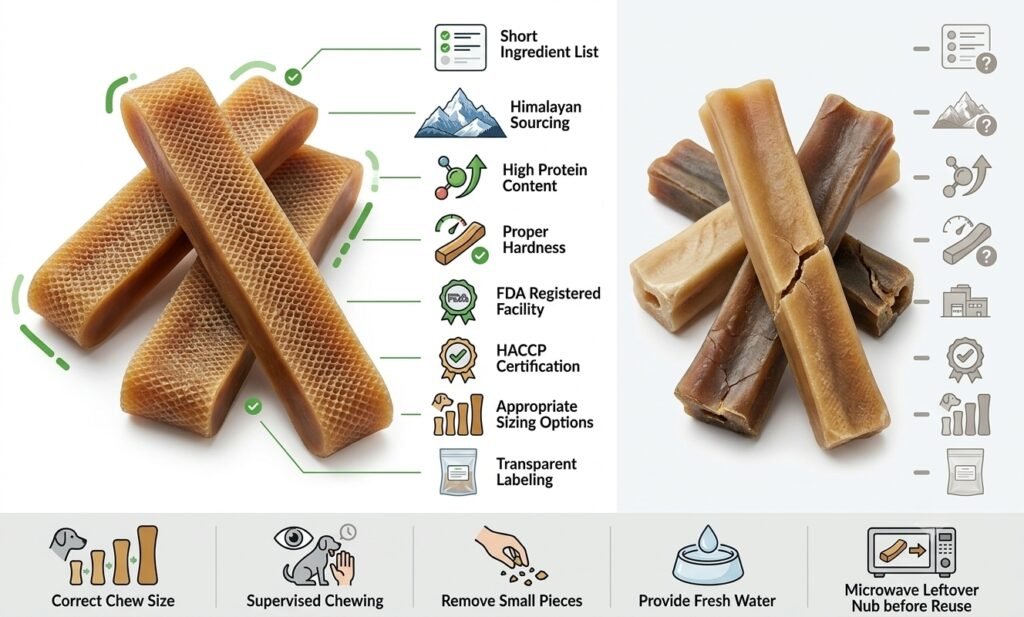
A quality Himalayan yak chew has a short ingredient list of three to four items, consistent hardness from end to end, and traceable sourcing from the Himalayan region. Beyond that, protein percentage, moisture content, and country of origin are the details worth checking on the label before you buy.
What Should You Look for Before Buying?
Before buying, check for the following:
- A short ingredient list: yak milk, cow milk, lime juice, and salt, nothing more.
- A guaranteed analysis with real numbers: Look for crude protein above 50% and crude fat under 5%; marketing copy without a guaranteed analysis panel is a yellow flag.
- Consistent density: A chew that’s rock-hard on the ends but soft in the middle was likely dried too quickly at high heat.
- Origin transparency: Nepal remains the traditional and most established source; a producer who can name the region and describe the process is generally more trustworthy than one who can’t.
- Facility standards: such as FDA-registered, HACCP, or GMP-certified production, indicate that the product passes formal food-safety checkpoints on top of the traditional recipe.
- Sizing options that match your dog’s weight: not a single one-size-fits-all bar.
Origin also affects price. Milk in Nepal costs more to produce than milk from some neighboring countries, so authentic, traditionally sourced Nepali chhurpi tends to sell at a premium over lower-cost regional alternatives. That premium reflects real input costs and a slower production timeline, not just a marketing story. For the full cost breakdown, see why yak chews are expensive compared with rawhide and other long-lasting chews.
How Can YforYak Dog Chew Help?
YforYak manufactures Himalayan yak chews in Tokha, Kathmandu, Nepal, sourcing yak and cow milk directly from herding communities and processing it through the traditional curdle‑press‑dry method in an FDA‑registered facility that operates under HACCP and ISO‑certified quality systems. The company was founded by Dhurba Raj Regmi, who brings more than a decade of experience in Nepal’s agribusiness and export sector, with a stated goal of building sustainable income for the farmer groups behind the supply chain.
Every YforYak chew keeps to the traditional three-to-four ingredient recipe: yak milk, cow milk, lime juice, and salt, with no shortcuts on drying time and no artificial additives.
What Are the Key Takeaways About Himalayan Yak Chews?
Himalayan yak chews are made from yak milk, usually blended with cow milk, curdled with lime juice, seasoned with salt, and dried for weeks to months until hard. Five points are worth remembering:
- The ingredient list stays short: Yak milk, cow milk, lime juice, and salt cover the traditional recipe; nothing artificial is required.
- Yak milk’s density is what makes the chew hard: Higher fat, protein, and mineral content than cow milk, plus larger fat globules, produce a firmer curd from the start.
- Low moisture does the preservation work: Chews finishing under 14% moisture don’t need chemical preservatives to stay shelf-stable for months.
- Nutrition runs protein-heavy and fat-light: commonly 50% to 66% crude protein with under 5% fat, well above what a typical kibble delivers per gram.
- Safety comes down to sizing and supervision, not the ingredients themselves: Match the chew to your dog’s weight and chewing style, watch the first few sessions, and retire the piece once it’s small enough to swallow.
If you’re weighing a yak chew against other long-lasting options, ingredient simplicity and digestibility are the two traits that consistently set the category apart from rawhide and synthetic alternatives. Choosing a well-sourced, properly dried chew and matching it to your own dog’s size and chewing habits is what turns that raw nutritional profile into a genuinely safe, long-lasting treat. Dogs that settle into a long, structured gnawing session behave very differently from dogs that gulp and swallow, so watching how your own dog handles the first session, or two, tells you more than any package label can.