

Himalayan dog chews are hard, protein-rich yak milk chews designed to provide long-lasting chewing activity, dental support, and safer enrichment compared to rawhide and many heavily processed dog chews. Traditional Himalayan yak chews originate from Nepal and surrounding Himalayan regions, where yak and cow milk are naturally cured, pressed, and dried into dense cheese blocks with very low moisture content. Their durability, simple ingredient profile, and digestibility have made them one of the most popular natural dog chews for aggressive chewers, puppies, senior dogs, and dogs that need extended mental stimulation without artificial additives or chemical preservatives.
Choosing the best Himalayan dog chew depends on far more than brand name alone. Ingredient quality, yak milk concentration, hardness level, chew density, dog size, chewing intensity, dental condition, and safety practices all directly affect how long the chew lasts and how safe it is for your dog. Low-quality Himalayan chews often contain inferior milk blends, inconsistent drying methods, or weak structural density that reduces durability and increases breakage risk. This guide explains how Himalayan dog chews are made, how to identify authentic high-quality yak chews, which options work best for aggressive chewers, puppies, and senior dogs, how they compare to bully sticks and rawhide, and what safety precautions help prevent choking, digestive issues, and dental injuries.
What Makes the Best Himalayan Yak Chews for Dogs?
Not all Himalayan yak chews offer the same quality. A good Himalayan yak chew for dogs usually has a short ingredient list, clear sourcing information, and the right size for your dog’s chewing strength. Before choosing a chew, look for ingredient transparency, safety guidance, and a brand that explains how the product is made.
- Simple ingredient list: Look for a short ingredient list, usually milk, lime juice, and salt, with no artificial colors, flavors, preservatives, or fillers.
- Clear sourcing: Choose chews from brands that clearly disclose where the product is made and how the milk is sourced.
- Proper size for your dog: Match the chew to your dog’s mouth size, weight, and chewing strength to reduce swallowing risk and improve safety.
- Slow natural drying: High-quality yak chews are typically dried and processed until they become firm and long-lasting, but exact drying times vary by producer.
- Transparency: Choose brands that clearly list ingredients, explain sourcing, and provide safety guidance for size, supervision, and chew use.
Using these criteria can help you choose a Himalayan yak chew that may last longer and fit your dog better, but supervision is still important because hard chews can cause tooth fractures or choking hazards.
What Are Himalayan Dog Chews Made From?

Himalayan dog chews are made from 4 primary ingredients: yak milk, cow milk (in some blends), salt, and lime juice. No artificial preservatives, binding agents, or synthetic flavorings enter the production process. The simplicity of the ingredient list is one of the clearest quality signals a buyer can check.
The traditional recipe originates in the Himalayan regions of Nepal, Bhutan, and Tibet, where local communities have produced similar hard cheese products for centuries. Herders discovered that compressing and drying yak milk under high pressure created a hard, portable food that stayed shelf-stable without refrigeration.
How Is Yak Milk Used in Himalayan Dog Chews?
Yak milk is the primary structural and nutritional component of a Himalayan dog chew. Peer-reviewed research published in Nutrients (2023) documents its fat content at 5.6-7.5%, significantly higher than standard bovine milk at approximately 3.5%, and its protein content at 4.9-5.9%, versus 3.14% in cow milk. These elevated fat and casein concentrations contribute directly to the dense, compact texture that gives the chew its characteristic hardness and durability after compression and extended drying.
The production process involves 3 key stages:
- Boiling: Yak milk is heated and combined with lime juice, which acts as a natural coagulant, separating curds from whey.
- Pressing: The curd mass is compacted under weighted pressure for several days to remove moisture and form a solid block.
- Drying: The block is sun-dried or smoked for 28 to 35 days, reducing moisture content to below 15% and creating the rock-hard texture buyers recognize.
What most buyers overlook: the ratio of yak milk to cow milk varies by brand. Products with a higher yak milk percentage tend to produce a firmer, longer-lasting chew. Always check whether the label lists yak milk as the first ingredient.
Why Are Himalayan Dog Chews Considered Long-Lasting?
Himalayan dog chews last longer than most chews because of their extremely low moisture content and high-density compressed structure. The drying process removes the majority of water from the milk curd block, leaving behind a hard matrix that dogs must work through slowly.
A standard medium-sized chew typically lasts a moderate chewer between 1 and 3 weeks. Aggressive chewers work through the same chew in 3 to 7 days. No other natural chew category, including bully sticks, tendons, or ears, matches this durability range consistently.
The hardness also means dogs cannot bite off large chunks easily. They scrape and soften the surface through repeated licking and gnawing, which keeps the chewing session controlled and extended.
Are Himalayan Dog Chews Safe for Most Dogs?
Himalayan dog chews are safe for most adult dogs when matched correctly to the dog’s size and chewing strength. The 4-ingredient formulation contains no rawhide, no bleaching agents, no artificial preservatives, and no by-product fillers, making it one of the cleaner options on the commercial chew market.
Common mistakes that create safety issues include selecting the wrong size, leaving a dog unsupervised, and allowing a dog to access the final small piece without converting it into a soft puff snack. Properly managed, the injury risk is low compared to antlers, bones, and nylon chews.
Dogs with dairy sensitivity represent the primary exception. Himalayan chews are a processed dairy product. Dogs with diagnosed lactose intolerance or a known milk protein allergy react to these chews with digestive upset, including loose stool, gas, and vomiting. Introduce any new chew in a short supervised session first.
What Should You Look for When Buying Himalayan Dog Chews?
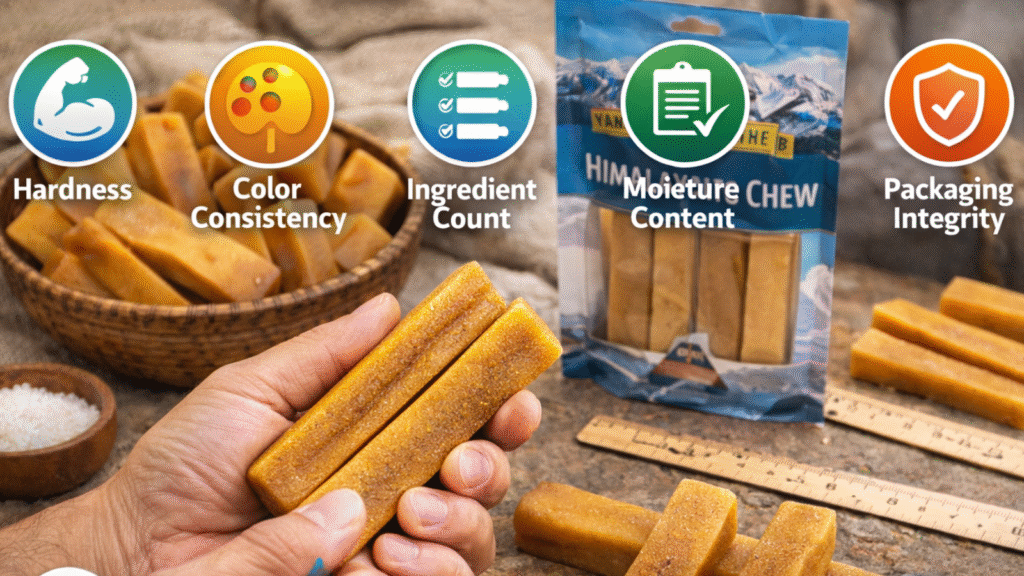
When buying Himalayan dog chews, evaluate 4 core factors: ingredient transparency, appropriate sizing, hardness rating, and brand sourcing credentials. A chew that fails on even one of these dimensions delivers either a shorter-lasting product, a safety risk, or nutritional disappointment.
How Can You Check Ingredient Quality?
Check ingredient quality by reading the full ingredient declaration on the packaging, not just the marketing language on the front label. A genuine, high-quality Himalayan dog chew lists only these ingredients: yak milk, cow milk (optional), salt, and lime juice.
3 red flags that indicate a lower-quality product:
- Added preservatives, such as sodium benzoate or potassium sorbate, are unnecessary in a properly dried chew
- Artificial flavorings: a sign that the base product lacks palatability on its own
- Vague “natural flavors” listings: these can include a wide range of undisclosed ingredients
Also, verify the country of origin. Authentic Himalayan chews source milk from high-altitude yak herds in Nepal or Bhutan. Products manufactured in other regions using standard cow milk and labeled as “Himalayan style” do not deliver the same density or nutritional profile.
What Size Himalayan Dog Chew Fits Your Dog Best?
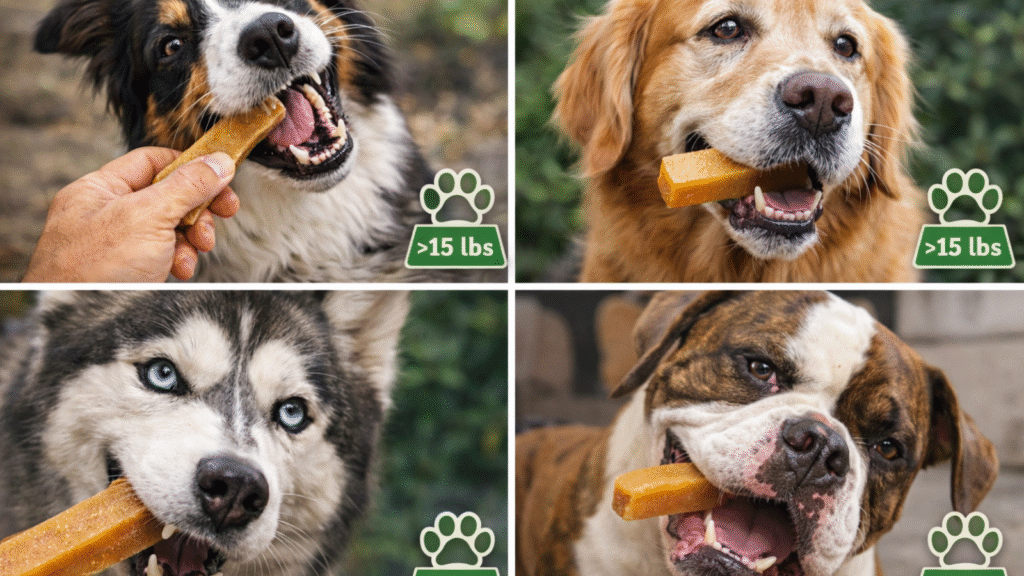
The correct size Himalayan dog chew matches your dog’s body weight range and jaw width. A chew that fits correctly sits comfortably between the dog’s front paws during chewing, cannot be swallowed whole, and requires genuine effort to work down.
The 5 standard size categories and their corresponding weight ranges:
| Size | Dog Weight Range | Example Breeds |
| XS | Under 15 lbs | Chihuahua, Yorkshire Terrier |
| S | 15–35 lbs | Beagle, French Bulldog |
| M | 35–65 lbs | Border Collie, Labrador |
| L | 65–90 lbs | German Shepherd, Rottweiler |
| XL | 90+ lbs | Great Dane, Saint Bernard |
The most common buying mistake is undersizing for the dog’s actual chewing force. A 40-pound dog with aggressive chewing behavior performs better with a large chew than a medium one. Factor in chewing intensity, not just body weight.
Which Hardness Level Is Right for Your Dog?
The correct hardness level matches your dog’s dental health and chewing style. Standard Himalayan dog chews register as very hard, comparable to a dried antler tip. This level suits adult dogs with healthy teeth and active chewing habits.
Dogs with worn teeth, dental disease, cracked molars, or post-surgical jaw recovery need a softer option. Some brands produce softer yak chew variants by reducing the drying duration or increasing the cow milk ratio. These softer versions still outlast most bully sticks but give more easily under jaw pressure.
The “thumbnail test” provides a practical field check: press your thumbnail firmly against the chew surface. A safe hardness allows a faint impression mark. A chew that leaves zero marks is too hard for dogs with compromised dental health.
How Can You Spot Low-Quality Himalayan Dog Chews?
Low-quality Himalayan dog chews display 5 recognizable characteristics: a lighter coloration than genuine chews, a hollow or porous cross-section, a noticeably shorter-lasting time, an unusual or sour smell, and a soft texture that yields too quickly under finger pressure.
Genuine chews range in color from pale golden yellow to deep amber, depending on smoking and drying time. Products that appear white or chalk-colored typically indicate incomplete drying, excess salt, or a lower yak milk ratio. Check for a consistent, dense cross-section when the chew breaks; a well-made product shows uniform solid material throughout.
Which Himalayan Dog Chews Are Best for Aggressive Chewers?
The best Himalayan dog chews for aggressive chewers are extra-large, extra-hard variants with a high yak milk concentration and a smoking-dried finish, which produces the densest possible structure. A dedicated wholesale yak chew manufacturer & supplier that sources from high-altitude Himalayan herds and applies drying periods of 35 days or more, delivers the highest durability for power chewers.
What Features Make a Chew More Durable?
A more durable Himalayan dog chew demonstrates 3 structural features: a uniformly dense cross-section with no air pockets, a deep amber or dark golden coloration indicating extended drying, and a surface that feels rough and irregular rather than smooth.
Smooth-surfaced chews have often been machine-polished or lightly processed after drying. This removes the naturally abrasive outer layer that contributes to both durability and dental scraping action. Prioritize chews with a textured, uneven exterior.
How Long Should a Himalayan Dog Chew Last?
A properly sized Himalayan dog chew lasts between 7 and 21 days for a moderate chewer with daily 20-to-30-minute chewing sessions. Aggressive chewers reduce this window to 3 to 7 days. Light chewers or senior dogs with gentle jaw pressure extend a single chew to 4 weeks or beyond.
Tracking duration across 2 or 3 chews gives a useful baseline for your dog’s specific chewing intensity. This baseline helps you buy in the correct volume, typically 2 to 4 chews per month for moderate chewers.
Are Extra-Hard Himalayan Dog Chews Worth Buying?
Extra-hard Himalayan dog chews are worth buying for aggressive-chewing adult dogs with confirmed dental health. They deliver the longest lasting time per dollar and reduce the frequency of replacement. For all other dogs, puppies, seniors, or dogs with dental sensitivity, the standard hardness provides better safety and comfort.
Extra-hard variants carry a higher fracture risk for dogs who apply maximum bite force on a single point rather than chewing evenly. If your dog tends to “death grip” chews rather than gnaw them, monitor the first session closely.
Which Himalayan Dog Chews Are Best for Puppies?
The best yak chews for puppies are small-sized, softer-formula variants specifically labeled for puppies, typically made with a higher cow milk ratio and a shorter drying period. Standard adult Himalayan chews are too hard for puppy teeth and carry a fracture risk to developing dentition.
When Can Puppies Safely Start Himalayan Dog Chews?
Puppies safely start Himalayan dog chews at 16 weeks (4 months) of age, after their milk teeth are fully established and before their adult teeth begin erupting around 5 months. Starting earlier risks damaging developing tooth buds and gum tissue.
Between 5 and 8 months, when adult teeth are actively coming in, softer chews serve the puppy’s teething relief needs more appropriately than hard compressed yak blocks. Return to standard puppy yak chews once the full adult dentition is in place by 7 to 8 months.
What Sizes Work Best for Small Puppies?
Small puppies between 5 and 15 pounds perform best with XS or puppy-specific Himalayan chews measuring 3 to 4 inches in length. The piece must be wide enough that the puppy cannot position it transversely across the back molars and apply full jaw force to snap it.
Width matters as much as length. A chew should sit in front of the molars, not between them. Front-of-mouth gnawing produces the controlled surface scraping that makes these chews both safe and effective for dental hygiene.
How Can You Prevent Choking Risks With Puppies?
Prevent choking risks with puppies by removing any piece that reaches 1.5 inches or shorter in length before the puppy can swallow it whole. Inspect the chew at the start and end of every session. Puppies lose track of size boundaries faster than adult dogs during excited chewing.
The safest approach for puppies: convert the small remaining piece into a puffed microwave snack. Place the small piece on a microwave-safe plate and heat for 45 to 60 seconds until it puffs into a light, airy cheese cracker. This eliminates the choking risk while rewarding the dog with the remaining nutrition.
Which Himalayan Dog Chews Are Best for Senior Dogs?
The best Himalayan dog chews for senior dogs are softer-formula yak chews sized one category smaller than the dog’s body weight suggests, giving older dogs satisfying chew activity without excessive jaw fatigue or dental stress. Senior dogs benefit from chewing engagement but require a gentler hardness profile.
Are Softer Himalayan Dog Chews Better for Older Dogs?
Softer Himalayan dog chews are better for older dogs in most cases, particularly those with worn enamel, missing teeth, root exposure, or jaw arthritis. Senior dogs still derive psychological and physical benefit from chewing, but the rigid structure of a standard extra-hard chew creates fracture risk and discomfort.
Brands that produce a “senior formula” or “soft recipe” yak chew reduce the drying period to 14 to 21 days instead of the standard 28 to 35 days. This shorter drying window preserves more moisture in the final product, reducing surface hardness by approximately 20 to 30% compared to the standard recipe.
How Can Senior Dogs Benefit From Dental Chewing?
Senior dogs benefit from dental chewing through 3 measurable mechanisms: mechanical plaque removal, gingival stimulation, and behavioral stress reduction. The abrasive surface of a yak chew scrapes tartar accumulation from tooth surfaces, reaching areas a toothbrush often misses in an uncooperative dog.
Gingival stimulation from chewing increases blood flow to the gum tissue, which supports periodontal health. Gingival stimulation from chewing increases blood flow to the gum tissue, supporting periodontal health. Research published in Frontiers in Veterinary Science (2020) found that periodontal disease affects 80-89% of dogs over 3 years of age, making daily chewing activity one of the most accessible preventive behaviors available to dog owners between professional cleanings. Working dogs, high-energy breeds, and dogs left alone for 6 or more hours daily benefit most from the extended engagement window that a Himalayan chew provides. Research published in Animals (2022) found that up to 56% of the general dog population display signs of separation-related behaviours at some stage in their lives, with destructive chewing near the site of owner departure among the most common. A controlled clinical study published in the Journal of the American Veterinary Medical Association found that providing a chew toy at the time of departure was among the most effective and owner-compliant interventions for reducing separation distress. A Himalayan chew given before an owner’s departure occupies the dog through the period of highest anxiety, the first 30 to 60 minutes after being left alone.
How Do Himalayan Dog Chews Compare to Other Dog Chews?
Himalayan dog chews compare favorably to most alternatives in 3 key dimensions: ingredient cleanliness, lasting duration, and digestibility. They outperform rawhide on safety, match or exceed bully sticks on duration, and surpass synthetic chews on digestibility.
Are Himalayan Dog Chews Better Than Rawhide?
Himalayan dog chews are safer and nutritionally superior to rawhide across every measurable category. Rawhide undergoes a multi-stage chemical processing sequence that may include sodium sulfide or lime-based hair removal treatments, hydrogen peroxide bleaching for whitening, and artificial flavor coatings, none of which appear in the Himalayan chew production process. The FDA’s formal recall of major rawhide brands in 2017 confirmed that some manufacturing facilities use quaternary ammonium compounds, industrial antimicrobial cleaning chemicals, as unapproved processing aids, resulting in gastric symptoms including diarrhea and vomiting in affected dogs.
Rawhide also softens into a slippery, pliable sheet when wet, creating a documented aspiration and intestinal blockage hazard. Himalayan chews, by contrast, dissolve into small digestible particles as the dog works through them. Rawhide also softens into a slippery, pliable sheet when wet, creating a documented aspiration and intestinal blockage hazard. The FDA’s Animal Health Literacy guidance warns that unchewed rawhide pieces can lodge in a dog’s trachea, a blockage described as life-threatening, and instructs pet owners to seek emergency veterinary care immediately. Separately, the FDA has issued formal recalls of multiple major rawhide brands (including American Beefhide and Healthy Hide) over chemical contamination from unapproved manufacturing processing aids. No equivalent regulatory action exists for properly sized yak chews.
How Do Himalayan Dog Chews Compare to Bully Sticks?
Himalayan dog chews last 3 to 5 times longer than bully sticks for moderate chewers. A bully stick typically lasts 15 to 30 minutes for an engaged chewer. A comparable Himalayan chew for the same dog lasts multiple days.
Bully sticks carry a higher odor profile, particularly when wet, and produce a softer texture that some power chewers consume in a single extended session. Himalayan chews produce minimal odor and maintain their structure throughout repeated chewing sessions. The full side-by-side breakdown of yak chews vs bully sticks covers odor, fat content, caloric density, and duration to help match the right option to your dog’s profile.
Bully sticks contain higher fat content per gram, making them the higher-calorie option. Dogs on caloric restriction perform better with a Himalayan chew as a treat. For dogs needing caloric density, a bully stick serves that need more effectively.
Which Chews Last Longer for Heavy Chewers?
For heavy chewers, the dedicated guide to yak chews for aggressive chewers confirms what this durability ranking shows: extra-large Himalayan chews outlast every other natural chew category, including antlers, bully sticks, pig ears, tendons, and fish skins. Antlers come closest in durability but carry a higher tooth fracture risk due to their uneven hardness and brittleness.
The ranking for durability in heavy chewers:
- Extra-large Himalayan yak chew: 3 to 10 days
- Antler (split): 3 to 7 days, higher fracture risk
- Himalayan standard chew: 2 to 7 days
- Bully stick (thick/braided): 30 to 60 minutes
- Pig ear: 10 to 20 minutes
What Health Benefits Can Himalayan Dog Chews Provide?
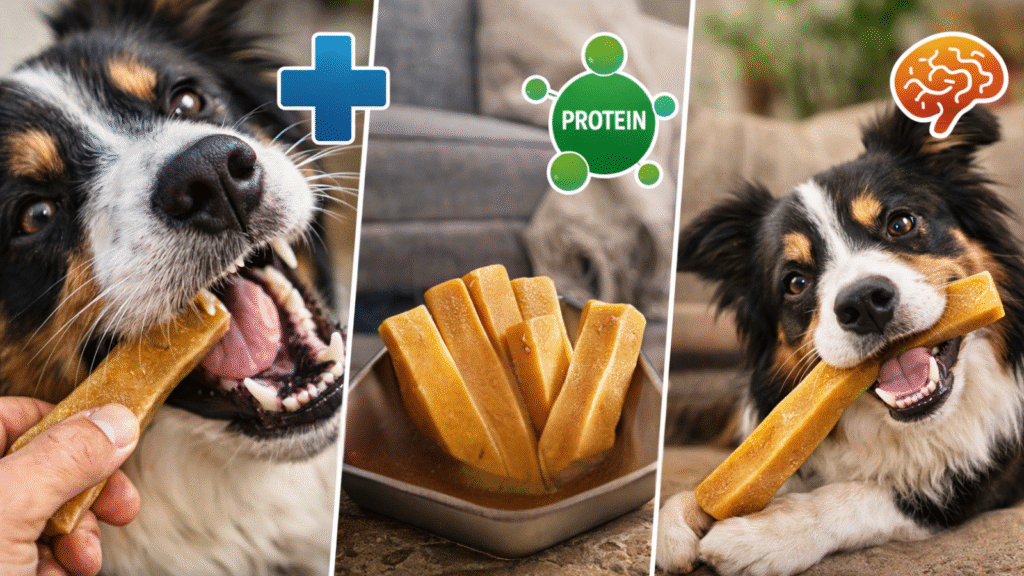
Himalayan dog chews provide 4 documented health benefits: dental plaque reduction, high-quality protein delivery, behavioral enrichment through chewing stimulation, and calorie-controlled treat satisfaction. These benefits emerge from the combination of the chew’s physical structure, nutritional composition, and behavioral engagement mechanism.
Can Himalayan Dog Chews Support Dental Health?
Himalayan dog chews support dental health through active mechanical abrasion of tooth surfaces during chewing. The full list of dental benefits of Himalayan yak chew covers everything from plaque disruption to gingival stimulation. The rough, compressed texture scrapes biofilm and early tartar deposits from the enamel, particularly on the carnassial teeth (upper fourth premolars and lower first molars), where tartar accumulates fastest.
A peer-reviewed study published in the Journal of Veterinary Dentistry (Quest, 2013) found that dogs receiving one dental chew daily showed statistically significant reductions in plaque accumulation, calculus buildup, and oral malodor compared to control dogs receiving no chew. A 2024 follow-up study in the same journal confirmed these effects in client-owned dogs receiving a daily structured chew. Himalayan chews do not replace professional veterinary dental cleaning but represent meaningful daily mechanical maintenance between appointments.
Do Himalayan Dog Chews Help Reduce Boredom?
Himalayan dog chews reduce boredom by providing sustained mental and physical engagement that occupies the dog’s attention for extended periods, far longer than food puzzles, stuffed toys, or most edible treats. Dogs engaged in focused chewing activity demonstrate reduced anxiety behaviors, including separation distress, destructive chewing, and attention-seeking vocalization.
Working dogs, high-energy breeds, and dogs left alone for 6 or more hours daily benefit most from the extended engagement window. A Himalayan chew given before an owner’s departure occupies the dog through the period of highest anxiety, the first 30 to 60 minutes after being left alone.
Are Himalayan Dog Chews High in Protein?
Himalayan dog chews are among the highest-protein natural chews available, deriving their nutritional density from yak milk, which research published in Nutrients (2023) confirms contains significantly higher protein (4.9-5.9%) and fat (5.5-7.5%) concentrations than standard bovine milk. The traditional drying and compression process reduces moisture to below 15%, concentrating these nutrients in each chew. The fat content of the final product averages 1.5 to 3 grams per 100 grams, making Himalayan chews a high-protein, low-fat option compared to bully sticks, pig ears, or lamb trachea. This protein comes from casein and whey fractions of the yak and cow milk used in production.
The fat content averages 1.5 to 3 grams per 100 grams, significantly lower than that of bully sticks, pig ears, or lamb trachea. This makes Himalayan chews the highest protein-to-fat-ratio natural chew in the consumer market, a meaningful distinction for dogs on weight management programs.
What Safety Tips Should You Follow With Himalayan Dog Chews?
The 5 core safety tips below are drawn from our detailed yak chew safety guide: supervise every session, match size to the dog’s body weight, remove pieces shorter than 1.5 inches, introduce the chew gradually for dairy-sensitive dogs, and never allow a dog to share a chew with other animals.
How Should You Supervise Your Dog During Chewing?
Supervise your dog during chewing by staying within visual contact for the full session, particularly during the first 2 to 3 uses of any new chew. Watch for 3 behaviors that indicate an issue: extended gagging, attempts to swallow a large section whole, or aggressive biting down on the end of the chew rather than scraping the surface.
Active supervision does not require sitting next to the dog. Visual proximity, being in the same room or within line of sight, provides enough awareness to intervene quickly. Once a dog’s chewing pattern with a specific chew is established and consistent, supervision can transition to periodic check-ins every 10 minutes.
What Should You Do With Small Leftover Pieces?
Small leftover pieces shorter than 1.5 inches should be converted into puffed cheese snacks using a microwave rather than being discarded or left with the dog. The complete guide to puffing yak chews in the microwave explains the exact timing, plate selection, and what to watch for. Done correctly, the piece puffs dramatically in volume, transforming into a light, crispy treat that dissolves safely in the mouth.
This technique, recommended by most reputable Himalayan chew brands, eliminates the choking hazard while delivering the remaining nutritional value to the dog. It also removes the temptation for owners to simply leave small pieces accessible, which represents the most common safety failure point.
Can Himalayan Dog Chews Cause Digestive Issues?
Himalayan dog chews cause digestive issues in dogs with dairy protein sensitivity or lactose intolerance, presenting as loose stool, flatulence, or vomiting within 4 to 8 hours of the first use. The processing of yak milk reduces (but does not eliminate) lactose content, so most dogs tolerate the chew well. Dogs with confirmed dairy allergy should avoid these products entirely.
Overconsumption represents a secondary digestive risk. Allowing a dog to consume a full, large chew in a single session delivers a concentrated protein and fat load that the digestive system processes as a significant meal. Limit chewing sessions to 20 to 30 minutes per day until you confirm the dog’s tolerance.
Where Can You Buy the Best Himalayan Dog Chews?
The best Himalayan dog chews are available through 4 primary purchase channels: dedicated online pet retailers, brand-direct websites, national pet supply chains, and specialty independent pet stores. Each channel offers distinct advantages in terms of product freshness, variety, and pricing.
Should You Buy Himalayan Dog Chews Online or In Stores?
Buying Himalayan dog chews online delivers a broader product selection, competitive per-unit pricing, and access to detailed sourcing information that in-store packaging often omits. Brand websites and established online pet retailers stock full-size ranges, multi-pack bundles, and variety options, including puppy formulas, senior formulas, and flavored variants.
In-store purchasing provides the advantage of physical inspection before buying. You can assess coloration, surface texture, and weight relative to the labeled size, all useful quality indicators. Independent pet specialty stores often stock premium or imported brands that national chains do not carry.
The practical recommendation: use an in-store visit to evaluate a brand’s physical quality once, then transition to online purchasing for that confirmed brand to access bulk pricing and consistent restocking.
How Can Trusted Pet Brands Help You Choose Better Chews?
Trusted pet brands simplify the selection process by providing transparent sourcing documentation, consistent quality control across production batches, and product lines optimized for specific dog profiles, including puppies, seniors, aggressive chewers, and dietary-restricted dogs.
Brands with strong reputations in the yak chew category publish their sourcing region, milk sourcing practices, and manufacturing certifications. Look for brands that specify Nepal or Bhutan as the country of origin, list yak milk as the first ingredient, and carry USDA or equivalent food safety certifications. Brands that avoid publishing sourcing details typically have something to obscure about ingredient origin or production methods.
The pet supplement and chew market is not uniformly regulated. Quality variance between brands is substantial. A trusted brand eliminates the guesswork that comes with evaluating unfamiliar products on ambiguous labeling.
What Are the Key Takeaways About Himalayan Dog Chews?
Himalayan dog chews deliver long-lasting, high-protein, dairy-based chewing enrichment that outperforms rawhide on safety, bully sticks on duration, and synthetic chews on digestibility. Choosing the right chew requires matching 4 variables, ingredient quality, size, hardness, and dog age, to your specific dog’s profile.
The 7 most important buying decisions are summarized:
- Ingredient check: Yak milk as the first ingredient, no artificial additives, Nepal or Bhutan sourcing
- Size selection: Match to body weight and chewing intensity, not weight alone
- Hardness calibration: Standard for healthy adult dogs, softer formula for seniors and puppies
- Age-appropriate choice: No standard hard chews for puppies under 16 weeks or dogs with dental disease
- Safety practice: Supervise sessions, remove pieces under 1.5 inches, convert leftover nubs into puffed snacks
- Digestive introduction: Start with short supervised sessions to confirm dairy tolerance
- Brand verification: Confirm origin, ingredient transparency, and food safety certifications before buying
Himalayan dog chews work best as a daily enrichment tool, not an occasional reward. Regular chewing activity compounds the dental health, behavioral, and nutritional benefits over time. A dog that chews 20 to 30 minutes daily on a quality yak chew maintains better oral hygiene, lower anxiety levels, and more consistent mental stimulation than a dog without a structured chew routine.
The buyer who reads this guide before purchasing avoids the 3 most expensive mistakes in the yak chew market: buying the wrong size, selecting a low-quality product with an inferior ingredient list, and leaving a dog unsupervised until safety habits are established. Those decisions account for the majority of negative chew experiences, all of them preventable with the right information before the first purchase.