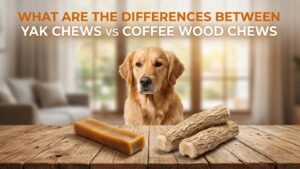
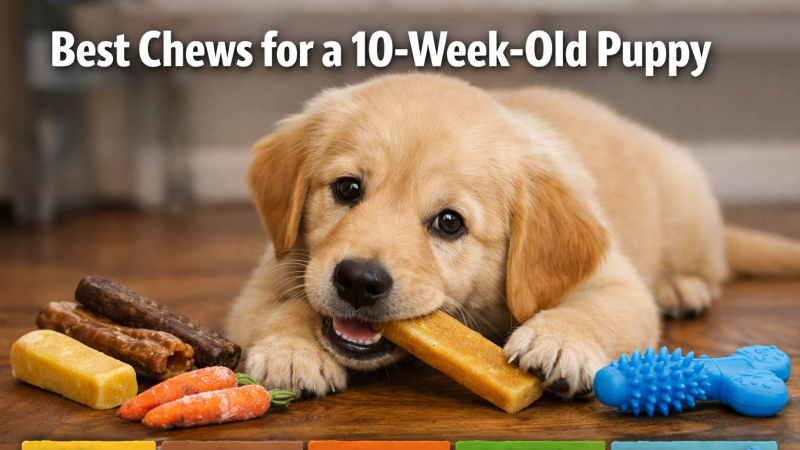
A 10-week-old puppy needs safe, soft chews because teething begins to intensify during this stage of development. Puppies at this age use chewing to relieve gum inflammation, explore their environment, strengthen jaw muscles, and reduce stress caused by erupting baby teeth. The best chews for a 10-week-old puppy include soft rubber teething toys, frozen puppy chews, and veterinarian-approved edible chews made from digestible ingredients such as collagen, sweet potato, chicken, and fish skin. Proper puppy chews provide teething relief without damaging fragile enamel or creating choking and intestinal blockage risks.
Choosing the right puppy chew affects far more than comfort during teething. Safe chew toys and edible puppy chews support healthy chewing habits, reduce destructive biting behavior, provide mental stimulation, and help puppies develop calmer behavior patterns during early neurological growth. Unsafe options such as rawhide, antlers, cooked bones, and hard nylon chews increase the risk of fractured teeth, digestive obstruction, and oral injuries in young puppies with underdeveloped jaws. This guide explains the safest chew categories, chew sizing rules, supervision standards, ingredient safety concerns, and the best chew options for different puppy behaviors and teething needs.
Why Do 10-Week-Old Puppies Need Safe Chews?
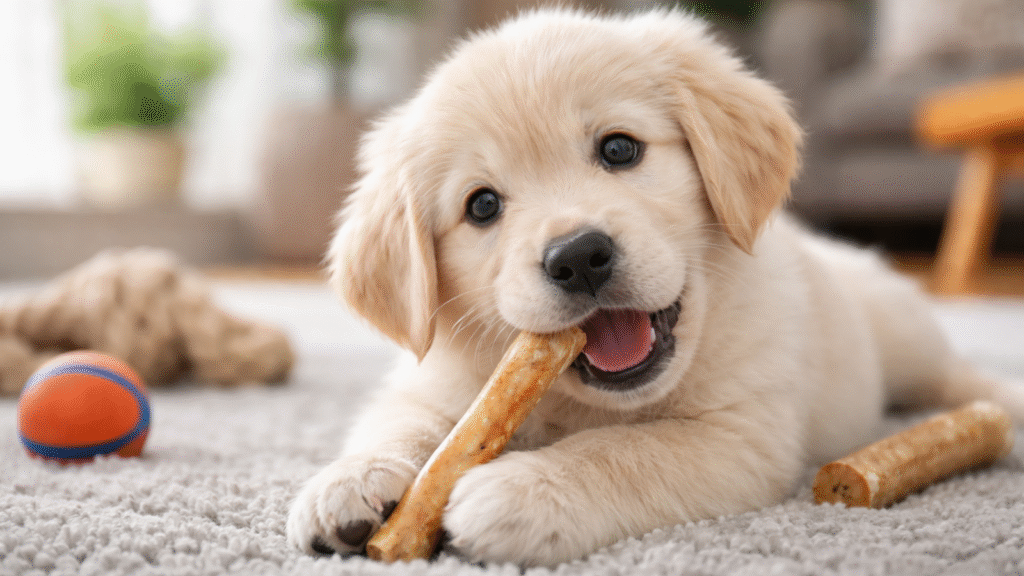
A 10-week-old puppy needs safe chews because their primary teeth are erupting, gum tissue is inflamed, and chewing is the only physical mechanism that relieves that discomfort. Chewing is not just a comfort behavior: a 2025 peer-reviewed study published in Frontiers in Behavioral Neuroscience confirmed that providing appropriate chew toys reduces stress and anxious behavior in puppies when briefly separated from their owners, a direct behavioral benefit, not just teething relief. Chewing functions as one of the most effective and accessible enrichment strategies available to new puppy owners.
How Do Chews Help With Teething Pain?
Chews relieve teething pain through 3 direct mechanisms: counterpressure on inflamed gum tissue, stimulation of saliva production, and distraction from discomfort signals.
Counterpressure is the most important mechanism. When a puppy bites into a soft, pliable chew, the resistance pushes back against swollen gum tissue and interrupts the pain signal pathway. This is the same biological principle used in human infant teething rings.
Saliva production increases during chewing and contains natural enzymes that reduce gum inflammation. Puppies between 8 and 16 weeks produce the highest volume of saliva relative to their body weight at any point in their life; chewing activates and directs that response.
Distraction matters more than many owners expect. A puppy focused on a chew is not focused on pain, which reduces cortisol levels and supports calmer behavior during the teething window.
What Chewing Habits Are Normal at 10 Weeks?
At 10 weeks, normal chewing habits include constant mouthing of objects, chewing furniture and shoes, biting hands during play, and a preference for softer textures over hard surfaces.
A 10-week-old puppy chews between 6 and 10 times per day in short sessions of 5 to 15 minutes each. They often switch objects every few minutes, which reflects normal exploratory behavior rather than dissatisfaction with any single chew.
Chewing on human hands is also developmentally normal at this age. It is not aggression; it is how puppies map their environment and test bite pressure. Redirecting this behavior to an appropriate chew teaches impulse control while satisfying the biological drive.
Why Is Mental Stimulation Important for Puppies?
Mental stimulation at 10 weeks is critical because a puppy’s brain is forming neural pathways at the fastest rate of their entire life, and boredom-related stress hormones actively disrupt that formation.
Providing structured mental stimulation, including supervised chewing sessions, is a developmental priority confirmed by the AVMA’s 2024 literature review on puppy socialization, which notes that puppies’ brains rapidly develop through at least 20 weeks of age and that enrichment inputs during this window shape lasting behavioral patterns.
Puppies that receive insufficient mental stimulation before 16 weeks develop higher rates of anxiety, destructive behavior, and reactivity as adults. A safe chew placed at the right time is not a convenience; it is a developmental tool.
What Makes a Chew Safe for a Young Puppy?
A chew is safe for a 10-week-old puppy when it meets 4 non-negotiable criteria: appropriate softness, correct sizing for the breed’s mouth, digestible ingredients, and no fragmentation risk.
Which Ingredients Should You Avoid in Puppy Chews?
Avoid these 6 specific ingredients in puppy chews: artificial preservatives (BHA, BHT, ethoxyquin), added sugars or corn syrup, propylene glycol, artificial dyes (Red 40, Yellow 5), xylitol, and processed rawhide.
Xylitol is the most dangerous additive to check for on any edible chew label: according to the FDA’s Consumer Update, xylitol is rapidly absorbed into a dog’s bloodstream within 15 to 30 minutes and triggers a life-threatening drop in blood sugar, even in very small amounts. Processed rawhide swells up to 4 times its original size when wet, which creates an intestinal blockage risk specific to puppies whose digestive systems lack the enzymatic capacity to break it down.
Artificial dyes cause no nutritional harm but signal low manufacturing quality, which often correlates with undisclosed additives and inferior sourcing standards.
How Soft Should a Puppy’s Chew Be?
The most reliable safety check for any puppy chew is the thumbnail test: if a firm press of your thumbnail does not leave a visible indent in the surface, the chew is too hard for a puppy’s unmineralized enamel. This guideline is endorsed by veterinary nutritionists and the Veterinary Oral Health Council (VOHC) approval framework, as detailed in the 2024 peer-reviewed Today’s Veterinary Practice article on chew treat safety.
If the chew does not indent, it is too hard for a puppy at this developmental stage. A 10-week-old puppy’s enamel is not fully mineralized; it reaches full hardness between 6 and 12 months, depending on breed. Hard chews applied before that window crack cusps and fracture roots, causing pain and expensive veterinary intervention.
Rubber chews with a Shore A hardness rating below 50 are appropriate. Most quality puppy-specific rubber toys publish this specification on their packaging. If you are also evaluating natural protein chews, it is worth checking whether natural chews like yak chews fall within the safe hardness range for young puppies before making a selection.
What Size Chew Is Best for a Small Puppy’s Mouth?
The correct chew size for a 10-week-old puppy is larger than the widest point of the puppy’s open mouth and longer than the distance from the tip of the nose to the back of the jaw.
This sizing rule prevents the single most common chew-related emergency in young puppies: a chew becoming lodged in the pharynx. A chew that fits entirely in the mouth is a choking hazard by definition.
For small breeds such as Chihuahuas, Yorkies, or Shih Tzus, this means chews at least 3 to 4 inches long. For large or giant breed puppies such as German Shepherds or Labrador Retrievers, chews of 5 to 6 inches or longer are appropriate at 10 weeks. For owners evaluating natural protein chews, this guide to choosing the right yak chew size for your dog’s breed and age applies these same measurements to Himalayan chews specifically.
When Can a Chew Become a Choking Hazard?
A chew becomes a choking hazard when it wears down to a size small enough to be swallowed whole, splinters into sharp fragments, or softens to a degree that allows large pieces to detach.
The threshold is consistent across chew types: remove the chew when it reaches a size smaller than the puppy’s muzzle width. Set a physical size marker, a piece of tape on the counter at 2 inches, for example, and discard the chew before it crosses that point.
Fragmentation risk is specific to certain chew categories. Compressed vegetable chews, dried tendons, and natural bully sticks all soften and can detach end-pieces during active chewing sessions. Monitor these types in real time, not periodically.
Which Types of Chews Are Best for 10-Week-Old Puppies?
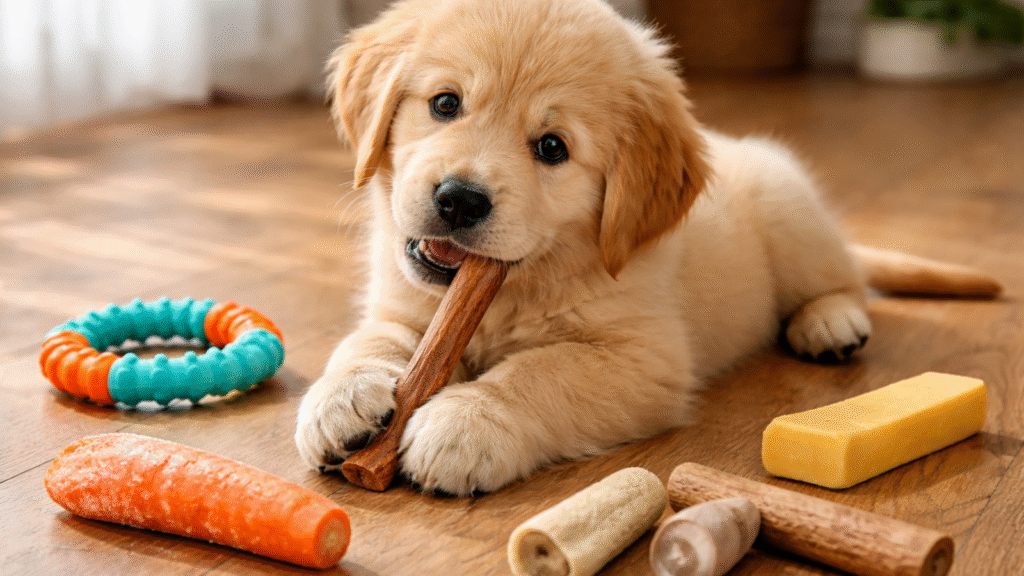
The 4 chew categories appropriate for 10-week-old puppies are soft rubber teething toys, veterinarian-approved edible chews, frozen chews, and age-appropriate natural chews made from soft protein sources.
Are Rubber Puppy Toys Good for Teething?
Rubber puppy teething toys are the most consistently safe chew option for 10-week-old puppies because they cannot be consumed, do not splinter, and can be sized appropriately for any breed.
Quality rubber teething toys for this age group feature textured ridges or nubs that massage gum tissue during chewing. The KONG Puppy toy is the most researched option in this category. Its natural rubber compound is calibrated specifically for puppy jaw strength, and it can be filled with soft treats to extend engagement to 15 to 30 minutes per session.
Rubber toys also double as training tools. A frozen rubber toy filled with plain Greek yogurt or pureed pumpkin becomes a high-value reward that reinforces crate behavior, quiet settling, and toy focus during the early socialization window.
Are Edible Puppy Chews Safe for Daily Use?
Edible puppy chews are safe for daily use only when they are specifically formulated for puppies under 12 weeks, made from a single digestible protein source, and free from the 6 ingredient categories listed above.
The 3 safest edible chew categories for 10-week-old puppies are collagen chews (softer than bully sticks and highly digestible), freeze-dried single-ingredient chews such as chicken or duck neck pieces, and soft sweet potato chews. For a detailed comparison of how collagen-based and yak milk chews stack up against bully sticks for puppies, including safety ratings and chew duration, that breakdown is worth reviewing before selecting an edible chew.
Collagen chews are the strongest performer in this category. They soften quickly with saliva, reduce to small digestible pieces rather than detaching large chunks, and provide collagen protein that supports joint development, a genuine nutritional benefit for large-breed puppies growing rapidly.
Limit edible chews to 1 per day maximum. Digestive systems at 10 weeks are still maturing, and excess protein from chews on top of regular meals causes loose stool, flatulence, and, in some cases, pancreatitis with high-fat options.
Can Frozen Chews Soothe Sore Puppy Gums?
Frozen chews provide direct, measurable gum relief because cold temperature reduces local blood flow to inflamed tissue, which decreases swelling and interrupts pain receptors at the site.
The most effective frozen chew options for 10-week-old puppies include frozen rubber toys filled with wet puppy food, frozen carrot sticks (for puppies past their first deworming and with vet clearance), and frozen puppy-safe broth cubes molded around a rope toy.
Frozen items work best when offered 2 to 3 times per day during peak teething discomfort, which typically occurs between 10 and 14 weeks. Offer them on a mat or in a crate to manage mess. Do not freeze hard items such as ice cubes on their own; the density of pure ice can fracture puppy teeth.
Are Natural Chews Safe for Young Puppies?
Some natural chews are safe for 10-week-old puppies, but the category requires careful selection because natural does not automatically mean age-appropriate. Choosing products from a reliable yak chew manufacturer and supplier that uses traceable, single-ingredient protein sources significantly reduces the sourcing-related risks in this category.
Safe natural chew options for this age group include soft-dried chicken feet (without the nails), thin dried fish skins, and collagen strips from young cattle. These options share 3 characteristics: they soften rapidly, digest completely, and do not fracture into sharp pieces. If you are evaluating Himalayan-style chews for this category, this resource on whether Himalayan yak chews are safe for puppies covers age-appropriate softness grades, sizing, and what to look for when selecting one.
Antlers, hooves, and dried pig ears are natural but inappropriate at this age. Antlers and hooves rank among the hardest chew materials available and fracture puppy enamel. Pig ears carry a CDC-documented Salmonella contamination risk: in a 2019 multistate outbreak report, 154 people were infected with Salmonella in 34 states after contact with pig ear dog treats, with Salmonella confirmed in 135 product samples. For puppies under 12 weeks whose immune systems are still developing, this contamination risk is especially serious.
Which Chews Should You Avoid Giving a Puppy?
Avoid 4 specific chew categories for a 10-week-old puppy: rawhide in any form, hard bones, adult dog chews, and any chew with added seasonings or artificial flavoring.
Are Rawhide Chews Safe for 10-Week-Old Puppies?
Rawhide chews are not safe for 10-week-old puppies. The risk profile includes intestinal blockage, chemical contamination from processing, and choking from large detached pieces, all of which are amplified in puppies under 12 weeks.
Rawhide is produced by chemically treating the inner layer of animal hides with sodium sulfide or bleaching agents, then pressing and drying. These chemicals are not fully neutralized in the final product. Rawhide’s safety record is backed by documented FDA action: the FDA issued a recall after confirming that rawhide manufacturing facilities used quaternary ammonium compounds, an industrial disinfectant, not approved for dog chew production, resulting in confirmed pet illness from diarrhea and vomiting. Compressed rawhide carries the same chemical processing risk as traditional rawhide.
Compressed rawhide, marketed as safer than traditional rawhide, carries identical risks. The compression simply changes the texture. The base material, sourcing, and chemical processing remain the same.
Can Hard Bones Damage Puppy Teeth?
Hard bones fracture puppy teeth, a documented outcome the FDA has formally warned about: between 2010 and 2017, the FDA received approximately 68 illness reports linked to bone treats, including roughly 15 dog deaths. Reported harms included broken teeth, GI obstruction, vomiting, diarrhea, and bleeding. The FDA’s standing consumer advisory recommends against giving dogs any bone treat regardless of the dog’s size or the bone’s size.
The 4 bone types most commonly associated with puppy tooth fractures are cooked chicken bones (which splinter into sharp shards), beef marrow bones (too dense for unmineralized enamel), antler chews, and compressed nylon bones marketed as “chew toys.”
A fractured tooth at 10 weeks is not trivial. Even though puppy teeth are temporary, a fractured baby tooth can develop a periapical abscess that damages the developing permanent tooth beneath it, creating a dental problem that lasts the dog’s entire life.
Why Are Adult Dog Chews Unsafe for Puppies?
Adult dog chews are unsafe for 10-week-old puppies because they are formulated for jaw strength, digestive enzyme profiles, and body weights that a 10-week-old puppy will not reach for 12 to 24 months.
Adult chew sizing is the primary danger. A chew designed for a 40-pound adult dog is too large to grip safely for a 10-week-old puppy and too small to avoid being swallowed partially whole. The nutrition profile is also mismatched; many adult chews contain protein and fat percentages that exceed puppy digestive capacity and cause acute gastrointestinal distress.
How Often Should a 10-Week-Old Puppy Chew?
A 10-week-old puppy benefits from 3 to 4 supervised chewing sessions per day, each lasting between 5 and 15 minutes, with at least 30 minutes of rest between sessions. For a guide that scales these recommendations as your puppy matures past the teething window, this breakdown of how often you should give your dog a chew covers frequency adjustments from early puppyhood through adulthood.
How Long Should Chewing Sessions Last?
Chewing sessions for 10-week-old puppies last 5 to 15 minutes per session. Beyond 15 minutes of continuous chewing, jaw muscle fatigue sets in, and the puppy begins applying irregular pressure, which increases the risk of accidental gum abrasion and erratic chewing behavior.
Watch for 3 signs that a session has gone on too long: pawing at the face, drooling excessively beyond normal teething amounts, and dropping the chew repeatedly without re-engaging. These behaviors signal jaw fatigue, not disinterest in the chew.
How Many Chews Can a Puppy Have Each Day?
A 10-week-old puppy can have 1 edible chew and 2 to 3 non-edible chew sessions per day. This combination delivers teething relief and mental stimulation without overloading caloric intake or digestive capacity.
Rotating chew types across the day, rubber in the morning, frozen at midday, and a soft edible chew in the evening, maintains novelty and sustains engagement across all 3 sessions. Novelty matters because a puppy that loses interest in a chew reverts to mouthing furniture, hands, and clothing.
When Should You Remove a Puppy Chew?
Remove a puppy chew immediately in 5 specific situations: when it breaks into fragments, when it reaches the size threshold (smaller than muzzle width), when the puppy shows signs of distress, when chewing has lasted over 15 minutes continuously, and when the puppy attempts to swallow large pieces whole.
Do not wait until a fragment detaches to remove a compromised chew. Inspect the chew surface every 3 to 5 minutes during supervised sessions. A chew with surface cracks, split ends, or softened tips requires immediate removal regardless of overall size.
How Can You Introduce New Chews to a Puppy?
Introduce new chews to a 10-week-old puppy by offering the chew at ground level, allowing the puppy to sniff it for 30 to 60 seconds, then gently encouraging contact without forcing it into the mouth.
Should Puppies Be Supervised While Chewing?
Yes. Every chewing session for a 10-week-old puppy requires direct visual supervision without exception. No chew category, including rubber toys, eliminates the need for supervision at this age.
Supervision at this stage means being within arm’s reach and watching actively, not simply being in the same room. The response window when a puppy begins to choke is 15 to 30 seconds. An owner across the room or looking at a screen cannot respond within that window.
As the puppy matures past 16 weeks and demonstrates consistent, controlled chewing behavior, supervision requirements can be gradually reduced, but only with chews that have a proven safety record for that specific puppy’s chewing style.
How Can You Tell if a Puppy Likes a Chew?
A puppy that engages positively with a chew displays 4 observable behaviors: sustained engagement beyond 2 minutes, relaxed body posture with elbows on the ground, a “chewing face” with rhythmic jaw movement, and returning to the chew after brief interruptions.
A puppy that dislikes a chew shows disinterest within 30 seconds, sniffs and walks away, or picks it up and immediately drops it. This is useful information. A chew a puppy ignores provides no teething relief and no mental stimulation, try a different texture, temperature, or flavor profile.
What Signs Show a Chew Is Too Hard or Unsafe?
A chew is too hard or unsafe when a puppy shows 5 warning signs: yelping or whimpering during chewing, pawing at the mouth after chewing, sudden reluctance to eat after a chewing session, bleeding gum tissue visible on the chew surface, or a chipped tooth fragment visible in the mouth or on the floor.
Gum bleeding from a minor abrasion is different from persistent bleeding. Minor contact bleeding (a faint pink tint on the chew surface) resolves within 24 hours without intervention. Bright red blood, bleeding that continues after the chewing session ends, or blood pooling in the mouth requires veterinary evaluation.
What Are the Best Chews for Different Puppy Needs?
Different puppy temperaments and behavioral profiles require 3 distinct chew strategies: one for aggressive chewers, one for anxious puppies, and one for puppies that need extended engagement.
Which Chews Work Best for Aggressive Chewers?
Aggressive chewer puppies at 10 weeks benefit most from thick-walled rubber teething toys with textured exterior surfaces and small treat-fill cavities. The thick wall resists rapid destruction, and the treat-filled cavity sustains engagement without requiring the puppy to chew faster or harder.
The common mistake with aggressive chewer puppies is selecting harder chews on the assumption that they will last longer. Harder chews do last longer, but they also cause more dental damage. A heavy-duty puppy rubber toy outlasts a thin edible chew without the dental risk. When you do want a natural edible option for a heavy chewer, this guide to the best yak chews for aggressive chewer dogs identifies which grades and sizes provide durability without crossing the safe hardness threshold.
Replace rubber toys when bite marks penetrate more than halfway through the wall thickness. At that point, the structural integrity is compromised, and fragments can detach.
Which Chews Help Calm Anxious Puppies?
Anxious puppies at 10 weeks respond best to frozen rubber toys filled with high-value soft food, such as plain wet puppy food, unsweetened plain pumpkin puree, or plain Greek yogurt.
The combination of cold temperature, sustained licking and chewing activity, and high-value food reward creates a measurable calming effect through 2 mechanisms: repetitive oral motor activity reduces cortisol, and high-value food triggers dopamine release. This is the biological basis for why a puppy visibly relaxes within 3 to 5 minutes of engaging with a food-stuffed frozen toy.
Offer this chew type during specific high-stress windows: crate introduction, first nights in a new home, post-vaccination appointments, and thunderstorm or firework events.
Which Chews Keep Puppies Busy the Longest?
The chew types that sustain puppy engagement longest are food-stuffed rubber toys (15 to 30 minutes), lick mats with frozen toppings (10 to 20 minutes), and soft edible collagen chews (10 to 20 minutes, depending on size and jaw strength).
Food-stuffed rubber toys consistently rank highest for engagement duration because they combine 3 reinforcement mechanisms: chewing, licking, and intermittent food reward. Each time the puppy gets a small amount of food, the reinforcement resets the engagement cycle.
Lick mats are technically not chews, but they serve the same mental stimulation function and are appropriate from 8 weeks onward. They are particularly effective when refrigerated or frozen with a thin layer of puppy-safe topping, pumpkin puree, mashed banana, or plain cream cheese in very small amounts.
How Can You Choose the Right Puppy Chews?
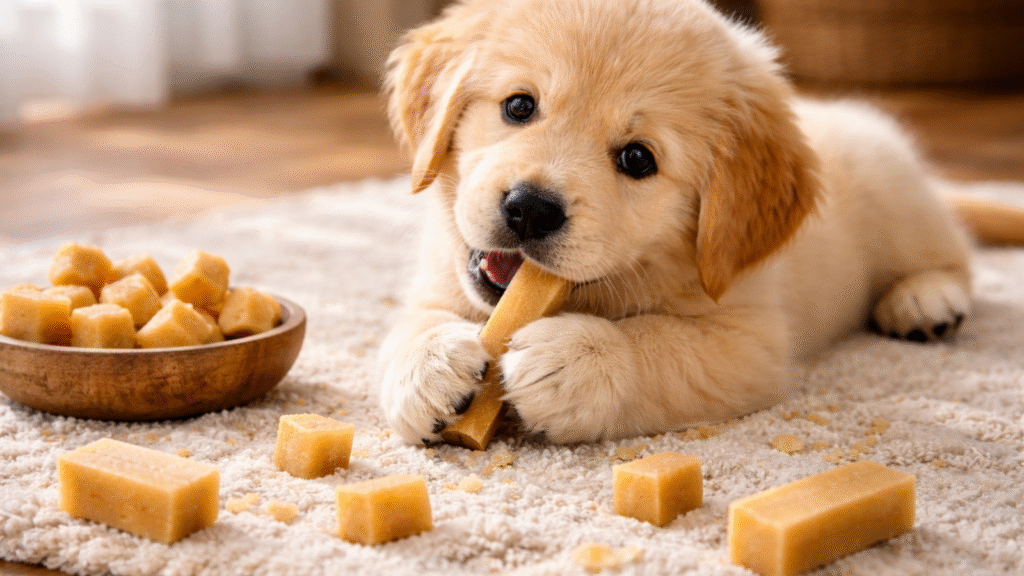
Choose the right chew for your 10-week-old puppy by applying 3 selection criteria in sequence: age-appropriate hardness verified by the thumbnail test, correct sizing for the breed’s mouth, and an ingredient list free from the 6 ingredient categories identified earlier.
Start with rubber teething toys as the default and lowest-risk option. Add 1 edible chew category at a time, with at least 48 hours between new introductions, to identify any individual digestive sensitivity before adding additional variety. When you are ready to introduce a natural protein chew to the rotation, this curated list of the best yak chews for puppies applies the size, softness, and ingredient criteria from this article directly to vetted Himalayan chew options.
Consult your veterinarian at the 10-week or 12-week wellness appointment specifically about chew selection. Bring the packaging of any chew you are currently using or considering. For the most authoritative reference on which chews meet veterinary dental safety standards, consult the Veterinary Oral Health Council (VOHC), the independent body that awards its Seal of Acceptance to chew products scientifically proven to reduce plaque and tartar. Your veterinarian can also help you cross-check any chew against the VOHC accepted products list at the 10-week or 12-week wellness visit. This is one of the most authoritative references available for this decision.
Can a Trusted Pet Store Help You Pick Safe Chews?
A knowledgeable pet specialty retailer can help narrow the selection within safe categories, but the final selection decision belongs to the owner and veterinarian, not the retail staff.
Retail staff are not trained to assess chew safety at a clinical level. They can identify products labeled for puppies, describe popular choices, and explain ingredient lists, but they cannot evaluate whether a chew is appropriate for your specific puppy’s breed, jaw development, chewing intensity, or health status.
Use pet store staff as a starting point, not an endpoint. Bring a list of your puppy’s breed, current weight, and any known sensitivities to make the conversation more productive.
What Are the Key Takeaways About Puppy Chews?
The 7 most important facts about chews for 10-week-old puppies are:
- Softness is the top safety criterion. Any chew that does not indent under thumbnail pressure is too hard for this age group.
- Sizing prevents choking. Every chew must be larger than the puppy’s open mouth and longer than the muzzle-to-jaw measurement.
- Rawhide is never safe at this age. No form of rawhide, traditional, compressed, or flavored, is appropriate for a 10-week-old puppy.
- Supervision is non-negotiable. Every chewing session requires direct, arm’s-reach supervision until the puppy reliably demonstrates controlled chewing behavior.
- 1 edible chew per day is the maximum. Exceeding this causes digestive distress and unbalances the puppy’s nutritional intake.
- Frozen chews provide the most direct teething relief. Cold temperature reduces gum inflammation through a documented biological mechanism.
- The thumbnail test is your single most reliable safety check. Apply it to every chew, every time, regardless of label claims.
At 10 weeks, chewing is not optional for a puppy; it is a biological necessity. The owner’s role is to make every chewing opportunity a safe one by applying consistent size, softness, and supervision standards across every session.
When in doubt, choose a quality rubber teething toy over any edible or natural chew option. It is the lowest-risk, highest-reliability tool available at this developmental stage, and when combined with a frozen filling, it satisfies every need a 10-week-old puppy brings to a chewing session.