
Yak chews are expensive because they are made from scarce Himalayan yak milk, require weeks of handmade cheese production and slow drying, contain only a few natural ingredients, last significantly longer than most dog chews, and cost more to source and ship as global demand continues to rise. Rather than paying for branding alone, buyers are paying for limited raw materials, labor-intensive manufacturing, premium ingredient quality, and exceptional durability that reduces the overall cost per hour of chewing.
Yak chews, also known as Himalayan dog chews or chhurpi, are traditional hard cheese chews made from yak milk, cow milk, lime juice, and salt. Their higher price reflects every stage of production, from seasonal milk collection in the Himalayas to careful drying, quality testing, packaging, and international distribution. This guide explains the five major cost drivers behind yak chews, including milk scarcity, handmade manufacturing, ingredient quality, chew longevity, and supply chain costs. It also compares yak chews with bully sticks, rawhide, antlers, and other long-lasting dog chews to determine whether their premium price delivers better long-term value for different types of dogs.
What Makes Yak Chews Cost More?
Five factors set the price of a yak chew: milk scarcity, production time, ingredient sourcing, chewing durability, and demand. Each one adds cost at a different stage, from the Himalayan pasture to the export container, and together they explain why a yak chew sits well above the price of a rawhide twist or a basic nylon bone.
- Milk scarcity: yaks produce a fraction of the milk cows do, and Himalayan herds are shrinking rather than growing
- Production time: the cheese is pressed and dried by hand over several weeks, not extruded in minutes on an assembly line
- Ingredient sourcing: a traditional batch uses only yak milk, cow milk, lime juice, and salt, with no cheap filler to bring the cost down
- Durability: one chew can occupy a dog for days, which changes the entire cost-per-use calculation
- Demand: the global market for long-lasting natural chews is projected to grow from roughly $0.8 billion in 2026 to $1.5 billion by 2036, according to Future Market Insights’ Natural Chew Pet Treats Market report, which puts long-lasting hard chews at 55.3% share of the category and identifies Saudi Arabia as the fastest-growing regional market.
That last point cuts both ways. Research on Nepali chhurpi trade backs this up: a Journal of Ethnic Foods survey of Nepali Chhurpi producers and exporters found that annual export growth accelerated from just 5% in fiscal year 2016/17 to 56% by 2020/21, even as the raw material has become harder to source. Rising demand and shrinking supply, at the same time, is the short version of why prices keep climbing. The next sections break each factor down in order, starting with the one buyers ask about most: the milk itself.
How Does Milk Quality Affect Cost?
Milk quality drives cost because the raw material itself, yak milk, is rare, seasonal, and getting harder to secure every year. A chew is only as good as the milk behind it, and that supply is genuinely limited, not restricted for effect.
Why Is Yak Milk More Expensive?
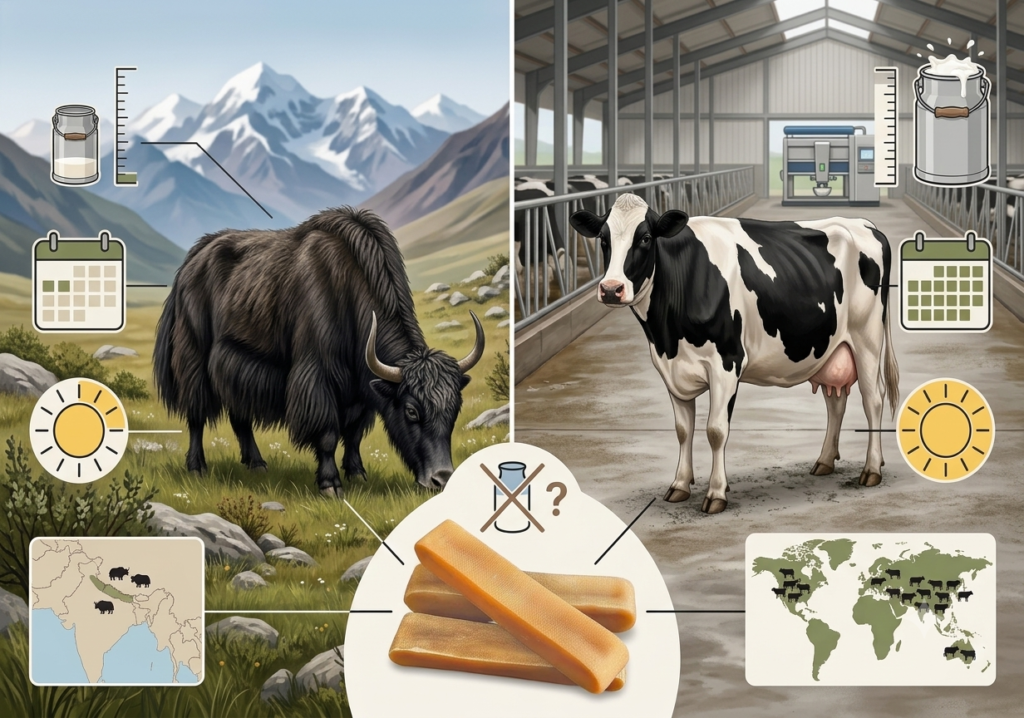
Yak milk costs more than cow milk because one yak produces a fraction of the volume, for roughly half the year, from a population that is shrinking. A nak, the female yak, tops out around 2 liters of milk a day. Cross her with domestic cattle, and you get a chauri, which can give up to 6 liters, still well short of what a commercial dairy breed produces. A yak’s lactation runs about 5 months, against roughly 10 months for a Holstein cow, whose daily output is far higher. Total yield across a full yak lactation typically falls between 150 and 500 kilograms, a volume that a commercial dairy operation can produce in a matter of weeks.
Supply is also shrinking in absolute terms. According to the Nepal Government’s 2023/24 National Livestock Census, Nepal’s total yak, nak, and chauri population stood at 71,913 heads during the 2023/24 fiscal year. Because this figure combines pure yaks with crossbred animals, claims about declining yak herds should be interpreted carefully. Some researchers estimate that Nepal now has only around 20,000 pure yak and nak and 40,000–60,000 chauri, with both populations continuing to decline. Fewer than 10,000 households across Nepal’s mountain districts now rely on yak husbandry as their primary livelihood. Researchers at the International Centre for Integrated Mountain Development (ICIMOD) attribute this decline in part to climate change, noting that warmer winters, erratic snowfall, and shorter growing seasons are reducing the high-altitude pastures that yaks depend on. At the same time, migration from mountain communities to cities and overseas has reduced the number of people available for the physically demanding, seasonal work of yak herding. Together, shrinking grazing areas and a declining herding workforce limit milk production and increase the cost of the milk that reaches processing facilities.
How Does Handmade Production Add Cost?
Handmade production adds cost because the process cannot be rushed or automated without ruining the final chew. Coagulating milk into cheese, then drying it hard enough to survive months on a shelf without preservatives, takes skilled hands and patient timing at nearly every stage.
How Are Yak Chews Made?
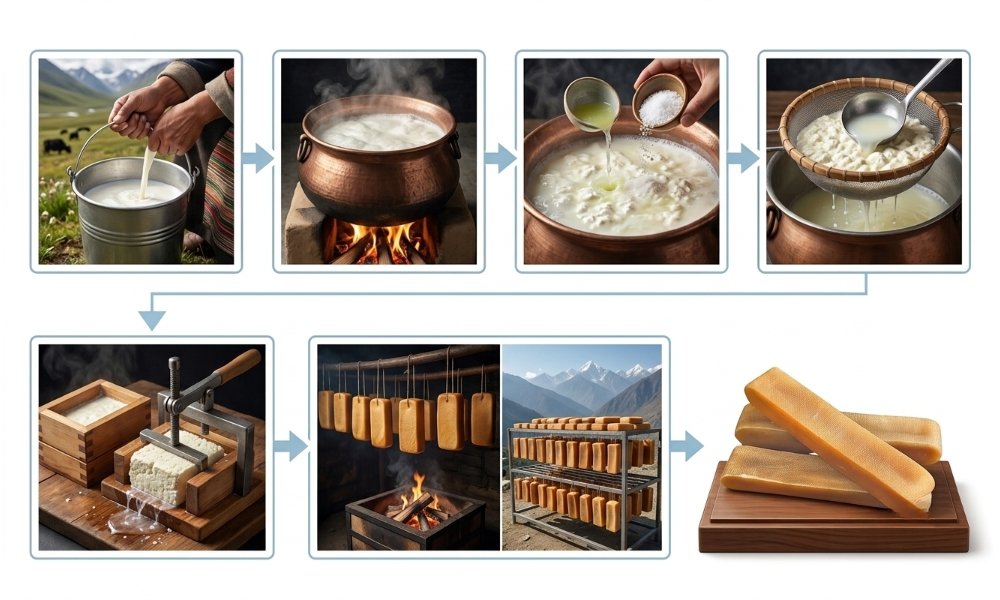
A yak chew starts as fresh yak and cow milk and ends as a dense, dried cheese, through a process that runs three to six weeks from raw milk to a finished, export-ready bar. Producers first test incoming milk for temperature, acidity, and antibiotic residue, since inconsistent milk ruins a batch before it reaches the pot. The milk is heated to a controlled temperature, typically in the 90 to 100 degree Celsius range, then curdled with food-grade lime juice and a measured amount of salt. Neither ingredient is there for flavor; they are what separate curds from whey. The curds are packed into cloth and pressed under steady weight for about a day to force out the remaining moisture, then cut or shaped into the bars, nuggets, or size grade a given batch calls for.
From there, the shaped cheese moves into low-temperature drying rooms for the bulk of the timeline, followed by a shorter conditioning period that lets moisture equalize all the way through the block so it does not crack. A well-made bar gets tested by hand for hardness before packaging, most often with a simple thumbnail press: a surface with absolutely zero give means the hardness is right, while even a slight indent indicates the batch retains too much moisture and needs more time in the drying room.
Why Does Drying Take So Long?
Drying takes weeks rather than hours because moisture has to migrate out from the center of a solid block without cracking the surface or trapping bacteria inside. Blast a cheese block with high heat to speed the process up, and the outside forms a hard shell while the interior stays soft and damp, exactly the condition that lets mold and bacteria take hold during storage and shipping. Traditional producers avoid that shortcut with low-temperature, high-airflow drying rooms instead, sometimes adding a light cold-smoking step for flavor and extra moisture control. The target is a water activity level at or below 0.60, a food-safety threshold below which most spoilage organisms cannot grow, plus a final moisture content under about 10 percent. Reaching that safely, all the way through a thick bar, takes patience measured in weeks rather than hours. A thin, puppy-size nugget clears that bar faster than a dense, extra-large bar built for a determined chewer, which is one reason the biggest sizes cost more per gram, not only more overall.
How Does Production Affect Price?
Every stage of handmade production adds labor and time that a machine-extruded treat skips entirely, and that gap shows up directly in the price. A rawhide twist or a nylon bone can be shaped and packaged in minutes on an automated line. A yak chew needs milk testing, hands-on pressing, weeks of monitored drying, a manual hardness check, and edge-finishing before it is ready to ship, and none of those steps compress well, which is why working with an established Himalayan yak chew manufacturer matters more than shopping on price alone. Skilled labor in Himalayan production regions is also limited, since a relatively small pool of workers manages herding, milking, and cheese-making across a short season. Add quality testing for moisture and microbial safety on top of that labor, and the cost per unit climbs well above anything that comes off an extrusion line in a factory.
Are Premium Ingredients Worth It?
Premium ingredients are worth the added cost for most dogs because yak milk itself is unusually dense in protein and fat, and a genuine chew has nothing else diluting that nutrition. A three or four-ingredient chew cannot hide behind filler, which means the quality of the milk shows up directly in both the price and the finished product.
Why Is Yak Milk So Valuable?
Yak milk is valuable because it packs more solids, fat, and protein into every liter than cow, goat, or sheep milk, closer in composition to buffalo milk than to standard dairy. According to composition data published by the FAO’s dairy milk composition reference page, yak milk runs 15 to 18 percent total solids, 5.5 to 9 percent fat, and 4 to 5.9 percent protein, closer in composition to buffalo milk than to standard dairy. A 2023 Journal of Food and Nutrition Research comparison of yak and Holstein milk — based on 124 yak and 400 Holstein milk samples- found total protein 71.4% higher and total solids 52.7% higher in yak milk than in Holstein cow milk.
That density matters twice over. First, the milk itself is more nutritionally concentrated per liter, richer in casein, essential amino acids, and minerals such as calcium and iron. Second, cheese made from that milk sets firmer and denser than cheese made from thinner, more diluted milk, which is a direct, physical reason yak chews end up so much harder and longer-lasting than most other dairy-based treats.
Do Natural Ingredients Raise Costs?
Yes. Sourcing only real yak and cow milk, lime juice, and salt costs more than using filler, but it also leaves nothing to disclose or hide. For a full breakdown of what Himalayan yak chews are actually made of, a traditional recipe is milk for at least 99 percent of the finished chew, with lime juice under 1 percent and salt at a fraction of a percent, just enough to coagulate the curd and manage moisture. Cutting costs usually means one of three shortcuts: blending in milk from mixed or undisclosed sources, adding synthetic binders to compensate for weaker milk protein, or skipping intake testing for antibiotic residue and acidity altogether. None of those shortcuts show up on a label the way an artificial flavor or a dye would. That is exactly why asking a seller about milk sourcing tells you more than reading the ingredient list on its own.
Why Do Yak Chews Last Longer?
Yak chews last longer than most other chews because the drying process leaves them extremely dense and low in moisture, so a dog works through far more material before finishing one. A bully stick softens and shreds as a dog chews it. A yak chew wears down gradually from the surface inward, instead, closer to how a hard candy dissolves than how a piece of jerky tears. Depending on a dog’s size and chewing style, a single chew can last anywhere from a few hours to several days, and an extra-large bar given to a large, motivated chewer can realistically stretch across three to seven days of supervised sessions. For a closer look at expected timelines by size, see how long yak chews typically last.
How Does Durability Save Money?
Durability saves money because the real cost of a chew is price divided by hours of use, not price alone. A standard bully stick runs roughly 80 to 120 calories, and most medium dogs finish one in 10 to 20 minutes. A yak chew delivers a comparable calorie count per inch, but a dog works through it across hours instead of minutes, often returning to the same bar over several sessions spread across several days. Run the math over a week of chewing, and a $15 to $20 yak chew that lasts most of that week can end up costing less per hour of engagement than five or six bully sticks bought to cover the same stretch, even though the single upfront price looks far higher on the shelf. Judged by sticker price, a yak chew looks expensive. Judged by cost per hour of chewing, the gap narrows fast and often reverses.
Why Do Dogs Need Fewer Chews?
One correctly sized yak chew covers days of chewing instead of minutes, so a dog simply goes through fewer of them. A chew matched to a dog’s weight and chewing intensity does not need replacing after a single session, which cuts down on how often an owner reorders, repackages leftovers, or cleans up remnants. This matters most for large, powerful chewers, since a properly sized extra-large bar can occupy a determined dog for the better part of a week, compared with several bully sticks or rawhide pieces needed to fill the same stretch of time. Fewer purchases and fewer replacements offset a chew’s higher unit price over time, before even factoring in the reduced mess of a treat that does not disappear in one sitting.
Are Yak Chews Better Than Others?

Yak chews are not universally better than other chews. They win decisively on durability and odor, and they lose ground on softness and digestibility for dogs that need a gentler option. The right answer depends on the dog in front of you: an adult chewer with healthy teeth gets more from a yak chew than a senior dog with worn enamel or a puppy still growing adult teeth.
How Do They Compare on Value?
On a side-by-side basis, yak chews last the longest and smell the least, bully sticks digest the easiest, rawhide carries the most digestive risk, and antlers and nylon chews outlast even a yak chew at the cost of a higher risk of cracked teeth. The table below lays out how the most common long-lasting chews compare.
| Chew type | Typical time to finish | Digestibility | Dental fracture risk | Odor |
| Yak chew (chhurpi) | Hours to several days | Softens with saliva; fully digestible | Moderate; soften first for at-risk dogs | Virtually odor-free |
| Bully stick | 10 to 40 minutes | Breaks down like regular food | Low | Strong |
| Rawhide | 20 to 60 minutes | Poor; can swell and risk blockages | Low to moderate | Mild to moderate |
| Antler | Days to weeks | Not digestible | High | Odorless |
| Nylon or synthetic bone | Weeks to months | Not digestible | High | Odorless |
No single chew wins across every column. That is the real argument for rotating chew types instead of committing to one and sticking with it regardless of how a dog’s needs change over time. f bully sticks are the main alternative on your shortlist, this yak chews vs. bully sticks comparison breaks the trade-offs down in more depth.
What Makes Them Stand Out?
Yak chews stand out for being genuinely low-odor, short-ingredient, and mentally engaging for longer than almost anything else on a pet store shelf, with a dental trade-off that responsible owners need to manage rather than ignore. Because the recipe rarely runs past four ingredients, yak chews suit dogs with sensitivities to common meat proteins, grain, or gluten better than many alternatives, though dogs with a genuine dairy allergy still need to avoid them. The hard surface also helps scrape plaque during chewing, a real mechanical benefit rather than a marketing claim. That same hardness is the chew’s biggest limitation, too: veterinary dental specialists group dried yak cheese with antlers and bones as chews hard enough to fracture a tooth in an aggressive chewer, so the standout durability and the standout risk come from the same property.
What Factors Change Yak Chew Prices?
Beyond the base cost of milk and labor, price moves with size, shipping distance, and how a chew is packaged for its trip from the Himalayas to a store shelf. Two chews using an identical recipe can still land at noticeably different prices once size and logistics enter the picture.
Does Size Affect the Cost?
Larger chews cost more per unit, and often per gram too, because a bigger block takes longer to dry all the way through, not simply because it contains more milk. Producers typically grade chews on a size ladder: small bars around 30 to 45 grams for toy and small breeds, medium bars around 65 to 85 grams, large bars in the 100 to 160 gram range, and extra-large or jumbo bars above 170 grams for the most determined chewers. Moisture has to travel farther from the center of a jumbo bar to reach its surface than from the center of a small nugget, so the largest sizes spend disproportionately longer in the drying room relative to their weight. For a large, aggressive chewer over 20 kilograms, sizing up rather than down is usually worth the extra cost anyway, since an undersized chew invites biting instead of gnawing and disappears faster than its price justifies. This guide to choosing the right yak chew size for your dog’s breed and age walks through the full sizing ladder.
Do Packaging and Shipping Matter?
Packaging and shipping add real cost because most yak chews travel thousands of miles from Himalayan production regions to a shelf or a doorstep in North America or Europe. A chew with no artificial preservatives needs a genuine moisture barrier, often a multi-layer film with a desiccant packet, to survive weeks in transit without picking up moisture or mold. Export shipments typically move by air or sea freight out of Nepal, and door-to-door delivery to the United States or Canada commonly takes one to three weeks once a shipment leaves the production facility, on top of customs clearance and import paperwork. None of that logistics chain is optional for an imported product, and all of it sits on top of the production cost before a retailer adds its own margin.
Are Expensive Yak Chews Worth Buying?
Expensive yak chews are worth buying for healthy adult dogs with moderate to strong chewing habits, and worth skipping or modifying for puppies, seniors, and dogs with existing dental problems. Price alone does not answer whether a specific chew suits a specific dog; the dog’s age, teeth, and chewing style answer that question first, and it is worth reading a dedicated guide on whether Himalayan yak chews are safe for puppies before introducing one to a dog in any of those higher-risk groups.
What Benefits Justify the Price?
The price buys extended mental engagement, dense natural nutrition, a short and recognizable ingredient list, and a real reduction in destructive chewing around the house, a combination that is hard to get from a single cheaper product all at once. A dog working through a hard chew for an hour or two is a dog that is not chewing a table leg or a shoe in the meantime. The protein and calcium content support muscle maintenance and bone health without added sugar, grain, or artificial flavor. For owners managing a dog’s weight, the slow consumption rate means a single chew delivers less concentrated calorie intake per minute than a fast-disappearing treat does. None of that guarantees a good fit for every dog, which is why the benefits only justify the price once they are matched to the right chewer.
How Can You Choose the Right One?
Choose a yak chew by matching size to a dog’s weight and chewing intensity, confirming the ingredient list stops at milk, lime juice, and salt, and testing hardness before handing it over unsupervised. Run through these checks before buying or serving one:
- Confirm the ingredient list names only milk, lime juice, and salt, with no added flavoring, coating, or preservative
- Match the size grade to the dog’s weight rather than defaulting to the cheapest option on the shelf
- Press a thumbnail into the chew; a surface with absolutely no give is exactly what you want, and any slight indent is a warning sign that the chew is under-dried
- Soak the chew in warm water for 5 minutes, then puff it in the microwave for 45 to 60 seconds until it turns into a soft, crunchy cheese puff for puppies, seniors, or dogs with any dental history.
- Supervise the first several sessions and remove the piece once it wears down small enough to swallow whole.
A common mistake is buying based on a breed’s reputation rather than the individual dog’s actual chewing style. A Labrador that gnaws patiently needs a different chew than a Labrador that crunches through anything in under a minute.
How Can YforYak Help You Choose?
YforYak documents every stage of production, from incoming milk tests through final hardness checks, which gives owners something most yak chew listings do not: a way to verify quality before it becomes a problem at home. The company’s production facility in Tokha, Kathmandu, tests raw yak and cow milk for temperature, acidity, and antibiotic residue before it enters production, standardizes solids content for consistent curd firmness, and monitors pH through the coagulation stage rather than relying on a fixed recipe alone. Buyers comparing multiple sources can use this guide to find a reliable Himalayan yak chews supplier as a vetting checklist. Drying happens in low-temperature, high-airflow rooms; water activity is validated against the same safety threshold covered above, and every batch is hand-tested for hardness before packaging. YforYak’s founder, Dhurba Raj Regmi, built the company on more than a decade of experience in Nepal’s agricultural export sector, with a stated goal of growing the country’s pet-chew exports tenfold by the end of the decade.
Can YforYak Dog Chew Offer Better Value?
A documented process offers better value less because of the story behind it and more because consistency is what actually determines whether a chew is worth its price. An inconsistent chew, too soft in one batch and rock-hard in the next, wastes money either way: a too-soft chew disappears fast, and a too-hard chew risks a dental injury that costs far more than the chew itself. Batch-level testing for hardness, moisture, and microbial safety is what keeps a given size grade behaving the same way from one order to the next, which is the practical reason standardized production tends to mean fewer wasted purchases over time.
What Are the Key Takeaways?
Yak chews cost more because scarce, seasonal milk from a shrinking Himalayan herd goes through weeks of hand production, using only milk, lime juice, and salt, to make a chew that can outlast a week’s worth of cheaper alternatives. None of the five cost drivers behind that, milk scarcity, labor-intensive production, ingredient purity, durability, and rising demand, is artificial. Each one shows up as a real, traceable step in getting a chew from a Himalayan pasture to a food bowl.
Judged purely on shelf price, a yak chew looks like a splurge. Judged on cost per hour of chewing, ingredient transparency, and how many cheaper treats it replaces, the price holds up for most healthy adult dogs. The main exceptions are puppies with baby teeth, seniors with worn enamel, and dogs with a history of dental fractures, all of whom do better with a softened or puffed version instead. The honest answer to why yak chews are so expensive is that very little about making one is actually cheap, not that the price has been inflated for a trendy treat. If you are still weighing a specific size or batch, the ingredient list and the thumbnail test above will tell you more than the price tag ever will.