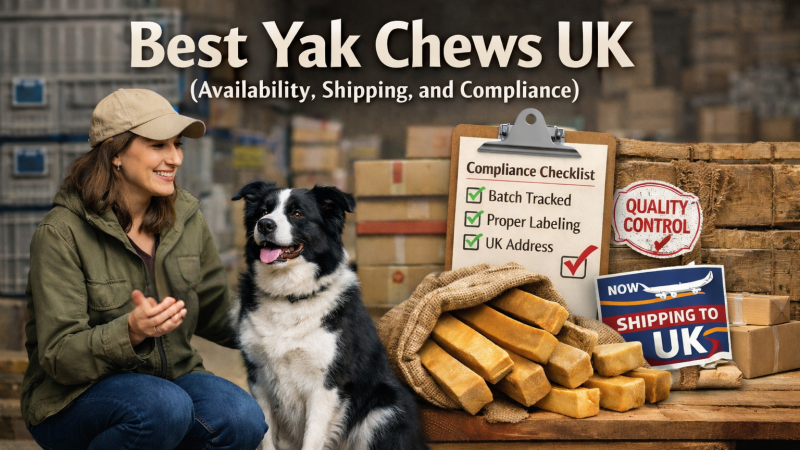
Yak chews are smoke-dried Himalayan dairy bars made from yak milk, lime juice, and salt, sold in the UK as long-lasting dog chews. As dairy-derived products of animal origin (POAO), they move through import controls, warehouse handling, and UK pet food labelling requirements before reaching retailers. The difference between a premium chew and a disappointing one rarely comes down to appearance alone. Availability channel, shipping conditions, batch traceability, and label compliance determine whether the product arrives fresh, structurally sound, and legally fit for sale in Great Britain or Northern Ireland.
The best yak chews in the UK are those distributed through accountable supply chains, stored under controlled humidity, and labelled with full analytical constituents, best-before dating, and a responsible UK business address. Brand-direct websites, specialist independent pet retailers, and verified marketplace listings with transparent seller identity consistently outperform anonymous third-party resellers. This guide explains how to evaluate UK stock freshness, dispatch timelines, packaging integrity, compliance signals, and import readiness so both dog owners and retail buyers can purchase with confidence and avoid cracked, moisture-damaged, or non-compliant products.
Best Yak Chews in the UK

Finding the best yak chews in the United Kingdom (UK) takes more than a quick search. The market is crowded with products that vary significantly in hardness, ingredient quality, size grading, and shelf integrity. Some listings are excellent. Others arrive brittle, mislabelled, or sourced from processors with no visible quality documentation.
Yak chews, also known as Himalayan churpi chews, are long-lasting dairy-based treats made primarily from yak milk, with some formulas incorporating cow milk as a secondary dairy source. They are smoke-dried and pressed into hard bars that dogs gnaw on slowly. The UK pet treat sector has adopted them enthusiastically, and demand has grown steadily from 2021 to 2022. Nepal’s churpi export sector has grown dramatically: the country’s Department of Customs recorded Rs 4 billion (~USD 30 million) in dog chew exports in the first 11 months of FY2024/25 alone, a 227% increase on FY2019/20 figures and a 34.3% year-on-year rise (Nepal Department of Customs Trade Statistics, FY2024/25).
Pick the Right Yak Chew by Dog Size and Chewing Style (Small/Medium/Large)
The right yak chew size is determined by 2 factors: the weight of your dog and the intensity of their chewing style. Getting this wrong is the most common mistake new buyers make, and it matters for safety, not just satisfaction.
Use this decision map before buying:
- Small dogs (under 10 kg) with gentle chewing styles: Select extra-small or small-graded bars, typically 30 grams (g to 50g. These dogs graze slowly and benefit from softer-pressed chews. Avoid oversized bars that force awkward jaw positioning.
- Medium dogs (10 kg to 25 kg) with moderate chewing styles: A medium bar in the 70g to 100g range suits this group well. Look for consistent hardness throughout the bar, not just on the outer surface.
- Large dogs (over 25 kg) with power chewing styles: Choose large or XL bars from 120g upward. Power chewers consume chews faster than most owners expect. A chew that disappears in under 30 minutes is likely undersized for the dog. Budget for more frequent replacement rather than buying up in hardness, which increases tooth fracture risk.
- Mixed household (multiple dogs): Buy by the heaviest, most aggressive chewer in the home. Never allow a small dog access to a large-dog chew unsupervised. The end piece becomes a choking risk regardless of dog size. For a deeper breakdown matched to breed and weight, see this guide on choosing the right yak chew by dog size.
Safety-First Rules UK Buyers Should Follow (Teeth Risk, Supervision, End-Piece Choking)
Yak chews are among the safest long-lasting chews on the market, but 3 specific risks demand consistent attention from every UK buyer. These are tooth fracture, unsupervised access, and end-piece ingestion.
The thumbnail test is the most practical hardness check available to an owner. Press your thumbnail into the surface of the chew firmly. The chew is too hard to give if your nail leaves no mark at all. Products with extreme hardness levels are associated with slab fractures of the carnassial teeth, particularly in dogs over 3 years old with existing enamel wear. If you are unsure whether the hardness level is appropriate for your dog, this resource covers when yak chews are too hard for dogs and what to do about it. This risk increases with heavily smoke-dried chews that have lost internal moisture during prolonged warehouse storage.
Supervision is non-negotiable for the first 3 chewing sessions with any new product. Watch how fast your dog consumes the outer surface and whether they attempt to break the bar rather than graze it. Adjust size grading up or down based on what you observe.
The end piece, the final 5 centimetres (cm) to 7cm of the bar, presents the highest choking hazard. Remove this piece before it reaches that size. A simple and effective solution exists: microwave the end piece for 45 seconds to 60 seconds. It puffs into a light, crunchy snack that is safe and digestible. Not all brands communicate this, but it is standard practice among experienced yak chew owners. For a full walkthrough of the technique, the yak chew microwave puffing guide covers timing and safety steps in detail.
Ingredients and Processing That Affect Quality
The ingredient list of a yak chew tells you far more than most buyers realise, and 4 core components define everything from hardness to digestibility. Those 4 components are yak milk, cow milk (in blended formulas), lime juice, and salt.
- Pure yak milk formulas carry a premium price and a softer protein profile. Yak milk is naturally higher in fat and protein compared to standard cow milk, which affects how the curd binds during pressing.
- Yak-plus-cow blends are the industry norm across most manufacturers, including those exporting to the UK. They are not inferior products. The ratio matters more than the presence of cow milk itself. A blend using 70% to 80% yak milk and the remainder cow milk produces a well-structured, firm chew with good protein density.
- Lime juice acts as the acidifying agent during curd formation. It lowers the pH of the milk mixture, separating whey from the solids. The quality and quantity of lime used directly affect how consistently the bar presses and how evenly it dries. Cheap or inconsistent lime sourcing produces bars with soft spots, internal voids, or uneven hardness that only become apparent once a dog starts chewing.
- Salt regulates moisture during the smoke-drying phase. Too little salt and the chew retains internal moisture, accelerating mould risk during shipping and storage. Too much salt raises sodium levels to a point where regular feeding of multiple chews becomes a dietary concern for smaller dogs. Responsible manufacturers publish analytical values (protein, fat, moisture, ash, sodium) on or with the product. Buyers in the UK benefit from requesting these values before committing to a supplier.
Smoke-drying is the final processing stage and the one most variable between manufacturers. Traditional slow smoke-drying over 20 days to 28 days produces a chew with a darker surface, even internal density, and the characteristic aroma UK dog owners associate with quality. Fast-dried or oven-assisted products often have a paler exterior, inconsistent hardness from end to end, and shorter shelf stability once opened. For buyers interested in how traditional processing influences product quality, this private-label Himalayan dog chew manufacturer uses a slow smoke-drying process in Nepal. The manufacturing method is publicly documented, providing transparency into how the chews are produced.
Comparison Table: What to Check Before Buying (Size, Ingredients, Price Band, Shipping, Compliance Signals)
Use this checklist structure before committing to any yak chew product in the UK market. The table below reflects the 6 most decision-critical variables.
| Check Point | What to Look For | Red Flag |
| Size grading | Clear weight bands (g) per SKU | Vague descriptors only (“large,” “small”) |
| Ingredient list | Yak milk, cow milk, lime juice, salt | Additives, preservatives, unlisted fillers |
| Analytical values | Protein %, fat %, moisture %, ash % | No values are published or available on request |
| Price band | £8 to £14 for a medium bar (70g to 100g) | Under £5 with no credible origin story |
| Shipping origin | UK-warehoused or declared UK import | No shipping origin disclosed |
| Compliance signals | Batch code, best-before, business address | Missing any of these 3 elements |
The price band reference above is a general market guide for 2025 to 2026 UK retail. Significant deviation below this range, particularly from marketplace listings with no identifiable brand or business address, signals either old stock, a relabelled product, or a sourcing chain with no visible quality controls. If you are also comparing yak chews against other long-lasting treat formats, this breakdown of yak chews versus other dog chews explains the key differences in ingredients, durability, and digestibility.
UK Availability: Where to Buy Yak Chews Safely (and Avoid Bad Stock or Fake Listings)
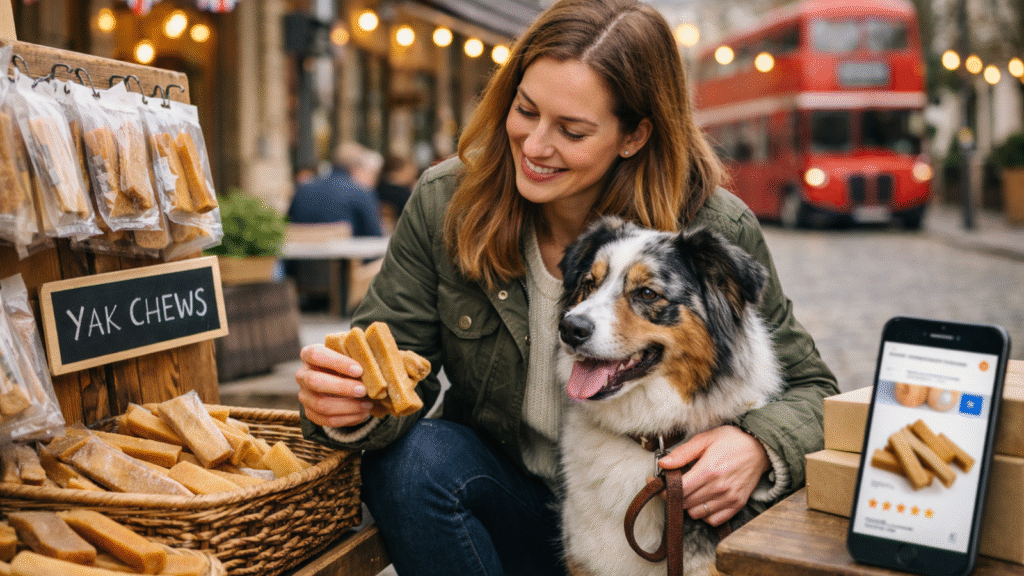
The United Kingdom has a healthy and growing retail ecosystem for yak chews. Buyers have access to specialist pet retailers, brand-direct websites, and major online marketplaces. Each channel carries distinct advantages and risks. Understanding these differences is the fastest way to consistently buy quality products.
Best Places to Buy in the UK: Brand Sites, Specialist Pet Retailers, and Vetted Marketplaces
The 3 most reliable purchase channels for yak chews in the UK are direct brand websites, specialist independent pet retailers, and curated sections of vetted online marketplaces. Each serves a different buyer’s need.
- Brand-direct websites offer the clearest product information, the freshest stock rotation, and direct accountability. Brands that manufacture or exclusively import their products maintain tighter control over freshness and labelling compliance than third-party resellers. Buyers who discover a quality brand worth trusting gain the most value from going direct.
- Specialist independent pet retailers, both physical stores and online, tend to carry pre-vetted product ranges. A reputable independent retailer does not stock 30 variations of the same generic chew. They stock 3 to 5 brands they have personally evaluated. This curated approach is a genuine quality signal. Ask the retailer directly whether they have tested the product on their own animals or visited the brand’s fulfilment operation.
- Vetted sections of major marketplaces (such as Amazon’s Brand Registry listings) carry more accountability than generic third-party seller listings. Fulfilled-by-brand or Fulfilled-by-Amazon (FBA) stock from an identified, branded seller is preferable to a generic listing shipped directly from an unverified overseas account. Always check the seller’s name, the listed business address, and the number of fulfilled orders before purchasing from a marketplace listing.
How to Spot Old, Brittle, or Moisture-Damaged Stock Before Checkout (Photos, Reviews, Pack Cues)
Old or poorly stored yak chews are the most common quality complaint in UK online reviews, and the warning signs are visible before you complete your order. Knowing what to look for saves money and protects your dog.
- Check the product photos critically. Fresh yak chews have a consistent dark amber to mid-brown surface with visible smoke-drying texture. Surface cracking that runs lengthwise along the bar, white powdery patches on the exterior, or an unusually pale colouration all suggest either old stock or incorrect storage before dispatch.
- Read reviews specifically for the words “arrived cracked,” “crumbled,” “hollow,” or “smelled off.” These phrases appear consistently in reviews of compromised stock. One or 2 such reviews in a large pool may reflect transit damage. A cluster of these reviews within a 3-month to 6-month window suggests a systemic stock quality issue with that listing.
- Examine the packaging description carefully. A resealable, sealed-atmosphere pack (vacuum sealed or nitrogen flushed) is the industry standard for quality yak chews. Listings that describe packaging as a simple bag with no mention of sealing method are at higher risk for moisture ingress during transit. The packaging details matter particularly for UK buyers, given the typically humid ambient conditions that accelerate mould formation in improperly stored chews.
Fake or Relabelled Listings: Seller Checks, Origin Clarity, and Batch/Lot Traceability Clues
Relabelled yak chew listings are a genuine problem in the UK online market, and 4 specific checks reveal whether a listing is trustworthy. Those checks are seller identity, declared country of origin, batch or lot code visibility, and ingredient source transparency.
Legitimate yak chew brands declare the country of manufacture clearly on both the listing and the physical pack. Nepal is the primary manufacturing country for genuine Himalayan-style churpi chews. A listing that omits the country of origin entirely is non-compliant with UK labelling requirements for pet food, which is itself a disqualifying signal.
Batch or lot codes printed on the physical packaging allow traceability from the buyer back through the supply chain to a specific production run. The absence of a batch code does not always indicate fraud, but it indicates a manufacturer that has not invested in the traceability infrastructure that responsible UK retailers and individual buyers deserve.
Check the seller’s trading history on the marketplace platform. A seller who has been active for fewer than 6 months, carries multiple unrelated product categories, and shows reviews across those categories is almost certainly a generic reseller with no relationship to the manufacturer. These listings carry the highest risk of relabelled, aged, or improperly stored products.
Great Britain vs Northern Ireland: Why Availability and Delivery Rules Can Differ (What Buyers Notice)
The regulatory and logistical distinction between Great Britain (GB) and Northern Ireland (NI) matters to yak chew buyers in ways that do not apply to most other pet products. Under the Windsor Framework’s Northern Ireland Retail Movement Scheme (NIRMS), pet food moving from Great Britain to Northern Ireland has been covered since 1 October 2023. From 1 July 2025, all such products require individual ‘Not for EU’ labelling under Phase 3 requirements (Northern Ireland Customs and Trade Academy, 2025). Buyers in Northern Ireland should confirm with their seller whether their postcode is covered under standard delivery terms.
Northern Ireland continues to apply European Union (EU) Single Market rules for goods moving between Northern Ireland and the Republic of Ireland, while Great Britain (England, Scotland, and Wales) operates under retained UK domestic regulation. For buyers, the practical effect is that some smaller UK-based yak chew importers fulfill orders to NI addresses differently from GB addresses. Delivery times extend, certain packaging declarations may differ, and occasional listing restrictions apply to NI postcodes.
Buyers in Northern Ireland benefit from explicitly checking with the seller before purchasing whether their postcode is covered under the standard delivery and return terms. Retailers sourcing for NI-based customers apply this check at the procurement stage rather than discovering limitations after an order is placed.
UK Shipping, Storage, and Freshness: Protect Chew Quality from Warehouse to Your Home
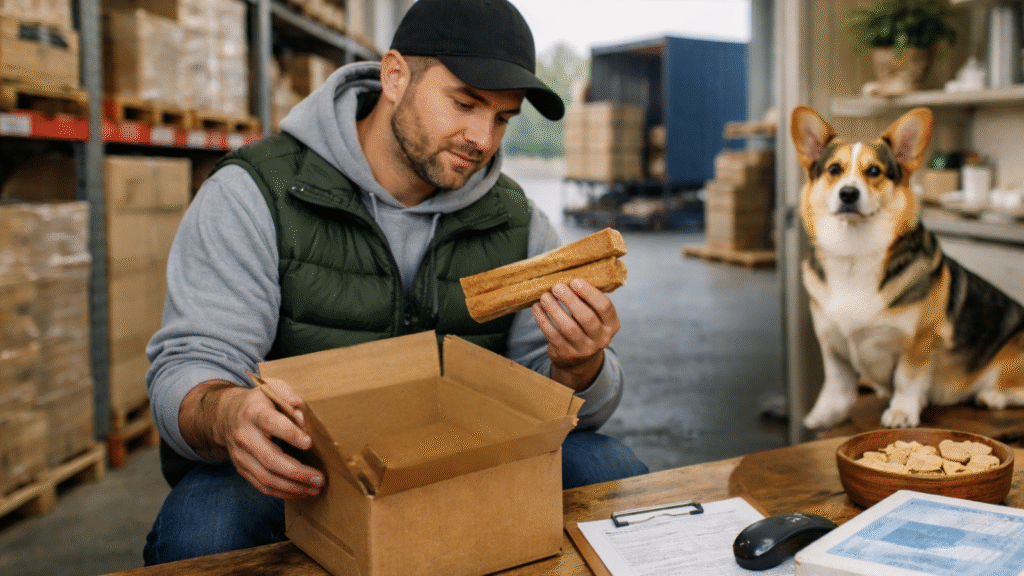
A high-quality yak chew manufactured in Nepal starts its journey well. The challenge is preserving that quality across an international supply chain, a UK warehouse, domestic dispatch, and home storage. Each stage introduces a specific risk. Understanding these risks helps buyers set the right expectations and spot problems early.
UK Delivery Expectations: Dispatch Times, Tracking, and When Express Shipping Matters
UK-warehoused yak chew orders from reputable brands are dispatched within 1 business day to 3 business days, with standard tracked delivery arriving within 2 days to 5 days of dispatch. Direct-from-origin orders, sourced from Nepal-based manufacturers without UK stock, carry lead times of 10 days to 21 days, depending on the shipping method selected.
Express shipping becomes genuinely important in 3 scenarios. The first scenario is the summer months (June to August) in the UK, when ambient temperatures in uncontrolled delivery vehicles increase the moisture reactivation risk in the outer layer of the chew. The second scenario is bulk orders over 5 kg, where a longer transit time in a warm, sealed box creates conditions for mould development on products with borderline moisture content. The third scenario is time-sensitive gifting situations, where delivery failure means no replacement can arrive in time.
Standard tracked shipping through major UK courier networks offers adequate protection for most single-box orders during temperate months. The tracking visibility matters more than the speed for most buyers, since it enables prompt action on delays before product quality degrades in a delayed package.
Packaging That Prevents Cracking and Mould Risk (Seals, Humidity Control, Handling Protection)
The packaging a yak chew arrives in is one of the strongest signals of how much the supplier cares about product integrity from factory to doorstep. A chew can be perfect at the point of manufacture and arrive compromised entirely due to inadequate packaging.
Vacuum-sealed pouches or nitrogen-flushed bags are the 2 most effective packaging formats for preserving yak chew freshness during transit. Both methods remove or displace oxygen, which is the primary driver of surface mould development. Pouches that seal completely around the product without air pockets maintain consistent internal humidity and protect against the physical shock of courier handling.
Thick corrugated outer packaging reduces the fracture risk for the chew itself. Yak bars are dense and brittle. A chew that rattles in a thin poly bag inside a non-padded box arrives cracked more often than most suppliers openly admit. Responsible suppliers nest chews in tissue paper, shredded paper fill, or biodegradable cushioning before sealing. The weight of the outer box relative to the product weight is a useful proxy: a well-packaged 100g chew arrives in packaging that weighs 60g to 100g itself.
Storage Guide for UK Homes: Reseal, Humidity, Shelf-Life Reality, and Warning Signs to Discard
Opened yak chews stored correctly in a UK home environment remain fresh for 4 weeks to 8 weeks, but the UK’s ambient humidity makes improper storage a genuine risk. The average UK indoor relative humidity (RH) ranges from 40% to 70%, depending on season and home type, which is within the risk band for mould formation on high-protein dairy products.
Reseal the packaging completely after each use. Transferring the chew to an airtight glass or hard-plastic container is the most effective long-term storage solution, particularly in older UK homes with poor ventilation or in coastal areas with persistently high ambient humidity. The full yak chews storage guide covers UK-specific humidity conditions, container options, and shelf-life expectations by season. Avoid storing chews in direct sunlight, near radiators, or in areas where temperature fluctuates significantly, such as conservatories or garages.
The unopened shelf life of correctly manufactured and packaged yak chews is 2 to 3 years from the date of production. This figure depends entirely on the product maintaining its sealed, low-moisture atmosphere throughout that period. Once opened, the practical shelf life drops sharply.
Discard a chew immediately when you observe any of 3 warning signs. The first warning sign is visible mould (green, white, or black patches on the surface). The second warning sign is a sour or rancid odour that differs from the normal smoky dairy scent. The third warning sign is significant softening of the chew surface, which indicates moisture absorption has begun internally. No price consideration justifies feeding a compromised chew.
What to Do if Chews Arrive Cracked, Soft, or Suspicious (Returns, Photos, and Supplier Questions)
Documenting the problem within 24 hours of receipt gives you the strongest possible position for a return, replacement, or refund, regardless of the supplier or marketplace. Speed matters here because courier-related damage claims have time windows, and delay weakens your case.
Photograph the package before opening it. Photograph the chews as received. Note the batch code, best-before date, and any visible damage. This 3-step documentation process protects your consumer rights and gives the supplier actionable information to address the underlying problem at their end.
Contact the supplier directly with the photographs and batch code. A supplier worth dealing with long-term takes quality complaints seriously and responds within 1 business day to 2 business days. Suppliers who deflect, blame the courier without investigation, or offer a discount rather than a replacement are demonstrating their customer service standard clearly. That standard is a reliable predictor of future experiences.
Marketplace purchases carry the additional protection of platform buyer guarantees. The UK Consumer Rights Act 2015 (Section 11 ) provides statutory rights for goods not as described, entitling buyers to a full refund within 30 days of purchase if products are faulty, damaged, or fail to match the listed description. A cracked or mould-affected chew clearly falls within this protection.
UK Compliance and Buyer Verification: Labels, Claims, and Trust Signals
The UK pet food regulatory framework applies to dog chews as a category of complementary pet food. Understanding what the rules require helps both individual buyers and retail buyers identify compliant products quickly and avoid liability. Non-compliance in this category is more common than most people expect, particularly among marketplace listings sourced from manufacturers unfamiliar with UK-specific requirements.
UK Label Essentials: What Should Be Printed on the Pack (Ingredients, Best-Before, Business Details, Origin)
A compliant UK yak chew label carries 5 mandatory elements, and the absence of any single element is a compliance gap that responsible buyers flag immediately. Those 5 elements are the product name and species suitability, an ingredients list, analytical constituents, a best-before date or production lot code, and the name and address of the responsible business.
The ingredients list follows UK pet food labelling regulations, which require ingredients to be listed in descending order by weight. Yak milk and cow milk (or combined as “dried milk”) appear first in a compliant product. Lime juice and salt follow. Any additional ingredients require identification by their approved designation, not generic trade names.
Analytical constituents, protein, fat, crude fibre, and moisture, are mandatory for pet food products, including treats and chews. Products missing these values from the label are non-compliant regardless of how they are sold or positioned. This is one of the most reliable quick checks available to a buyer at the point of purchase.
The business details requirement means a UK business name and address (or an EU address for NI-applicable goods), not a website URL or social media handle. A product carrying only a social media account reference or a country-level address without a full postal address is non-compliant under UK pet food regulations.
Country of origin is not universally mandatory for all pet food in all circumstances, but in practice, its absence on a yak chew specifically raises legitimate questions about traceability and producer accountability. Reputable brands declare it voluntarily.
Claims That Need Evidence: “Natural”, “Lactose-Free”, “Dental”, “Hypoallergenic”
4 marketing claims appear frequently on Yak Chews packaging in the UK, and each carries a different evidential standard that buyers and retailers benefit from understanding. Those 4 claims are “natural,” “lactose-free,” “dental,” and “hypoallergenic.”
- The “natural” claim is the most loosely used. In the UK pet food context, “natural” requires that all ingredients are of natural origin with minimal processing. A yak chew made from milk, lime juice, and salt processed through traditional smoke-drying meets this standard. Evidence takes the form of a processing declaration from the manufacturer, ideally supported by a statement from a food technologist or quality assurance (QA) auditor.
- “Lactose-free” is a specific compositional claim requiring analytical evidence. The traditional churpi fermentation and drying process does reduce lactose to very low levels (typically under 0.1%). Responsible manufacturers provide a Certificate of Analysis (COA) from an accredited laboratory confirming the lactose value. A claim without a COA is an assertion, not evidence.
- “Dental” claims require supporting data showing a measurable effect on dental health, typically plaque or tartar reduction. Very few yak chew brands in the UK have this data at the product level. A chew that is hard and mechanically abrasive does have a physical effect on surface plaque, but that effect is not equivalent to clinical dental data. For a detailed look at what the evidence does support, this article on the dental benefits of Himalayan yak chews sets out which claims are substantiated and which are not. Buyers treating a dental claim as a substitute for regular veterinary dental care make a meaningful error.
- “Hypoallergenic” claims are the most susceptible to misuse. The term implies a reduced likelihood of allergic reaction. A yak chew is dairy-based and contains milk proteins, which are a documented allergen for some dogs. Hypoallergenic marketing on a dairy product without allergy-specific testing data is misleading, and buyers whose dogs have documented food sensitivities should consult a veterinarian before introducing any new protein source.
Verifiable Trust Signals: Batch Codes, Traceability, Consistent Analytical Values, and Recall Readiness
The difference between a trustworthy yak chew supplier and a low-accountability one is visible in 4 infrastructure elements that all serious manufacturers have in place. Those elements are batch coding, supply chain traceability, consistent and verifiable analytical values, and a documented approach to recall readiness.
- Batch codes connect every unit sold to a specific production run. A buyer who finds a quality problem in their purchase uses the batch code to report it, allowing the supplier to investigate and contain the issue to that run rather than pulling all stock. The absence of a batch code means the supplier cannot execute a targeted recall, a significant accountability gap.
- Traceability means the manufacturer records which farm supplied the milk for a given batch, the date of processing, the drying duration, and the quality test results for that run. Buyers who ask for this documentation and receive it clearly have found a manufacturer with genuine quality infrastructure. Buyers who receive vague responses or encounter reluctance benefit from treating that reluctance as a meaningful signal.
- Analytical values printed on the pack serve as both a regulatory compliance and a consistency benchmark. A buyer who purchases the same SKU from the same brand 3 times and observes significantly different protein or moisture values across batches has detected an inconsistency that warrants investigation. Responsible manufacturers maintain tight tolerance ranges on analytical results.
- Recall readiness, the ability to identify affected lots, notify customers, and withdraw product from sale efficiently, is the mark of a manufacturer operating to food safety standards. Ask a supplier directly: “What is your recall process, and has it ever been used?” The answer to both parts of that question is informative.
Buyer Checklist for Compliant Listings: What to Request Before First Purchase (Especially Online)
Before placing a first order for any yak chew product online, 6 specific items are worth requesting or verifying. Completing this checklist takes fewer than 10 minutes and significantly reduces the likelihood of receiving a non-compliant or substandard product.
The 6 items are as follows. First, confirm the full product label or packaging image showing all mandatory labelling elements. Second, request or confirm the availability of a COA for the specific product showing analytical constituents from an accredited laboratory. Third, verify the business name and registered address of the seller. Fourth, check the declared country of manufacture. Fifth, confirm the best-before date of the batch currently being dispatched. Sixth, ask for the batch code format so you know what to look for on the physical pack upon arrival.
Sellers who respond promptly and completely to these requests demonstrate accountability. Sellers who deflect, provide incomplete answers, or fail to respond within 2 business days of a pre-purchase query are demonstrating their post-purchase customer service standard. That information is valuable before you commit.
B2B UK Sourcing: Wholesale/Private Label Readiness (Documents, Testing, and Import Workflow)
The UK wholesale market for yak chews represents a significant opportunity for pet retailers, distributors, and private-label brands who understand the compliance landscape thoroughly. The barriers to entry for compliant UK retail or wholesale of yak chews are real but manageable. The retailers and buyers who succeed in this category are the ones who build supplier relationships with verified documentation from day one, rather than attempting to retrofit compliance after a product has been listed.
How UK Retailers Vet a Yak Chew Manufacturer: Process Control, Hardness Consistency, HACCP Mindset
Serious UK retailers apply a 3-stage vetting process to any new yak chew manufacturer, and suppliers who understand this framework close faster and retain customers longer. Those 3 stages are documentation review, sample evaluation, and process audit (remote or physical).
Documentation review begins with the manufacturer’s Hazard Analysis and Critical Control Points (HACCP) plan or equivalent food safety management documentation. A manufacturer claiming HACCP compliance without a documented plan is describing an aspiration, not a system. Retailers request the plan, not just a statement of compliance. ISO 9001 certification from an accredited body (not a self-declaration) provides additional process confidence. Facilities that are registered with the US Food and Drug Administration (FDA) carry internationally recognised process accountability, though this registration does not substitute for UK-specific compliance requirements.
The sample evaluation focuses on hardness consistency. A retailer ordering 50 kilograms (kg) of medium bars needs every bar in that shipment to fall within the same hardness tolerance range. Retailers building a shortlist of vetted manufacturers can cross-reference against this independently compiled review of top Himalayan yak chew suppliers before requesting samples. Significant variation within a single batch indicates inconsistent pressing pressure or uneven drying. Retailers who evaluate 3 separate samples from 3 separate production runs before committing to a first bulk order have the data needed to make a reliable assessment.
Process mindset assessment is less tangible but equally important. A manufacturer who proactively shares production records, welcomes questions about ingredient sourcing, and demonstrates familiarity with UK-specific import requirements is demonstrating the kind of operational culture that makes a long-term supply relationship viable.
YforYak Dog Chews, a Nepal-based yak chew manufacturer and exporter operating from Tokha, Kathmandu, positions itself explicitly for this kind of relationship. The company claims a capacity of up to 50,000 kg per month, ISO 9001 certification, FDA-registered facility status, and HACCP compliance. UK retailers evaluating YforYak as a supplier apply this 3-stage process rigorously, requesting certificates and COAs directly, as the company invites, rather than treating claims as verified.
UK Wholesale Compliance Pack: Specs, COA, Shelf-Life, Traceability, Packaging Declarations
A complete UK wholesale compliance pack from a yak chew manufacturer contains 7 document categories, and a supplier who delivers all 7 without being asked for each individually demonstrates genuine export readiness. Those 7 categories are product specification sheets, certificates of analysis, shelf-life data, traceability records, packaging declarations, country of origin certificates, and a labelling compliance statement for the UK market.
- Product specification sheets define every measurable characteristic of the product, dimensions, weight bands, hardness range, colour, odour, analytical values, and microbiological limits. These specifications form the foundation of a purchase order and the basis for a quality dispute. Without a formal spec sheet, a buyer has no contractual reference point for rejecting non-conforming stock.
- Certificates of Analysis from an accredited third-party laboratory confirm that a specific batch meets the specification. COAs issued by the manufacturer’s own in-house lab carry less weight than those from accredited external laboratories, though in-house data is better than no data. UK wholesale buyers request both when available.
- Shelf-life data supports stock rotation planning and regulatory compliance. A stated shelf life of 24 months to 36 months is standard for correctly manufactured and packaged yak chews. This claim requires supporting stability data, real or accelerated, not a manufacturer’s assertion alone.
- Packaging declarations confirm that the packaging materials are food-contact safe, which is a requirement under UK food packaging regulations. This is frequently overlooked by first-time UK importers of yak chews and creates compliance exposure at the point of retail listing.
Import into the UK (B2B): Testing Expectations, Health Cert Logic, IPAFFS-Style Notification Planning
Importing yak chews into the United Kingdom from Nepal as a pet food product triggers specific border control and notification requirements that differ from importing general merchandise, and understanding these requirements before placing a first order prevents costly delays at port. UK importers are required to pre-notify APHA via IPAFFS at least one working day before a POAO consignment’s expected arrival at an approved Border Control Post, a mandatory step under the UK Border Target Operating Model (GOV.UK, updated January 28, 2025 guidance).
Yak chews, as processed dairy-derived pet treats, fall under the category of products of animal origin (POAO). Their classification at the UK border determines the documentation requirements and whether physical or documentary checks apply. UK importers work with a border control post (BCP) on the requirements for their specific product category. This classification step is not optional; it is the logical starting point for any UK import plan.
Health certificates are required for POAO imports from most non-EU third countries. The certificate format and issuing authority requirements vary by origin country and product type. Nepal does not hold a blanket bilateral equivalence agreement with the UK for all animal product categories, which means certificate requirements benefit from verification with the UK Animal and Plant Health Agency (APHA) or a qualified import agent before the first shipment.
Testing expectations at the UK border reflect a risk-based approach. Products from new suppliers with no import history into the UK face a higher likelihood of documentary and physical inspection than established supply relationships. Importers who build a track record of compliant shipments with full documentation over 3 to 5 consignments typically see reduced inspection frequency over time.
Private Label for the UK Market: Compliance-First Artwork, Barcodes, and Marketplace-Ready Listings
A private label yak chew for the UK market requires artwork that is built around compliance first and brand aesthetics second, and getting this order of priorities reversed is the single most common and costly mistake new UK private-label buyers make. A beautiful label that fails to meet UK pet food labelling requirements is unpublishable on any compliant UK retail platform.
- Compliance-first artwork incorporates all mandatory labelling elements into the design before the brand identity elements are applied. This means the product name, species suitability, ingredients list, analytical constituents, best-before dating format, responsible business details, country of origin, and net quantity are locked in place before fonts, colours, and logos are chosen. Artwork that requires retrospective compliance additions almost always compromises the visual design.
- Barcodes for UK retail require an International Article Number (EAN) registered through GS1 UK. A product without a valid EAN barcode is not listable on major UK retail platforms, including Amazon UK and major pet specialty chains. The registration process through GS1 UK takes 3 days to 7 days and involves an annual fee based on the number of SKUs. Factoring this into the private-label timeline from the start avoids launch delays.
- Marketplace-ready listings extend compliance beyond the physical packaging to the digital product listing. Amazon UK, Zooplus, and other major UK online pet retail platforms require product titles, descriptions, and bullet points that do not include prohibited claims or non-evidenced health assertions. A listing review against platform-specific guidelines, conducted before the listing goes live, prevents the account penalties and listing suppression that follow a non-compliant upload.
YforYak supports private-label clients through the export documentation, packaging, and compliance declaration stages of this process. UK buyers considering a private-label partnership with a Nepal-based manufacturer of this kind should apply the complete vetting and documentation framework described throughout this guide. The opportunity is real, the compliance pathway is clear, and the UK pet treat market rewards suppliers and retailers who get it right from the start. Reach out to the YforYak team to discuss private-label requirements, MOQs, and documentation packs tailored to UK market entry.