
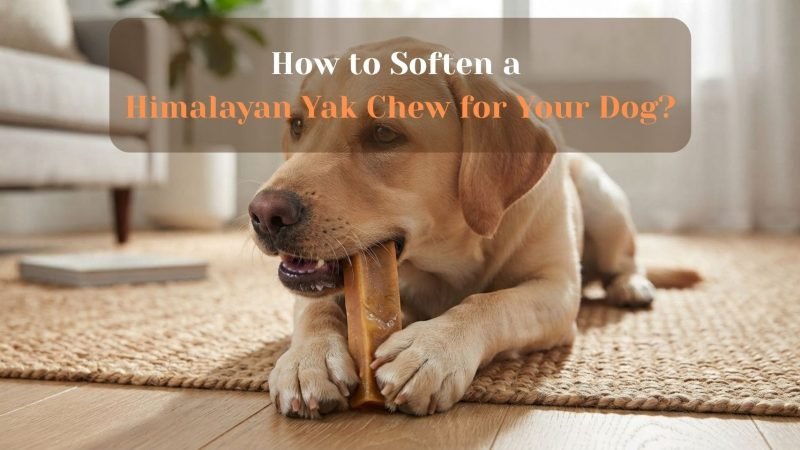
A Himalayan yak chew is naturally extremely hard; to significantly soften a whole chew, it must be boiled in water for 10 to 15 minutes, as warm water soaking cannot penetrate the dense core. Controlled boiling provides the necessary softening for dogs with significant dental limitations, puppies, or senior dogs, while microwaving is strictly reserved for safely puffing small remnant pieces.
A Himalayan yak chew is a dense, smoke-dried and sun-dried milk-protein dog chew made from yak milk, cow milk, lime juice, and salt, hardened through weeks of traditional smoking and high-altitude drying, designed to provide prolonged chewing and mental stimulation. Softening adjusts the chew’s hardness for puppies, senior dogs, small-breed dogs, and dogs with dental sensitivity without changing the basic chew itself. Safe preparation also depends on correct chew size, the dog’s chewing behavior and oral condition, direct supervision, session duration, piece removal, and proper storage after rehydration.
How Can You Soften a Himalayan Yak Chew With Warm Water?
Warm water soaking at 90°F to 110°F (32°C to 43°C) for 5 to 25 minutes is an effective method for mild surface hydration, releasing aroma and slightly loosening the outermost layer without compromising core density. The chew’s compressed milk protein matrix absorbs moisture evenly within this temperature range, softening the outer surface while the core retains enough density to function as an extended chew. Water above 130°F (54°C) degrades surface proteins unevenly, creating inconsistent texture zones that introduce new risks.
The warm water method works because Himalayan yak chews are hygroscopic; their dense, dry milk solids draw in moisture from the surrounding water. This rehydration mimics the natural salivation that occurs inside a dog’s mouth, softening the outer perimeter to jump-start interest while leaving the deeper core firm.
What Steps Should You Follow to Soften the Chew?

To soften a Himalayan yak chew using warm water, complete these 5 steps in sequence:
- Select a deep container, tall enough that the chew stays fully submerged without floating. A shallow bowl causes uneven softening because part of the chew remains exposed above the waterline.
- Fill the container with water at 90°F to 110°F (32°C to 43°C). Use a kitchen thermometer for the first 2 to 3 sessions until you gauge the correct temperature by feel.
- Submerge the chew completely and flip it once at the midpoint of your soak time to ensure even moisture absorption across both sides.
- Remove and pat dry with a clean cloth or paper towel. A wet chew drips, creates a mess, and becomes harder for your dog to grip during the session.
- Allow the chew to cool to room temperature for 5 minutes before serving. Heat retained in the core dissipates during this rest period.
One detail most preparation guides omit: the container shape matters. A cylindrical glass or tall food container keeps the chew upright and submerged with no effort. A flat, shallow bowl requires constant repositioning to achieve the same result, and uneven soaking is the predictable outcome.
How Long Should a Yak Chew Be Soaked?
Soaking duration depends directly on the chew’s size and the target softness level. The following times apply when using water held at 90°F to 110°F (32°C to 43°C):
| Chew Size | Weight Range | Light Softening | Moderate Softening |
| Small | Under 2 oz (56 g) | 5 minutes | 10 minutes |
| Medium | 2–4 oz (56–113 g) | 8 minutes | 15 minutes |
| Large | 4–6 oz (113–170 g) | 10 minutes | 20 minutes |
| Extra Large | Over 6 oz (170 g+) | 12 minutes | 25 minutes |
A soak exceeding 30 minutes degrades the chew’s structural integrity. At that threshold, the outer layer begins to dissolve rather than simply rehydrate, producing smaller breakaway pieces that increase choking risk rather than reduce it.
The thumbnail test confirms surface give (1 to 2 mm) after soaking, but owners of dentally vulnerable dogs should note that this elasticity is limited to the outer layer; true core softening requires boiling.
Why Would You Want to Soften a Himalayan Yak Chew?
4 primary conditions justify softening a Himalayan yak chew: age-specific dental vulnerability in puppies and senior dogs, anatomical size constraints in small-breed dogs, post-dental-procedure recovery, and the introductory period when a dog encounters a yak chew for the first time.
Himalayan yak chews are classified as hard chews under veterinary dental guidelines. Hard chews carry a risk of tooth fracture when the chew’s resistance exceeds the enamel tolerance of the dog receiving it. Board-certified veterinary dentists and the American Veterinary Dental College (AVDC) recommend applying the thumbnail test to any hard chew before giving it to a dog. If your thumbnail leaves no visible indentation, the chew exceeds safe hardness for most dogs.
Softening does not reduce the chew’s nutritional value. The protein content of a Himalayan yak chew, typically between 60 and 69 grams per 100 grams of chew per a 2023 Journal of Ethnic Foods analysis, remains intact through controlled preparation. What changes is the surface texture, which determines whether a given dog accesses the chew’s benefits safely or is excluded from them by hardness alone.
Can Puppies, Senior Dogs, and Small Dogs Benefit From a Softer Chew?
Yes, puppies aged 4 to 12 months, senior dogs aged 7 years and older, and small-breed dogs under 22 pounds (10 kg), including Chihuahuas, Shih Tzus, Toy Poodles, Yorkshire Terriers, and Miniature Dachshunds, are the 3 populations that benefit most directly from a softened Himalayan yak chew.
Puppies between 3.5 and 7 months are actively losing deciduous teeth and erupting all 42 permanent teeth. Even after the transition completes around 6–7 months, developing enamel and lower bite force in young dogs under 12 months still justify a softer chew. Puppy enamel is thinner, and developing bite force is considerably lower than that of an adult dog of the same breed. A standard hard yak chew during this developmental window creates a genuine fracture risk. A properly boiled and cooled chew delivers the jaw exercise and mental stimulation puppies require without subjecting fragile enamel to dangerous impact forces.
Senior dogs, typically 7–8 years and older for large breeds and 10–12 years and older for small breeds, frequently experience periodontal disease, enamel erosion, exposed roots, or missing teeth. Hard chews aggravate these conditions or cause pain that results in the dog abandoning the chew entirely. A softened chew keeps senior dogs engaged in healthy chewing behavior, which supports jaw muscle maintenance and reduces plaque accumulation on remaining teeth.
Small-breed dogs, including Chihuahuas, Shih Tzus, Toy Poodles, Yorkshire Terriers, and Dachshunds, have anatomically narrower jaws and proportionally smaller molars relative to their bite pressure. A large, hard yak chew forces these dogs to chew at extreme lateral angles to generate sufficient leverage, creating biomechanical stress on the temporomandibular joint over time. Sizing down and softening the chew simultaneously reduces joint stress and makes each session productive rather than frustrating.
When Is a Yak Chew Too Hard for a Particular Dog?
A Himalayan yak chew is too hard for a specific dog when the thumbnail test fails: pressing your thumbnail into the chew surface leaves no visible indentation. This benchmark applies equally to antlers, hooves, compressed bones, and hard nylons. Any chew that resists a thumbnail impression exceeds safe hardness for most dogs across all size and age categories.
Beyond the physical test, 3 behavioral signals during a chewing session confirm that a chew exceeds the appropriate hardness for that individual dog:
- The dog chews exclusively on one side of the mouth, a consistent pattern across multiple sessions that indicates jaw pain or tooth sensitivity on the avoided side.
- The dog approaches the chew, mouths it briefly, then walks away, repeated across 3 or more sessions; this signals discomfort rather than disinterest.
- The dog produces audible cracking or snapping sounds during chewing; this signals tooth-on-hard-surface contact at pressures that risk slab fractures on premolars and carnassial teeth.
Any single behavior from this list warrants softening the chew before the next session or transitioning to a softer chew category entirely.
Which Methods Are Safest for Softening a Yak Chew?
3 primary methods adjust the texture of a Himalayan yak chew: controlled boiling (the only reliable method for deep core softening of whole chews), warm water soaking (for light surface hydration and scent enhancement), and microwaving (for turning small remnant pieces under 1 inch / 2.5 cm into crunchy puffs). Each method produces a distinct texture outcome and applies to a specific use case.
Controlled simmering is the primary method when substantial softening is required, whereas warm water soaking serves as a gentle, surface-level introduction for dogs with healthy adult teeth. Boiling produces a more uniformly soft chew appropriate for dogs with advanced dental disease or post-surgical recovery. Microwaving transforms unusable remnant pieces into a safe puffed treat; it is not a softening method for whole or large chews, and using it as such creates harm rather than preventing it.
Should You Boil a Himalayan Yak Chew?
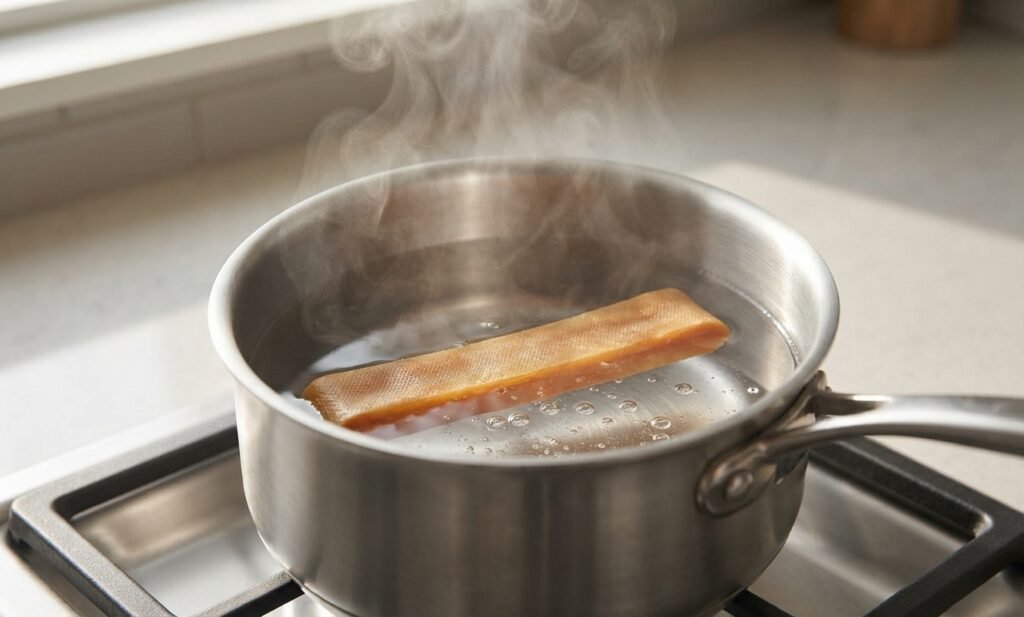
Controlled boiling is the standard method for physically softening whole yak chews, making them suitable for puppies, seniors, and dogs with periodontal vulnerability or low bite force.
To boil a yak chew correctly, follow this 4-step process:
- Place the chew in a pot of cold water; starting in cold water prevents the outer layer from hardening on contact with sudden heat.
- Bring the water to a gentle simmer at 180°F to 200°F (82°C to 93°C). Avoid a rolling boil; the turbulence causes uneven softening and material loss from the chew’s surface.
- Maintain the simmer for 15 to 20 minutes. Simmering beyond 25 minutes begins to dissolve the outer protein layer rather than rehydrate it.
- Remove the chew and cool it completely at room temperature for a minimum of 20 minutes. The interior retains heat longer than the surface, serving the chew warm risks oral burns.
The primary trade-off with boiling: a boiled chew loses approximately 40 to 60% of its durability compared to a warm-water-soaked version of the same size. It functions as a short-session chew rather than an extended activity. Boiling is a situation-specific preparation method for dogs with genuine dental limitations, not a shortcut for dogs who simply prefer a softer texture.
Boiling intensifies the cheese’s natural milk odor considerably. Plan for this in enclosed indoor spaces.
Can You Microwave a Himalayan Yak Chew?
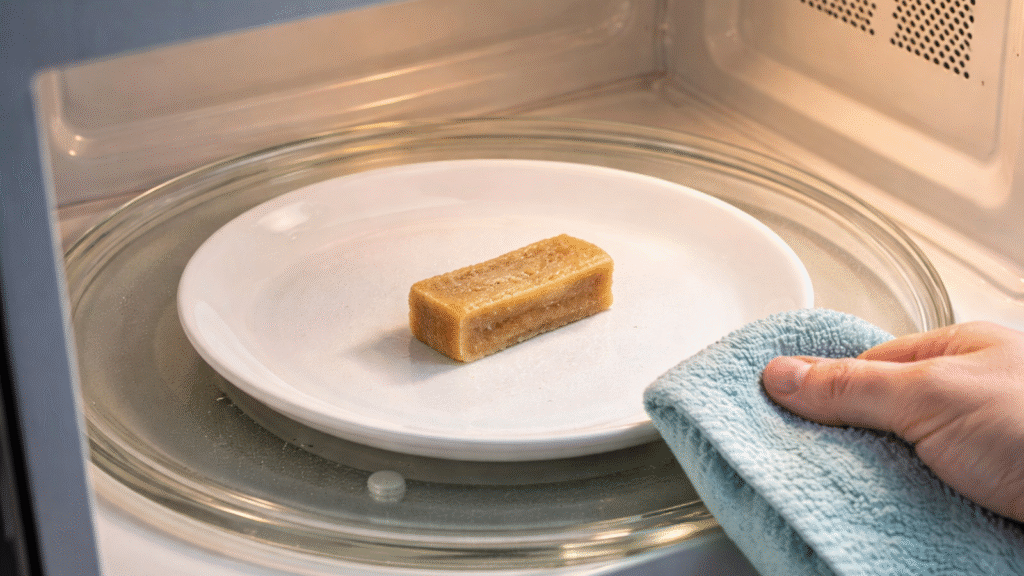
Yes, but microwaving applies exclusively to yak chew remnant pieces under 1 inch (2.5 cm) in length; microwaving a whole or large yak chew produces uneven texture, localized hardening, and surface splintering.
Small yak chew remnants expand and puff when microwaved on high power for 45 to 60 seconds. The moisture trapped inside the dense remnant vaporizes rapidly, causing it to inflate into a light, crunchy, cheese-puff-like treat. Dog trainers use this technique widely in recall training and enrichment sessions because the puffed texture crumbles immediately under minimal bite pressure, making it accessible to any dog without chewing force.
The correct process for microwaving yak chew remnants:
- Soak the remnant piece in warm water for 5 to 10 minutes, then place it on a microwave-safe plate. The absorbed moisture allows the piece to puff up safely and evenly without scorching.
- Microwave on high power for 45 to 60 seconds. Monitor actively; the piece expands rapidly in the final 15 to 20 seconds and scorches if left unattended.
- Allow the puffed piece to cool for a minimum of 5 minutes. The interior temperature after microwaving exceeds the surface temperature by 15 to 20°F (8 to 11°C), and serving immediately risks oral burns.
- Break the puffed treat into 3 to 4 size-appropriate pieces before serving to your dog.
Microwaving a whole yak chew causes the outer moisture layer to vaporize unevenly. The result is a hardened exterior crust surrounding a wet interior, a two-texture result that introduces irregular fracture points and sharp edges. This is the opposite of softening.
How Should You Prepare and Serve a Softened Yak Chew?
A softened Himalayan yak chew requires 2 preparation steps before serving: surface inspection for uneven softening zones and size verification against the dog’s oral anatomy. Both steps take under 2 minutes and directly reduce the primary risks associated with session-time piece breakage.
Surface inspection involves running your fingers along the entire chew after it cools. Locate spots where softening appears uneven, zones that remained dense despite soaking. These localized hard spots arise when part of the chew stays above the waterline during soaking or when the chew’s internal compression is denser in that zone during manufacturing. An additional 5-minute soak corrects most uneven spots. A sharp kitchen knife removes persistent ones.
Size verification confirms the softened chew’s longest dimension exceeds the width of your dog’s open mouth at its widest point. A chew that fits entirely inside the mouth creates a swallowing hazard regardless of its softness level. The soaking process occasionally reduces a chew’s length by 1 to 3 millimeters through surface material loss; re-verify every time before serving.
How Can You Reduce the Risk of Choking or Swallowing Large Pieces?
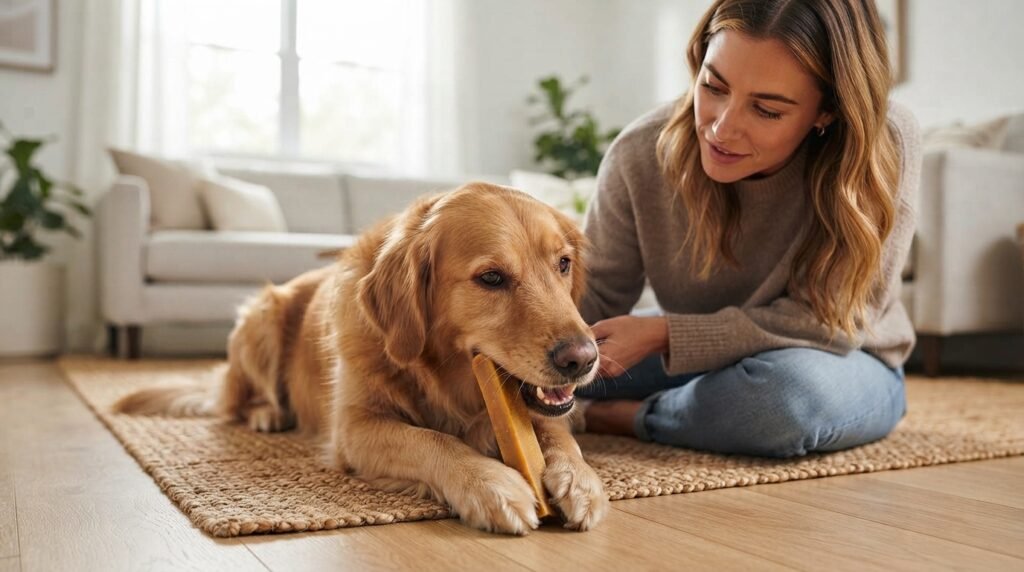
Choking risk with a softened yak chew decreases through 4 specific practices: direct supervision during every session, removal when the chew reaches 2 inches (5 cm) in remaining length, correct size selection at purchase, and avoiding sessions when the dog is in a highly excited or food-driven state.
Dogs choke on yak chew pieces under a specific condition: the chew softens to the point where larger fragments break off, and the dog, excited by the sudden availability of loose material, swallows without adequate chewing. Softening without session management produces this condition rather than preventing it.
The 2-inch (5 cm) removal rule is the single most practical checkpoint in any chew session. When the remaining piece reaches this length, remove it immediately. Microwave it using the puffing method if it measures under 1 inch, or discard it if it falls between 1 and 2 inches and your dog weighs under 25 pounds. At 2 inches, most dogs can position the piece entirely behind their back molars and attempt to swallow it as a single unit.
Supervision is the foundational safety measure. No preparation or softening method substitutes for direct visual oversight, particularly during the first 3 to 5 sessions with a new chew or after any change to the softening method used.
How Should You Store a Softened Yak Chew?
A softened yak chew is stored in a sealed container or zip-lock bag in the refrigerator for up to 48 hours at 34°F to 40°F (1°C to 4°C). Refrigeration slows bacterial colonization on the moistened protein surface and firms the outer layer slightly, useful when a chew was soaked longer than the target time.
Surface mold appears on an unprotected softened yak chew within 18 to 24 hours in warm or humid environments above 68°F (20°C). The moist protein surface creates conditions that support rapid microbial growth once the drying effect of the original manufacturing process is reversed by soaking. A sealed refrigerator eliminates this risk within the 48-hour window.
Do not freeze a softened yak chew. Freezing disrupts the rehydrated protein matrix. Upon thawing, the chew develops an inconsistent texture, brittle and crumbly in some zones, overly soft in others, which creates unpredictable chewing dynamics. Dry, unsoaked yak chews freeze well as an intentional texture variation for powerful adult chewers, but a chew that has been rehydrated through soaking does not share this property.
Before re-serving a refrigerated chew, allow it 15 minutes at room temperature. Cold chews cause some dogs to hesitate, and the lower surface temperature creates brief brittleness that disappears within minutes of warming.
What Should You Avoid When Softening or Giving a Yak Chew?
4 preparation errors account for the majority of safety issues associated with softened yak chews: soaking beyond 30 minutes, microwaving a whole chew, serving without supervision, and ignoring chewing behavior changes that signal difficulty or pain.
Most preparation errors trace back to one of two false assumptions: that softer always means safer, or that softening eliminates the need for active session management. Both are incorrect. Softening is a targeted texture adjustment, effective only when matched to the dog’s specific needs and paired with appropriate chew selection, sizing, and supervision.
What Handling and Preparation Mistakes Should You Avoid?
The 6 most common handling and preparation mistakes are:
- Using boiling water directly for soaking rather than for controlled simmering. Boiling water at the soaking stage causes the outer protein layer to dissolve unevenly, leaving a pitted, irregular surface rather than a uniformly softened one.
- Soaking and then air-drying the chew to restore a firmer texture. This permanently alters the protein structure and creates brittle, fracture-prone sections that did not exist in the original unsoaked chew.
- Using flavored liquids, broth, juice, or meat-flavored water as the soaking medium. Added sugars and elevated sodium in most commercial broths coat the chew surface, increasing dental plaque formation and making the chew more calorie-dense than intended.
- Leaving the softened chew in standing water between sessions. Extended post-soak submersion is not storage; it is continued soaking that progressively disintegrates the chew over hours.
- Skipping the size re-check after softening. A chew that measured the correct length before soaking may have lost 1 to 3 millimeters during the process. Verify the length every time before serving.
- Applying external heat, a hairdryer, oven, or direct sunlight, to accelerate cooling. Rapid external drying creates a hardened outer crust with a wet interior, a two-zone texture that removes the uniformity that makes a properly softened chew safe.
When Should You Stop Giving Your Dog the Chew?
Stop the chewing session immediately when any 1 of these 5 conditions occurs: the dog shows distress signals such as whining, pawing at the mouth, or excessive drooling; the chew reaches 2 inches (5 cm) or shorter in remaining length; a piece breaks off that exceeds the dog’s safe chewing size; the dog begins gulping without chewing; or the session has continued for more than 20 continuous minutes.
Chew sessions function best in 15- to 20-minute supervised intervals rather than extended free-access periods. Extended sessions increase the probability of piece breakage as the dog’s chewing becomes less controlled, introduce fatigue-related gulping behavior, and risk overconsumption in dogs with sensitive digestive systems. 1 supervised session per day represents the appropriate frequency for most dogs, rotating the yak chew with other chew types rather than giving it multiple times daily.
When Should You Throw Away a Softened Himalayan Yak Chew?
Discard a softened yak chew under 3 conditions: the piece measures under 2 inches (5 cm) and you do not plan to microwave and puff it; the chew shows visible mold or discoloration; or more than 48 hours have elapsed since softening, even under refrigeration.
A softened chew stored beyond 48 hours, even in a properly sealed container at the correct temperature, undergoes continued protein breakdown at the surface level. Bacterial load increases progressively after the chew’s original dry state is disrupted by soaking. The chew may appear and smell acceptable to the owner, but the surface microbial environment exceeds what is advisable for a treat that contacts the dog’s oral mucosa over extended chewing periods.
Discoloration on a softened yak chew presents as gray, green, or black surface patches. These patches indicate mold colonization, which begins within 18 hours on a moist protein surface kept at room temperature above 68°F (20°C). Gastrointestinal distress results from most surface mold exposure in dogs. Mycotoxin-producing mold strains produce more serious systemic effects that require veterinary attention.
The 2-inch (5 cm) removal threshold reflects the oral anatomy of the average dog across common weight classes. A piece at or below this length fits entirely past the back molars or pushes to the back of the throat during a swallowing motion, the 2 physical conditions that lead to choking or esophageal obstruction, regardless of how softened the chew is.
What Should You Do With Small Leftover Pieces?
Microwave remnant pieces under 1 inch (2.5 cm) on high power for 45 to 60 seconds to convert them into a safe, puffed treat that any dog consumes without chewing pressure or tooth fracture risk.
This technique appears consistently in dog training and small-animal nutrition communities and is recommended by many enrichment practitioners as a zero-waste approach to yak chew remnants. The puffed result carries no structural resistance; it crumbles under minimal bite pressure and dissolves quickly in the mouth, which eliminates both choking risk and dental impact risk simultaneously.
Break the puffed treat into 3 to 4 pieces sized appropriately for your dog before serving. For dogs under 25 pounds (11 kg), pieces no larger than a standard blueberry are appropriate. For dogs over 50 pounds (23 kg), half of the puffed piece serves as one unit.
Remnants measuring between 1 and 2 inches (2.5 to 5 cm) require a size-based judgment call. For dogs over 40 pounds (18 kg), pieces in this range typically puff and expand successfully in the microwave. For dogs under 25 pounds (11 kg), discard mid-sized remnants rather than risk uneven expansion that produces irregular, potentially hard fragments.
What Are the Most Common Questions About Softening Himalayan Yak Chews?
This section addresses the 6 most frequently asked questions about yak chew softening, based on real patterns observed across puppy socialization classes, senior dog care settings, and small-breed owner communities.
Can Himalayan Yak Chews Be Softened?
Yes, Himalayan yak chews can be modified through 3 specific techniques: controlled boiling for 10 to 15 minutes for true core softening, warm water soaking for light surface softening, and microwaving pre-soaked remnant pieces to create puffed treats. The chew’s milk protein base responds directly and predictably to moisture and heat within these ranges. Protein rehydration occurs reliably at the temperatures and durations described, allowing controlled texture adjustment without destroying the nutritional integrity that makes the chew a worthwhile long-term treat.
How Can You Make a Yak Chew Softer for a Puppy?
Controlled boiling for 10 to 15 minutes produces the appropriately softened core texture safely required for puppies aged 4 to 12 months. Select a small-format chew, 1 to 2 ounces (28 to 56 grams) for puppies under 25 pounds, before soaking. A correctly sized chew that is briefly soaked is safer than an oversized chew that is extensively soaked, because correct sizing controls piece-break dynamics throughout the session regardless of softness level.
Puppy chew sessions with a softened yak chew work best in 10- to 12-minute intervals. Puppies have shorter attention spans and lower chewing stamina than adult dogs. Short, enriching sessions achieve the developmental goal, jaw stimulation and enamel-safe chewing engagement, without the fatigue-related gulping that extended sessions introduce in young dogs.
How Can You Soften a Yak Chew for a Senior or Small Dog?
Senior dogs and small-breed dogs benefit from a 10- to 15-minute controlled boil, which produces a deeply softened texture that safely accommodates reduced bite pressure and mild dental sensitivity. For senior dogs with significant periodontal disease, bone loss, or multiple missing teeth, the 15-minute controlled simmering method produces deeper softening appropriate for dogs with severe dental limitations.
Pair the correct soak duration with the correct chew size. A small-breed dog receiving a medium- or large-format yak chew, even one that is thoroughly softened, faces the biomechanical challenge of maneuvering a piece that exceeds the dog’s comfortable jaw aperture. Size selection happens at purchase, not as an afterthought during preparation.
Is a Softened Yak Chew Safer for Every Dog?
No, a softened yak chew is specifically safer for age-vulnerable and size-specific dog populations but does not universally reduce risk for every dog. For large-breed adult dogs with healthy teeth and established power-chewing behavior, softening reduces the chew’s durability without meaningfully changing its safety profile. These dogs consume a softened chew faster, which reduces session length, increases piece-break frequency, and accelerates the timeline to the 2-inch removal point.
For dogs with a documented tendency to gulp food or treats without chewing, no softening method addresses the core risk. Gulp behavior is a feeding pattern rather than a response to chew texture. Behavioral management, hand-feeding broken pieces, using a lick mat to redirect, and shortening session intervals address gulping directly. Softening alone does not.
How Can a Dog-Safe Chew Routine Include a Himalayan Yak Chew?
A dog-safe chew routine positions the Himalayan yak chew as 1 of 3 to 4 rotating chew types, used in 15- to 20-minute supervised sessions no more than once per day, with the softening method calibrated to the individual dog’s age, size, and dental condition.
Chew rotation prevents habituation. A dog receiving the same chew every day develops increasing efficiency at breaking it down, sessions shorten, piece-break frequency increases, and the safety window narrows progressively. Rotating among a Himalayan yak chew, a rubber chew toy, and a softer natural option such as a collagen stick distributes chewing wear across different jaw muscle groups and maintains novelty that extends each session’s engagement value.
For dogs new to yak chews, begin with a softened version for the first 3 to 5 sessions, regardless of the dog’s age, size, or breed. This introductory period allows the owner to observe how the individual dog interacts with the texture, chewing pattern, session pace, piece-break frequency, and response to the chew’s density before transitioning to the standard dry hardness level.
Track session duration per chew type. A dog consuming a medium-sized yak chew in under 10 minutes is chewing at a pace that exceeds the chew’s intended use rate. Two adjustments correct this pattern: move to a larger chew size, or serve the chew at a firmer hardness level by reducing soak time in 2-minute increments until sessions extend to the target 15- to 20-minute range.
Can a Business That Sells Himalayan Yak Chews Help You Choose an Appropriate Chew?
Yes, a reputable Himalayan yak chew supplier provides size-matching guidance, hardness descriptions by size tier, and full ingredient sourcing information that directly informs both the purchasing decision and the softening approach before the chew arrives.
Selecting the correct chew size at purchase is as important as the softening method applied afterward. A chew that is too small for the dog reaches the 2-inch removal threshold faster than expected, regardless of how carefully the session is managed. A chew that is too large for a small or young dog creates maneuvering difficulties that softening cannot compensate for.
YforYak sources its Himalayan yak chews directly from Kathmandu, Nepal, using traditional yak cheese preparation methods, only yak milk, cow milk, lime juice, and salt. Each size tier is matched to a specific dog weight range, and the consistent hardness of every chew responds predictably to the warm water and boiling softening methods described throughout this guide. Explore YforYak Himalayan Yak Chews →
What Are the Key Takeaways About Safely Softening a Himalayan Yak Chew?
The 7 key principles for safely softening a Himalayan yak chew are:
- Controlled boiling at a gentle simmer for 10 to 15 minutes is the primary and safest method for softening whole chews, particularly for puppies, seniors, or dogs with dental vulnerabilities.
- Controlled boiling at a gentle simmer for 15 to 20 minutes produces deeper softening for dogs with significant dental limitations, a situation-specific method that reduces chew durability by 40 to 60%.
- Microwaving applies to remnant pieces under 1 inch (2.5 cm) only; high power for 45 to 60 seconds transforms remnants into a safe puffed treat; whole or large chews never go in the microwave.
- The 2-inch (5 cm) removal rule governs every session: remove the chew when it reaches this length; microwave it if under 1 inch; discard it if between 1 and 2 inches for dogs under 25 pounds.
- Puppies, senior dogs, and small-breed dogs are the 3 primary populations that benefit from softened chews. Softening is always paired with correct size selection, not used as a substitute for it.
- Refrigerate softened chews in a sealed container for up to 48 hours; do not freeze; do not leave in standing water; do not store uncovered at room temperature in warm environments.
- Direct supervision during every chew session is the single most effective safety measure, independent of softening method, chew size, or session duration.
A Himalayan yak chew prepared correctly for the individual dog receiving it delivers meaningful, measurable benefits: extended mental stimulation, jaw muscle engagement, and natural mechanical plaque reduction on tooth surfaces. Softening is not an indicator of a lesser product; it is the mark of an owner who understands their dog’s specific needs and applies that knowledge at preparation time.