
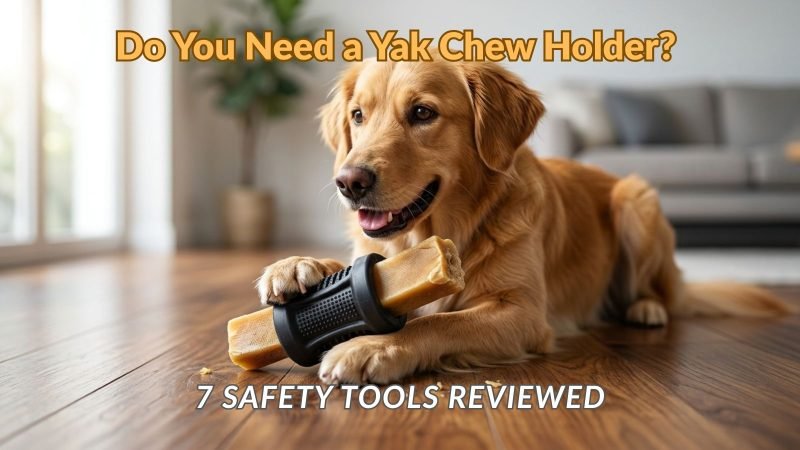
A yak chew holder earns its place the moment a hard chew wears down to its last two or three inches. At that size, a yak milk chew stops behaving like a treat and starts behaving like a hazard, small enough for a dog to fit the whole piece in their mouth, still dense enough to lodge in the throat or gut on the way down. Care-cost surveys in recent years report average emergency surgical bills for ingested foreign objects in the mid-thousands of dollars; depending on procedure complexity, hospital, and geography, bills can range from roughly $2,000 to more than $10,000. Pet owners increasingly hedge that risk with insurance: U.S. and Canadian insurers paid out $3.07 billion in claims in 2024 alone, per NAPHIA’s 2025 State of the Industry Report, much of it inside the accident-only category that explicitly covers foreign body ingestion.
Dog ownership isn’t a niche habit anymore, either. The American Pet Products Association’s 2026 State of the Industry Report puts dog ownership at 53% of U.S. households, around 71 million homes, with the pet food and treats category alone reaching $69.7 billion in 2025. A lot of those treats are hard chews, and a lot of those chews eventually reach the exact size a holder is designed for.
This guide covers how a yak chew holder works, which materials actually hold up, how to size one correctly, and when a holder isn’t the fix you actually need.
Key Takeaways
- Holders are designed to secure the final few inches (commonly 1–3 inches) of a hard chew; the exact dangerous fragment size varies by dog size and chew diameter, so monitor each dog rather than relying on a fixed inch rule.
- Food-grade natural rubber and silicone are the safest holder materials; hard nylon can crack teeth.
- Size the holder to your dog’s weight band, not to today’s chew.
- A holder doesn’t replace supervision, and it doesn’t fix a chew that’s already too hard for your dog’s teeth.
Why Should Dogs Use a Yak Chew Holder?
Dogs benefit from a yak chew holder because it closes a safety gap that a hard chew can’t close on its own. A dog controls a full-size chew with their paws, biting off only what they can manage. Once the chew wears down past the point where paws can pin it, control shifts entirely to the mouth, and that’s exactly where the risk starts.
How Does a Yak Chew Holder Improve Safety?
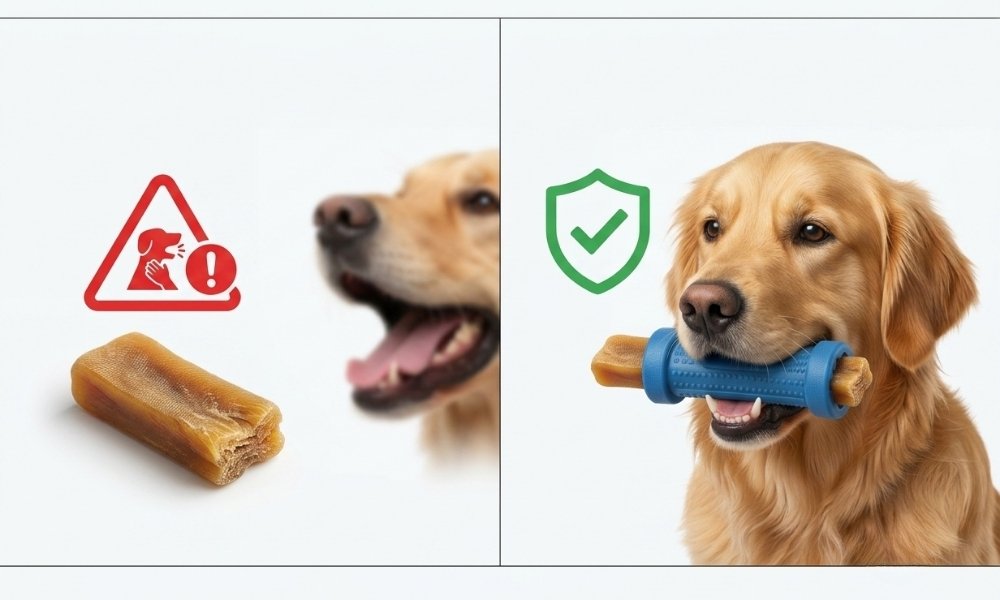
A yak chew holder improves safety by keeping a shrinking chew too large to swallow whole. The holder works as an extension of the chew, giving your dog something to brace against with their front paws even after the edible portion has worn down past a safe hand-held size. AKC’s guide to choosing safe edible chews is direct: once a yak chew wears down to a size your dog could swallow whole, it comes away, no exceptions. A holder extends the window before that removal has to happen, without changing the point at which the chew itself becomes unsafe.
Which Dogs Benefit Most?
Power chewers, dogs that gulp instead of gnaw, and dogs given a chew for an unsupervised stretch benefit most from a holder. Smaller breeds also gain more than owners tend to assume, since a fragment that’s harmless for a 60-pound dog can fully block the airway of a 12-pound one. Senior dogs working with worn or sensitive teeth do better with the extra grip a holder provides, since it takes some of the pressure off their jaw needed to keep a shrinking piece in place. Puppies are the one group that needs a different answer entirely, more on that below.
What Risks Does It Help Prevent?
A holder helps prevent choking and intestinal obstruction, the two outcomes vets see most often when a dog swallows a chew fragment whole. In a 72-case study in the Canadian Veterinary Journal of dogs and cats treated for chronic gastrointestinal foreign body obstruction, 94% survived to follow-up, though 15% developed major complications and nearly a third needed intestinal resection. A holder also reduces a second, less-discussed risk: tooth fracture. Dogs bite down harder than usual on a shrinking, awkward-shaped piece, and that added pressure is a common way a chew ends up cracking a tooth rather than being finished safely.
How Does a Yak Chew Holder Work?
A yak chew holder works through friction and material tension; the holder’s opening is slightly narrower than the chew, so the material compresses around it and grips it in place. Most designs share the same basic shape: a molded rubber or silicone body with a tapered channel that a dog owner pushes one end of the chew into. You’ll also see the same product sold as a “bully stick holder” or simply a “chew holder,” since most designs grip any long, dense chew regardless of what it’s made from.
How Does It Hold the Chew Securely?
The chew stays secure through compression, not adhesion; the holder material squeezes the inserted end from every side. Some holders add internal ridges or small molded teeth for extra bite; others use a mechanical clamp or locking latch that closes around the chew and can be tightened further as the piece wears down. Manufacturers commonly specify material hardness using Shore durometer scales. Holders intended to compress around a chew often use mid-range Shore A elastomers, but actual ratings vary by design and target dog size; check product specs (Shore A number) when comparing firmness. Either grip method does the same job: it keeps the chew from sliding free while your dog works the exposed portion.
Does It Extend Chew Time?
Yes, a holder extends usable chew time by making the final, otherwise-discarded inches of a chew safe to offer again. Without one, most owners throw that last piece away the moment it gets too small to hand a dog safely. Puffing yak chews in the microwave is a related trick for that same end piece: a brief 30- to 60-second turn expands it into a crunchy, airy treat that’s safer to finish outright once it’s cooled. A holder and a puffing solve the same waste problem in different ways. One keeps the dense chew going a little longer under supervision; the other changes its texture so density stops being a concern.
Is It Easy to Use?
Most holders take under a minute to load, insert the chew end into the opening, and push until it sits snugly. Locking or clamp-style holders take a few extra seconds since the latch needs to be closed, but that step also makes them harder for a determined chewer to work loose. Cleaning is the one recurring task, and it matters more than it sounds like it should. A holder that goes weeks without a wash collects saliva and bacteria in the same crevices that grip the chew, which turns a safety tool into a hygiene problem.
What Features Matter Most?
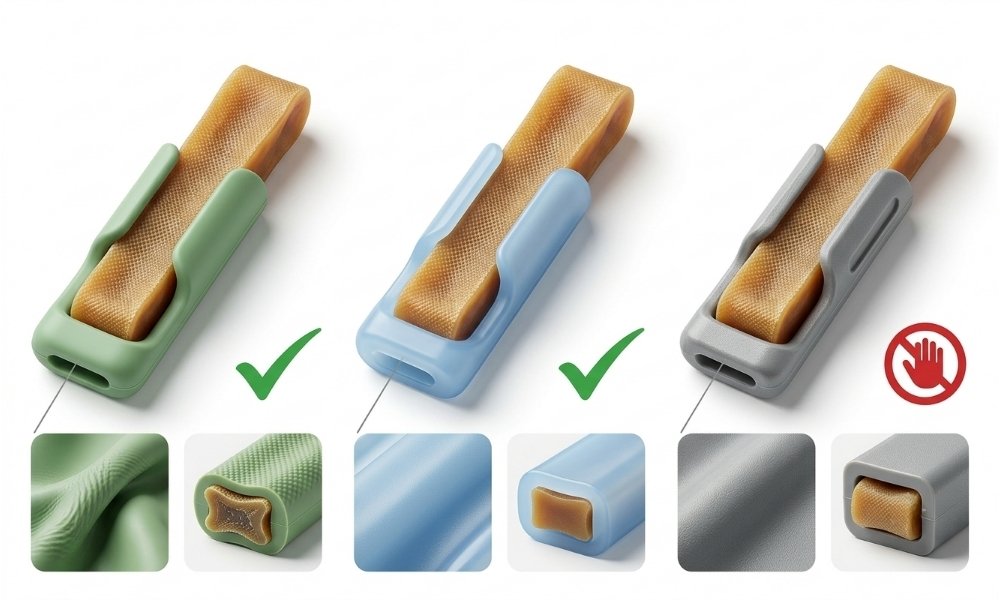
Three features determine whether a yak chew holder actually works: the material it’s made from, how well its size matches your dog, and how much pressure it can take before failing. Get any one of these wrong, and the holder either fails to protect your dog or gets destroyed within a single session.
Which Materials Are Safest?
Food-grade natural rubber and food-grade silicone are the safest materials for a yak chew holder. Natural rubber, tapped from the rubber tree’s sap, bends under pressure rather than cracking, which is why it’s the standard material in most heavy-duty pet chew products. Food-grade silicone is non-porous and easy to clean, making it a hygienic choice for light chewers; depending on formulation, some silicones may be less resistant to extreme bite forces than heavy-duty natural rubber compounds. Hard nylon is worth avoiding in a holder for the same reason vets generally flag it in chews. Hard nylon is worth avoiding in a holder for the same reason vets flag it in chews: dogs can generate voluntary bite forces of up to 1,394 Newtons, and a University of Pennsylvania/Mars Petcare cadaveric study found overall tooth-fracture prevalence in dogs runs 20–27%. When you’re comparing products, look for labeling that says food-grade, FDA-compliant, or BPA- and phthalate-free. That labeling is the clearest outside signal of the quality control behind the material, since “non-toxic” alone isn’t a regulated term in pet products.
What Size Should You Choose?
Choose a holder sized to your dog’s weight, not to the diameter of today’s chew. As a general guide, dogs under 25 pounds do well with a small holder, dogs between 25 and 50 pounds need a medium, and dogs above 50 pounds, especially aggressive chewers, need a large, reinforced holder built for sustained pressure. This lines up with how YforYak, a trusted Himalayan yak chew manufacturer, sizes its own chews: a medium bar is built for dogs in the 22- to 44-pound range, while dogs 45 pounds and up need a denser, heavier chew to get a full session out of it before it reaches holder territory. A holder sized too small for your dog’s jaw strength cracks quickly; one sized too large won’t grip a slimmer chew at all.
How Durable Should It Be?
A holder should survive several full chew cycles without cracking, splitting, or losing its grip. What counts as “durable enough” depends on your dog’s chewing style. Dogs that gnaw with steady, repetitive pressure wear a holder down slowly through surface abrasion, while dogs that crush or shred need a solid, seamless holder with no weak point to grip and tear. A one-piece rubber construction generally outlasts holders built from multiple joined parts, since seams are the first place wear shows up. If your dog falls into the crush-and-shred category, that single detail matters more than any other spec on the label.
Which Yak Chew Holders Are Best?
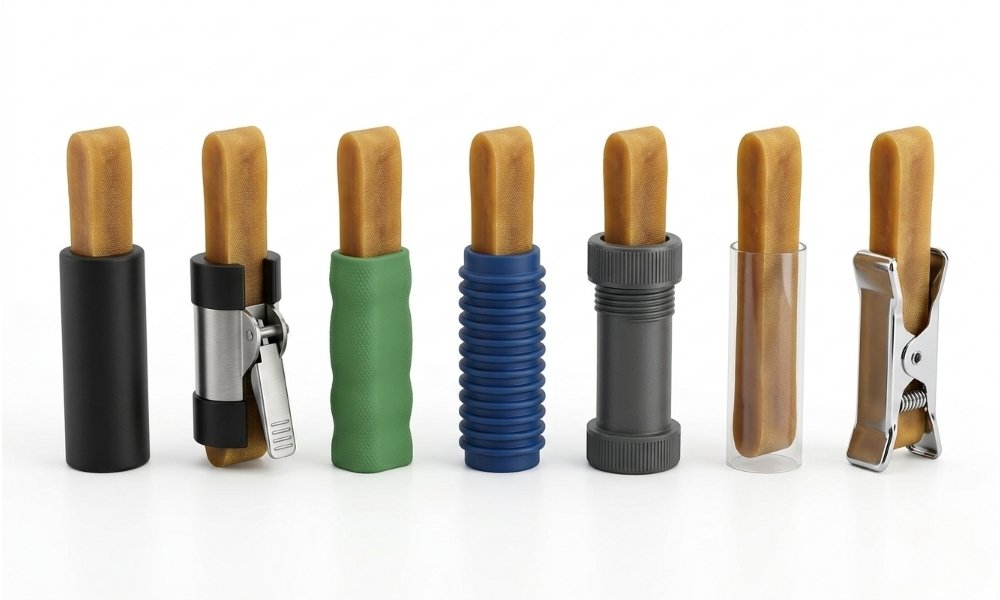
No single yak chew holder wins every category; the right pick depends on your dog’s size, chewing style, and how much you want to spend. The comparison below breaks down the main holder styles against the questions owners search for most.
| Holder Style | Material | Price Tier | Cleaning | Best Suited For |
| Solid rubber cylinder | Natural rubber | $$ | Dishwasher-safe | Large dogs, power chewers |
| Locking clamp | Rubber with mechanical latch | $$$ | Hand-wash | Dogs that pull chews loose |
| Silicone sleeve | Food-grade silicone | $$ | Dishwasher-safe | Puppies, seniors, light chewers |
| Ridged rubber | Natural rubber, textured interior | $$ | Dishwasher-safe | Dogs that need extra plaque control |
| Twist-on threaded | Natural rubber | $ | Hand-wash | Budget-conscious owners |
| Basic sleeve | Nylon-rubber blend | $ | Hand-wash | Light or occasional chewers |
| Spring-tension clip | Rubber-coated spring | $$ | Hand-wash | Short, supervised sessions |
Which Holder Offers the Best Value?
The twist-on threaded holder and the basic sleeve style offer the best value, since both handle the core job of securing the chew end without the manufacturing cost of a locking mechanism. They’re the right call for a moderate chewer who needs the safety benefit without paying for features built around extreme chewing pressure they’ll never generate.
Which Holder Is Best for Puppies?
A silicone sleeve is best for puppies, since it flexes more than rubber and puts less pressure on teeth that aren’t fully calcified yet. VCA notes most puppies have their full adult teeth by 6 to 7 months, but a 2023 peer-reviewed study of Yorkshire Terrier puppies found persistent deciduous teeth in 69% of dogs under 3 kg, so the smallest puppies often need longer, closer monitoring before graduating off a silicone holder. Pair a silicone holder with a softer, puffed chew format for puppies rather than a full-hardness bar; the holder manages the swallowing risk, but it can’t soften a chew that’s simply too dense for developing teeth.
Which Holder Is Best for Large Dogs?
A solid rubber cylinder or rigid rubber holder is best for large dogs, since both resist tearing under the higher bite force that comes with bigger jaws, the same reason it pays to pick yak chews for large dogs built dense enough to match that bite force. Silicone’s softness, an advantage for puppies, becomes a liability here; it’s more prone to shredding once a determined 70-pound dog gets a real grip on it. Large, aggressive chewers are the group most likely to destroy a holder in a single sitting if the material isn’t matched to their strength.
Which Holder Is Easiest to Clean?
Many silicone holders are dishwasher-safe; some rubber holders are hand-wash only because high heat and detergents can degrade certain rubbers. Always follow the manufacturer’s care instructions. Holders with a locking mechanism or a nylon-blend sleeve take more effort, since food residue and saliva collect in the seams and hinges that a dishwasher can’t always reach. If easy cleanup matters more to you than maximum grip strength, that trade-off is worth making deliberately rather than by accident.
Which Holder Is Most Durable?
The solid rubber cylinder and the locking clamp are the most durable styles because each addresses a different common failure point. The rubber cylinder resists tearing since it has no seams to catch a tooth; the locking clamp resists popping open under pressure since the latch, not friction alone, is doing the work of holding the chew in place.
Which Holder Has the Best Grip?
The locking clamp and the ridged rubber holder have the best grip, since both rely on more than plain friction to keep the chew from sliding free. A smooth-bore holder can lose its hold once a chew gets slick with saliva and wears down to a rounded nub. A mechanical latch or a textured interior keeps working even at that stage, which is precisely when a strong grip matters most.
Which Holder Is Best Overall?
A solid natural rubber cylinder is the best overall yak chew holder, since it balances durability, cleanability, and safety across the widest range of dogs. It won’t out-clean a silicone sleeve or out-grip a locking clamp, but it’s the only style that scores well in every category instead of excelling in one and falling short in another, which is what makes it the safer default when you’re buying a first holder and don’t yet know your dog’s exact chewing style.
How Do You Choose the Right Holder?
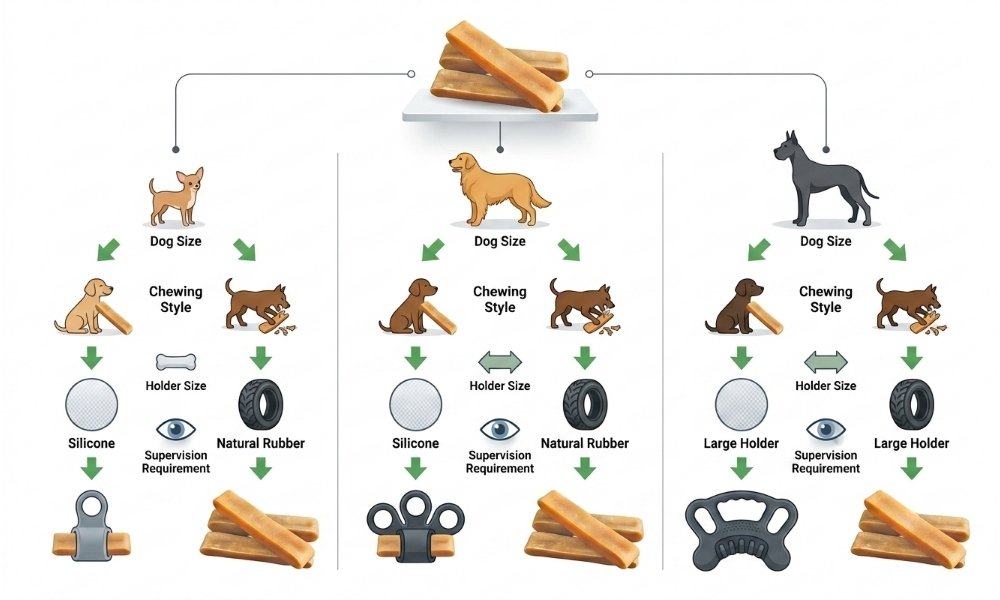
Choosing the right holder comes down to matching three things: your dog’s size and chewing style, the chew format you’re using, and how closely you can supervise. Get the size and material right first. Everything else is a smaller adjustment from there.
How Do You Match the Holder to Your Dog?
Match the holder to your dog by starting with weight, then adjusting for chewing style. A 30-pound dog that chews steadily can use a standard medium holder without issue. A 30-pound dog that crushes and shreds everything in reach needs that same medium size in a tougher, more reinforced material, the same logic behind choosing yak chews by chewing style rather than by weight alone. Watch your dog’s first few sessions with any new handler before leaving them with it unsupervised. Chewing style shows up fast, usually within the first ten minutes.
What Mistakes Should You Avoid?
The most common mistakes are sizing the holder to the chew instead of the dog, skipping supervision because a holder is in play, and ignoring early cracks in the holder itself. A few specific patterns worth naming:
- Buying a holder that fits today’s chew but won’t grip a wider replacement
- Assuming a holder means a dog can be left alone for long stretches
- Continuing to use a holder after it develops cracks, tears, or a loosened grip
- Giving a puppy or senior dog a full-hardness chew simply because a holder is holding it, instead of first checking which yak chews are safe for puppies at that dental stage
- Choosing a holder by price alone without checking the material label
A holder manages one specific risk. It doesn’t change whether the chew itself is the right hardness for your dog’s teeth and life stage.
When Should You Replace It?
Replace a holder as soon as you notice cracking, tearing, discoloration, or a grip that no longer holds the chew snugly. A holder that’s lost its tension lets a chew slip free at exactly the wrong moment, once it’s worn down to a size small enough to swallow. Most rubber and silicone holders hold up for months of regular use, so a sudden change in how well one grips is usually the clearest sign it’s time for a replacement rather than a deep clean.
How Can YforYak Help?
YforYak makes the chew, not the holder, and getting that chew’s size and hardness right from the start is the safety layer we actually control. We manufacture Himalayan yak milk chews in Nepal under our FDA and HACCP-certified manufacturing process, and we size them so the transition from full chew to holder-ready end piece happens gradually, at a predictable hardness batch after batch. That consistency matters more than it sounds like it should: a holder sized for one bar should grip the next bar from the same batch just as well, and inconsistent hardness between batches is exactly what breaks that assumption.
Can YforYak Dog Chews Pair With a Holder?
Yes, YforYak’s small-format bars and nuggets are sized to fit standard chew holders sold at pet retailers. If your dog is working through a full-size bar, our guide to Himalayan yak chews breaks down which size and texture suit your dog’s weight and chewing style before you ever reach the holder stage. And if you’re weighing whether a holder or a puffed chew is the better call for a puppy, senior, or sensitive chewer, that same question is worth working through before you buy either one.
What Should You Remember About Yak Chew Holders?
Yes, most dogs working through a hard chew need a yak chew holder, not for the whole session, but for the last two or three inches that turn a treat into a hazard. The safest setup pairs a holder made from food-grade natural rubber or silicone with a chew sized correctly for your dog’s weight, plus supervision that doesn’t stop just because a holder is doing part of the job.
Keep three things in mind: match the holder’s material to your dog’s chewing style, size it to your dog rather than to today’s chew, and replace it the moment it cracks, tears, or stops gripping. Get those three right, and a yak chew holder turns the riskiest part of chewing into one of the safest.