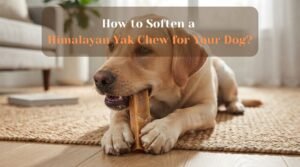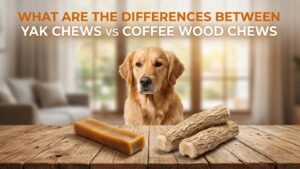
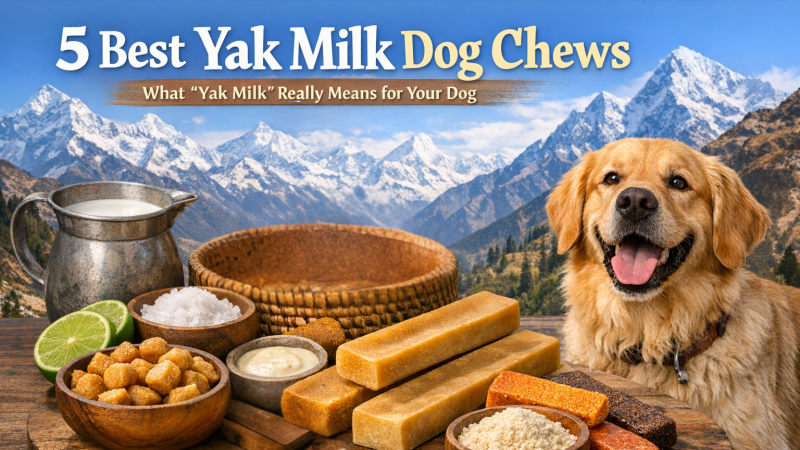
Yak milk dog chews are hard Himalayan cheese treats made from yak and cow milk that are compressed, dried, and cured into a dense, long-lasting chew for dogs. Traditional Himalayan churpi production in Nepal transforms fresh yak milk, cow milk, lime juice, and salt into a durable protein block that dogs slowly gnaw rather than instantly consume like soft treats. High-altitude yak milk contains elevated protein, omega-3 fatty acids, and casein compared with standard dairy, which helps create a chew that lasts significantly longer than rawhide, biscuits, or bully sticks.
Best yak milk dog chews combine authentic Himalayan sourcing, a clean four-ingredient recipe, and formats designed for different chewing styles. Classic yak chew bars, yak milk nuggets, puffed yak chews, yak cheese powder, and flavored yak chews each serve specific dogs based on breed size, jaw strength, and feeding purpose. Understanding what “yak milk” actually means, how churpi cheese is produced in Nepal, and how chew formats differ helps dog owners choose a safe, high-protein treat that provides long chewing time without artificial additives or fillers.
The 5 Best Yak Milk Dog Chew Worth Buying
The 5 best yak milk dog chew formats are classic yak chew bars, yak milk nuggets, puffed yak chew bars, yak cheese powder, and flavored yak chew varieties. Each format serves a different chewing profile, dog size, and use case; selecting the right one depends on your dog’s breed, jaw strength, and dietary needs.
1. Classic Himalayan Yak Chew Bars, Best for Power Chewers
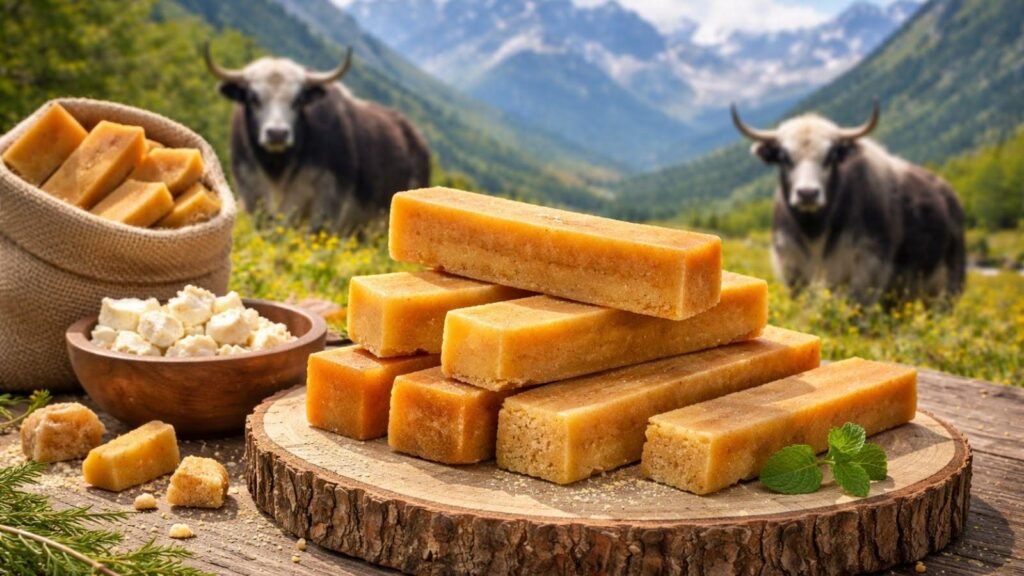
The classic bar is the original yak chew format. It is a rectangular block of compressed, smoke-dried yak and cow milk cheese, available in XS through XL sizing.
- Why it works for power chewers: The compression process produces a density that resists aggressive gnawing. A large-grade bar given to a 35 kg Labrador provides 2–5 hours of cumulative chewing activity across multiple sessions. If your dog tends to power through most chews within minutes, read about the best yak chews for large dogs to find the right size and grade.
- What to look for in a quality bar: Consistent color (tan to dark amber), firm texture with no soft spots, a slight smoky aroma, and a clean 4-ingredient label. Surface cracks are normal and indicate proper drying; they are not a quality defect.
- What most owners overlook: Store yak chew bars in a cool, dry place, not sealed in an airtight plastic bag. Sealing a yak chew in plastic traps residual moisture, which promotes mold growth on the surface. A breathable cloth pouch or open storage is preferable.
2. Yak Milk Nuggets, Best for Small Dogs and Senior Dogs
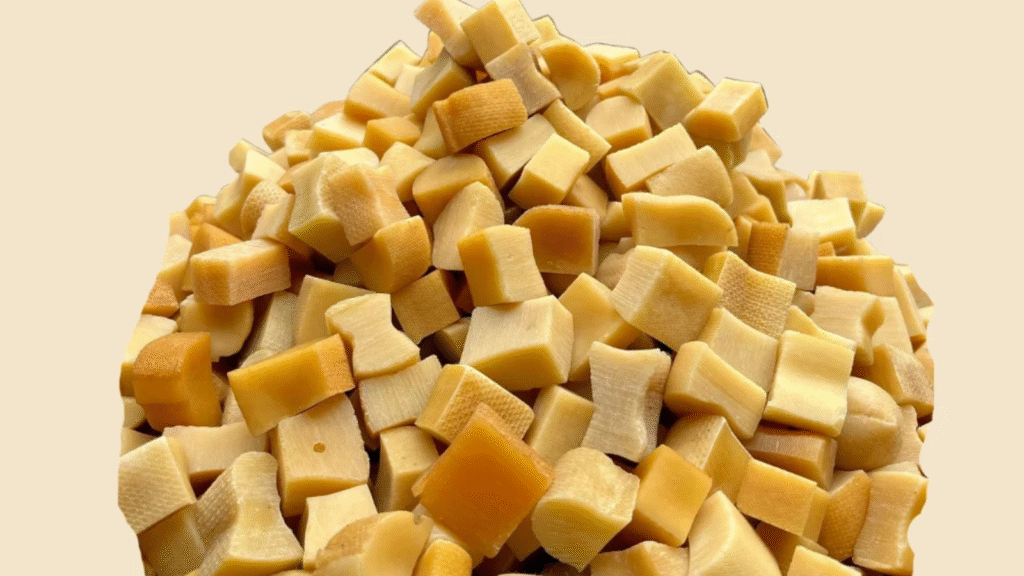
Yak milk nuggets are bite-sized pieces of the same compressed cheese chew material, cut into 2–4 gram individual pieces. They share the same 4-ingredient composition as the full bar.
- Why they work for small dogs: The reduced size eliminates jaw-width mismatch. A Chihuahua or Yorkshire Terrier can hold a nugget comfortably and work through it in 10–15 minutes, an appropriate chew duration for the breed’s size and energy expenditure.
- Why they work for senior dogs: Older dogs with dental disease, missing teeth, or reduced jaw strength cannot safely engage with full-size bars. Nuggets provide the same protein reward and chewing satisfaction at a scale that matches their capability.
- The feeding advantage of nuggets: Nuggets are also useful as high-value training rewards. Because they are nutrient-dense and strongly aromatic, dogs find them highly motivating, more so than standard biscuit treats, without the excessive calorie load of full-bar chews. For a full breakdown of how size affects chew selection, the guide on choosing the right yak chew by dog size covers every weight category in detail.
3. Puffed Yak Chew Bars, Best Two-Stage Treat Experience

Puffed yak chew bars are pre-processed using the same microwave technique described earlier in this article, then packaged as a standalone product. They deliver the identical nutritional profile as classic bars but in a completely different texture, light, airy, and crispy.
- Why the two-stage format matters: Dogs that struggle with the extreme hardness of a classic bar, young adult dogs transitioning from puppy treats, dogs recovering from dental procedures, or dogs simply preferring a softer texture, benefit from the puffed format. It provides the yak milk nutrition without the hardness barrier.
- How puffed bars complement classic bars: Many experienced yak chew owners use both formats. Classic bars for enrichment during unsupervised rest periods; puffed bars as an immediate reward after training or walks. The two textures engage different parts of the dog’s chewing experience.
- In real-world use: Puffed yak chew bars have a shorter shelf life than classic bars due to their open, airy structure. Consume within 2–3 weeks of opening the package for best palatability. For exact timing and technique, the step-by-step guide on how to puff yak chews in the microwave walks through the full process safely.
4. Yak Cheese Powder, Best for Picky Eaters and Food Toppers
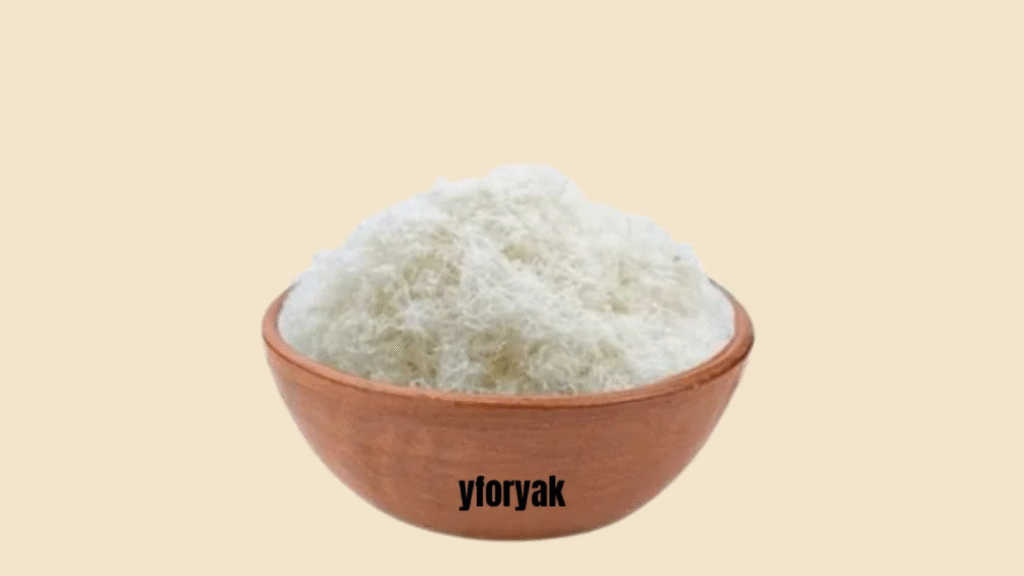
Yak cheese powder is spray-dried or finely ground yak and cow milk cheese, the same dairy base as the chew bars, processed into a free-flowing powder. It is not a chew format, but it belongs in the yak milk product category for dog owners dealing with specific dietary challenges.
Primary use cases for yak cheese powder:
- Food toppers for picky eaters, sprinkling 1–2 teaspoons on dry kibble, dramatically increases palatability for dogs that self-restrict food intake
- Medication concealment, the strong dairy aroma masks medication smells more effectively than peanut butter or soft treats
- Rehydration aid, mixing powder into warm water creates a flavorful broth-like liquid, useful for dogs recovering from illness who need fluid and calorie intake encouragement
What to verify on a yak cheese powder label: The same 4-ingredient standard applies. Powders with added maltodextrin, starches, or “anti-caking agents” beyond natural calcium compounds are not clean-label products.
5. Flavored Yak Chew Varieties, Best for Boredom-Prone Dogs
Flavored yak chews represent the newest segment within the Himalayan chew category. Base formats (bars or nuggets) are infused with natural flavor additives such as turmeric, peanut butter, blueberry, or chicken broth during the production process.
- Why dogs that are bored with standard chews respond to flavored varieties: Olfactory stimulation is the primary driver of food interest in dogs. Introducing a new aromatic layer to an already-familiar food format reignites engagement without changing the base nutrition profile.
- What to verify in a flavored yak chew: The flavoring agents should be single-ingredient and food-grade. “Peanut butter flavor” should mean ground peanuts or peanut paste, not artificial flavoring. “Turmeric-infused” should mean whole dried turmeric, not “natural flavors including turmeric.”
- Important note for sensitive dogs: Flavored varieties introduce additional ingredients beyond the classic 4. Dogs with known allergies or food sensitivities should be assessed for the specific flavoring ingredient before regular feeding. Rotate flavors periodically rather than feeding one flavored variety exclusively.
What Does “Yak Milk” Really Mean in a Dog Chew?
Yak milk in a dog chew refers to the traditional Himalayan churpi-making process, where yak and cow milk are combined, acidified with lime juice, compressed under weight, and smoke-dried into a hard protein block over weeks. The final product contains no liquid milk; it is a fully dehydrated cheese chew.
Understanding this process matters because it tells you everything about ingredient quality, protein density, digestibility, and safety.
The Difference Between Yak Milk and Cow Milk in Dog Chews
Yak milk contains higher fat and protein concentrations than standard cow milk. Yaks produce approximately 1.5–3 liters of milk per day, a fraction of what a Holstein dairy cow produces. This scarcity drives nutritional density.
Yak milk carries roughly 5.6–7.5% fat content, substantially higher than the 3.5–4% typical of commercial cow milk, along with elevated concentrations of CLA and omega-3 fatty acids, as confirmed by peer-reviewed nutritional analysis published in a 2023 NIH-indexed review. When this milk is processed into a chew, those protein chains become tightly compressed and extremely hard, which is why yak chews outlast most other dog treat formats.
Authentic yak chews blend yak milk with cow milk, typically in a ratio favoring yak milk. This combination balances hardness, protein density, and cost. Chews labeled “100% yak milk” without cow milk are rare, expensive, and not necessarily superior; the traditional churpi recipe has always used both.
Why “Yak Milk” Is Processed Into Hard Cheese, Not Liquid
The hardening process is what transforms raw milk into a safe, shelf-stable dog chew. Here is the 4-stage production sequence used in authentic Himalayan manufacturing:
- Milk collection: Fresh yak and cow milk from highland herders is collected at altitude, typically between 3,000 and 4,500 meters above sea level.
- Curdling: Lime juice and salt are added to acidify the milk, separating curds from whey.
- Compression: Curds are pressed repeatedly under heavy weights to expel maximum moisture content.
- Smoke-drying: Compressed blocks are hung and smoke-dried for weeks, sometimes months, until moisture content drops below 15%.
The result is a product with no artificial preservatives, no binders, and no synthetic additives, just dehydrated dairy protein compressed to maximum hardness. This process is identical to the human food product called churpi, which Himalayan communities have consumed for centuries.
The 4 Ingredients Behind Every Authentic Yak Chew
A genuine yak milk dog chew contains exactly 4 ingredients: yak milk, cow milk, lime juice, and salt. Nothing else.
This 4-ingredient standard is the clearest quality signal on any yak chew label. Products with additional ingredients, starches, additives, artificial flavors, or unlisted fillers are not authentic Himalayan-style chews. They are reformulated products using the “yak milk” term as a marketing label.
What “Lactose-Free” Actually Means in a Yak Chew
Yak chews are frequently marketed as lactose-free, which surprises dog owners who associate dairy with digestive sensitivity. The claim is accurate, and the science behind it matters.
Lactose is a milk sugar. During the churpi production process, the curdling and compression stages separate lactose (which remains in the whey liquid) from the casein and whey proteins (which are retained in the solid curd). The extended drying period further reduces residual lactose to negligible levels.
Dogs with mild dairy sensitivity tolerate yak chews well because the lactose content in a fully cured yak chew is functionally close to zero. This is not the same as saying all dogs with dairy allergies can eat yak chews freely; dogs with a true casein protein allergy still react. But lactose intolerance, which is the most common dairy-related digestive issue in dogs, is not triggered by a properly cured yak chew.
Why Are Yak Milk Dog Chews So Popular Among Dog Owners?
Yak milk dog chews have found a strong commercial niche within the growing demand for clean-label natural dog treats, a market valued at USD 6.99 billion in 2024 and growing at 12.3% annually. Their combination of high protein, long chew duration, and a 4-ingredient label aligns precisely with what natural treat buyers are prioritizing. This combination satisfies both the dog’s instinct to chew and the owner’s demand for a safe, natural product.
High Protein, Low Fat: The Nutritional Reality
A standard yak chew bar delivers approximately 60–65% crude protein on a dry matter basis. Fat content sits between 5–8%, making it a high-protein, moderate-fat chew. This macronutrient profile is significantly better than most commercially sold dog treats, which frequently contain high carbohydrate or sugar loads.
The protein in a yak chew is casein-dominant. Casein is a slow-digesting protein that releases amino acids gradually, beneficial for dogs who benefit from sustained satiety. This is one reason that chewing a yak chew for 20–30 minutes provides more benefit than eating a high-calorie biscuit treat in under 10 seconds.
Calcium and phosphorus are also present in meaningful quantities due to the dairy base, supporting dental and bone health as a secondary benefit.
Long-Lasting Chew Time Compared to Other Treat Formats
Chew duration is the metric dog owners care about most, and yak chews consistently outperform alternatives. For a deeper ingredient and safety comparison, the breakdown of yak chews vs bully sticks examines both formats side by side. The table below compares approximate chew durations across treat types for a 25 kg medium-breed dog:
| Treat Type | Avg. Chew Duration |
| Soft treats/biscuits | 5–30 seconds |
| Rawhide strips | 10–30 minutes |
| Bully sticks | 20–45 minutes |
| Yak chew bars (medium) | 45–120 minutes |
| Yak chew bars (large) | 2–5 hours across multiple sessions |
The hardness of a yak chew forces a dog to work on one spot at a time, delivering a mechanical scraping action along the gum line, consistent with clinical evidence showing dental chews reduce calculus accumulation by 45.8% and plaque by 17.3% in controlled trials, contributing to measurable oral health improvement over time. YforYak, a Nepal yak chew manufacturer, produces dog chew products in Kathmandu, Nepal, using the traditional Chhurpi process and offers bulk B2B sourcing with full export documentation.
The Microwave Puff Trick That Makes Yak Chews a Two-in-One Treat
One feature that surprises new yak chew owners is the microwave puff method. When the chew reduces to a small piece too tiny to chew safely, dog owners should not discard it. Instead, place the piece in a microwave-safe bowl and heat on high for 45–60 seconds.
The residual moisture inside the chew expands rapidly, puffing the hard piece into a light, airy, crispy cheese puff. This transformed treat delivers the same protein content in a completely different texture, soft, crunchy, and irresistible to most dogs.
This method extends the value of every chew, reduces waste, and gives dogs an exciting texture change. It is one of the most practical innovations in the yak chew category, and it works specifically because yak chews use no artificial binders that would prevent the puffing reaction. For precise heating times across different microwave wattages, see the dedicated article on how long to microwave a yak chew.
Who Benefits Most from Yak Chews: Aggressive Chewers, Sensitive Stomachs, and More
Yak chews serve 4 specific dog profiles particularly well:
- Aggressive chewers who destroy soft toys and consume bully sticks within minutes, the hardness of a yak chew provides genuine resistance
- Dogs with grain sensitivities: the 4-ingredient formula contains no grains, gluten, or corn
- Dogs with chicken: yak chews are a protein-novel treat, free from common allergens in commercial dog food
- Senior dogs with dental needs: The hard surface works against tartar through mechanical gum-line scraping, an important benefit given that 70–80% of dogs show signs of dental disease by age three, according to AAHA/AVDS preventive care guidelines. The softer puffed version suits dogs with reduced jaw strength who still need the same protective chewing habit.
Puppies under 4 months and toy breeds under 2 kg are better served by nugget formats rather than full bars, due to the hardness level of standard chew bars.
How to Read a Yak Chew Label (and Spot Low-Quality Products)
Reading a yak chew label correctly requires checking 4 things: the ingredient count, the origin declaration, the size grade, and the certification claims. A trustworthy yak chew lists 4 or fewer ingredients, identifies Nepal or the Himalayas as origin, matches the size grade to the dog’s weight, and provides verifiable certification details.
What “Himalayan” on the Label Actually Guarantees
The word “Himalayan” on a yak chew label is a geographic and cultural indicator, not a protected designation of origin (PDO). This matters because “Himalayan” does not carry the same legal protection as “Parmigiano-Reggiano” in Italian cheese law, for example.
Any manufacturer can print “Himalayan” on packaging regardless of where the product was actually made. This means sourcing verification falls entirely on the buyer. The most reliable verification methods include:
- Requesting a Certificate of Origin from the manufacturer
- Confirming the producing country on the import documentation (authentic Nepal-origin chews list NP as the country of origin)
- Asking for HACCP or DFTQC compliance documentation from the Nepalese facility
YforYak operates from Tokha, Kathmandu, Nepal, the same geographic region where Himalayan churpi production originated, and provides full export documentation, including CoO, sanitary certificates, and veterinary certificates for all B2B partners.
Size Grades Explained: XS, S, M, L, XL for Different Dog Breeds
Yak chew sizing is determined by bar weight, not bar length. The industry standard sizing by dog weight is:
| Size Grade | Bar Weight | Recommended Dog Weight |
| XS | 30–50 g | Under 5 kg (toy breeds) |
| S | 50–80 g | 5–10 kg (small breeds) |
| M | 80–120 g | 10–25 kg (medium breeds) |
| L | 120–180 g | 25–40 kg (large breeds) |
| XL | 180–250 g | Over 40 kg (giant breeds) |
Giving a toy breed dog a large-grade bar creates a safety risk, as the bar is too large for the jaw width and can become lodged. Giving a large dog an XS bar creates both a choking hazard and frustration, as the entire chew can be consumed in one session.
Red Flags on Yak Chew Packaging to Avoid
5 warning signs indicate a low-quality yak chew product:
- Ingredient list longer than 4 items: any addition beyond yak milk, cow milk, lime juice, and salt signals reformulation or filler use
- No country of origin listed: authentic Himalayan products always specify Nepal
- “Natural flavors” as an ingredient: a phrase used to mask synthetic additives
- No size grade specification: responsible manufacturers always grade by dog weight
- No batch or lot number: absence of traceable batch codes indicates no quality control system
Packaging that uses dramatic language like “premium artisan,” “hand-crafted in small batches,” and “100% natural” without verifiable certification backing those claims is not automatically trustworthy. Certifications do the work that marketing language cannot.
Certifications Worth Trusting (ISO, HACCP, FDA-Registered Facilities)
4 certifications genuinely matter for yak chew sourcing and consumer safety:
- ISO 9001: confirms a documented quality management system is in place at the manufacturing facility
- HACCP compliance: confirms hazard analysis at every critical control point in production, from raw milk collection to final packing
- FDA facility registration: required for any product exported to the United States market; confirms the facility is known to and registered with the US Food and Drug Administration
- DFTQC approval: the Department of Food Technology and Quality Control under Nepal’s government, the primary domestic food safety regulator for Nepali food exports
Facilities operating without any of these certifications should be treated with caution, regardless of their marketing claims.
How to Choose the Right Yak Chew Size and Hardness for Your Dog
Choosing the right yak chew requires matching 3 variables to your dog: weight-based size grade, chewing intensity classification, and supervision level. A correctly sized yak chew from a verified source is one of the safest long-duration chew options available, but size mismatch creates real risk regardless of product quality.
Matching Chew Hardness to Your Dog’s Chewing Style
Dogs fall into 3 chewing intensity classifications:
- Light chewers: lick and nibble treats rather than gnaw aggressively; common in toy breeds, senior dogs, and anxious dogs; best served by nuggets or puffed bars
- Moderate chewers: work through treats consistently but do not destroy them within minutes; most medium-breed dogs; best served by standard bars at an appropriate size grade
- Power chewers: destroy rawhide, bully sticks, and soft toys rapidly; typical of working breeds, bully breeds, and high-drive sporting dogs; require XL bars or regularly rotated chews
The nail test is a practical hardness check: press your thumbnail firmly into the surface of the yak chew. A safe, well-cured bar does not indent noticeably. A bar that dents easily is either undercured (too high moisture) or formulated with added softeners; neither is optimal.
Weight-Based Size Guide for Yak Chews
The size guide published in the label section above applies universally. One additional refinement: for power chewers, size up by one grade. A 20 kg dog classified as a power chewer handles an L-grade bar more safely and more satisfyingly than an M-grade bar, which they would reduce to a choking-risk fragment too quickly.
Supervision Tips and Safe Chewing Practices
3 supervision rules apply to every yak chew session:
- Always supervise the first session: Always supervise the first session, observe how your dog interacts with a new chew, their chewing technique, and whether they attempt to break off large chunks. For a complete safety overview covering all chew types and risk scenarios, see whether yak chews are safe for dogs.
- Remove the chew when it reaches thumb-length size: at that point, microwave-puff the remaining piece rather than allowing continued chewing
- Never give a yak chew to a dog experiencing any dental pain or recent tooth extraction: the hardness creates pressure that exacerbates dental injury
Fresh water should always be available during and after a yak chew session. The salt content of the chew drives mild thirst; this is normal and not a cause for concern, but access to water is non-negotiable.
How Often Can Dogs Have Yak Chews?
A yak chew bar is not a daily treat for most dogs. The recommended frequency is 3–4 times per week for medium-to-large breeds, and 2–3 times per week for small breeds and seniors.
The protein and fat content is calorie-meaningful. A 100 g yak chew bar delivers approximately 350–380 kcal. For a 10 kg dog whose total daily caloric requirement is approximately 400–500 kcal, a full M-grade bar in one sitting is calorically excessive. Chews count toward the daily caloric budget, a fact most owners overlook when assessing treat frequency. For a breed-specific schedule and calorie-aware feeding guide, the article on how often to give your dog a chew provides practical weekly plans.
Where Do the Best Yak Milk Chews Come From? (Origin Matters)
The best yak milk dog chews originate from Nepal, specifically from high-altitude regions where yak herding communities have produced churpi for centuries using consistent traditional methods. Nepal accounts for the majority of global yak chew exports. In a single fiscal year (2022-23), Nepal shipped 1,435 tonnes of dog chew to the U.S. alone, worth NPR 2.76 billion, per Nepal’s chhurpi export position tracked by the Department of Livestock Service. The country produces approximately 3,000 tonnes annually, with the U.S. representing 84.4% of all export revenue.
Why Nepal Is the Epicenter of Authentic Yak Chew Production
Nepal’s churpi-to-dog-chew export segment reached Rs. 3.18 billion (~USD 24 million) in FY 2023/24, down slightly from a record Rs. 3.40 billion the prior year but still representing a 240% surge over five years, with over 30 active producing companies, according to Nepal’s chhurpi export industry data (Rising Nepal report) cited by the Department of Livestock Service. This scale reflects both the depth of traditional dairy knowledge in the country and the global demand for natural, clean-label pet treats.
The environmental conditions that produce the best yak milk are unique to the Himalayan region. At altitudes above 3,000 meters, yaks graze on mountain grasses and herbs absent from lowland pasture, which directly influences the fatty acid and protein profile of the milk. Lower-altitude dairy substitutes cannot replicate the nutritional composition of authentic high-altitude yak milk, regardless of processing method.
Nepal’s DFTQC regulatory framework governs food safety standards for churpi exports. Facilities compliant with DFTQC standards are subject to periodic inspection, batch testing, and compliance verification, providing a baseline quality assurance layer that geography alone cannot.
What Ethical Sourcing Actually Looks Like in the Himalayan Region
Ethical sourcing in the yak chew industry involves 3 specific practices, not just a label claim:
- Direct milk purchase agreements with highland herder communities at fair trade prices that reflect the premium nature of high-altitude yak milk, not commodity dairy pricing
- Seasonal collection practices that do not compromise the nutrition and welfare of yak calves, who have an equal priority claim on their mother’s milk supply
- Community reinvestment: manufacturing operations that employ local workers, support local supplier incomes, and preserve traditional churpi-making skills as cultural knowledge
Ethical sourcing storytelling without verifiable supply chain documentation is a marketing exercise. When evaluating a yak chew supplier, request production location details, supplier community relationships, and evidence of direct procurement rather than third-party broker arrangements.
Are Yak Milk Dog Chews Safe for Puppies?
Yak milk dog chews are safe for puppies over 16 weeks of age when their baby teeth and jaw strength can handle moderate chewing resistance. Parents of younger dogs should check the full guide on yak chews for puppies, which covers age milestones, safe sizes, and supervision guidelines. Puppies under 6 months should receive small yak nuggets, not full bars, because dense bars increase the risk of tooth fracture or jaw strain. Always supervise chewing sessions.
Can Dogs Eat Yak Chews Every Day?
Dogs should not eat yak chews every day because a 100 g yak chew contains about 350–380 kcal, which can exceed the treat calorie limit for many dogs. Feed yak chews 3–4 times per week for medium and large breeds and 2–3 times per week for small or senior dogs to avoid excess calories.
Do Yak Chews Splinter Like Cooked Bones?
Yak chews do not splinter like cooked bones because the drying and compression process creates a dense cheese texture that erodes gradually. Dogs grind the chew into small, digestible cheese shavings instead of brittle fragments. Aggressive chewers should still be supervised to prevent cracked pieces.
What Is the White Powder on My Dog’s Yak Chew?
The white powder on a yak chew is crystallized salt or protein bloom formed during the drying process. Moisture evaporation pushes salt to the surface, which creates a harmless white coating similar to bloom on aged cheese. The powder is safe for dogs and does not indicate mold or spoilage.
How Long Do Yak Chews Last Before Going Bad?
Yak chews last 4–5 years from the production date when stored in a cool, dry place with airflow. Avoid sealed plastic bags because trapped moisture promotes mold growth. The complete yak chews storage guide covers container types, humidity controls, and signs of spoilage in detail. Spoilage signs include green or black mold, sour odor, or sticky surface texture, which indicate moisture contamination.
Are Yak Chews Good for Dogs With Chicken?
Yak chews are good for dogs with chicken because they contain dairy proteins from yak and cow milk casein, not poultry or red meat proteins. Different protein structures reduce allergic reactions in many dogs. Confirm dairy tolerance with a veterinarian before regular feeding.
Can Lactose-Intolerant Dogs Eat Yak Milk Chews?
Lactose-intolerant dogs can eat yak milk chews because the traditional churpi process removes most lactose during curdling and whey separation. Extended drying reduces remaining lactose to minimal levels. Dogs with casein protein allergy, which differs from lactose intolerance, should avoid yak chews.
How Do I Use the Microwave Puff Method Safely?
Use the microwave puff method by heating a thumb-sized yak chew piece for 45–60 seconds in a microwave-safe bowl until it expands into a cheese puff. Allow the puff to cool for 2–3 minutes before feeding to prevent mouth burns. This method safely uses leftover chew pieces.
What Is the Difference Between Yak Chews and Rawhide?
The main difference between yak chews and rawhide is the ingredient and digestibility. Yak chews contain compressed dried dairy protein from yak and cow milk, while rawhide consists of chemically processed cattle skin. Unlike yak chews, which are digested as compressed dairy protein, rawhide is manufactured with chemical processing aids. In 2017, the FDA documented a formal recall of multiple rawhide brands following FDA-documented chemical contamination in manufacturing facilities across three countries; reported adverse effects included diarrhea, vomiting, and gastrointestinal distress.
Do Vets Recommend Yak Milk Dog Chews?
Veterinarians often recommend yak milk dog chews as a safer, long-lasting alternative to rawhide and cooked bones. Yak chews contain four natural ingredients and high protein, while their dense texture promotes gradual chewing that helps reduce plaque buildup on teeth.