
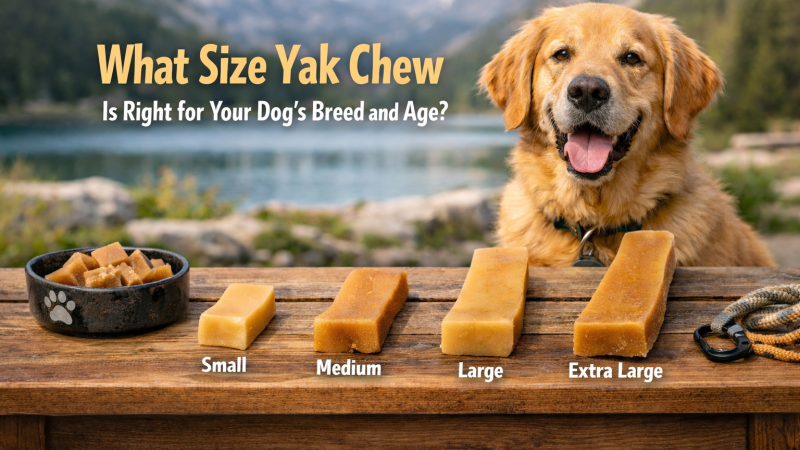
Yak chews are popular because they’re long-lasting, low-odor, and keep dogs busy, but the right size matters as much as the chew itself. A chew that’s too small can become a choking risk, while one that’s too hard or thick for the wrong dog can cause frustration (or dental trouble). This guide helps you choose a yak chew size that matches your dog’s breed, age, and chewing style, without guesswork.
Because sizing labels vary by brand (Small/Medium/Large/XL don’t always mean the same thing), the safest approach is to use simple rules you can apply to any package: weight range, snout length, chew thickness, and how your dog actually chews. You’ll also learn how to introduce yak chews gently, what to do with leftover end pieces, and when to pick an alternative that’s safer for your dog.
Pick the Right Yak Chew Size in 30 Seconds
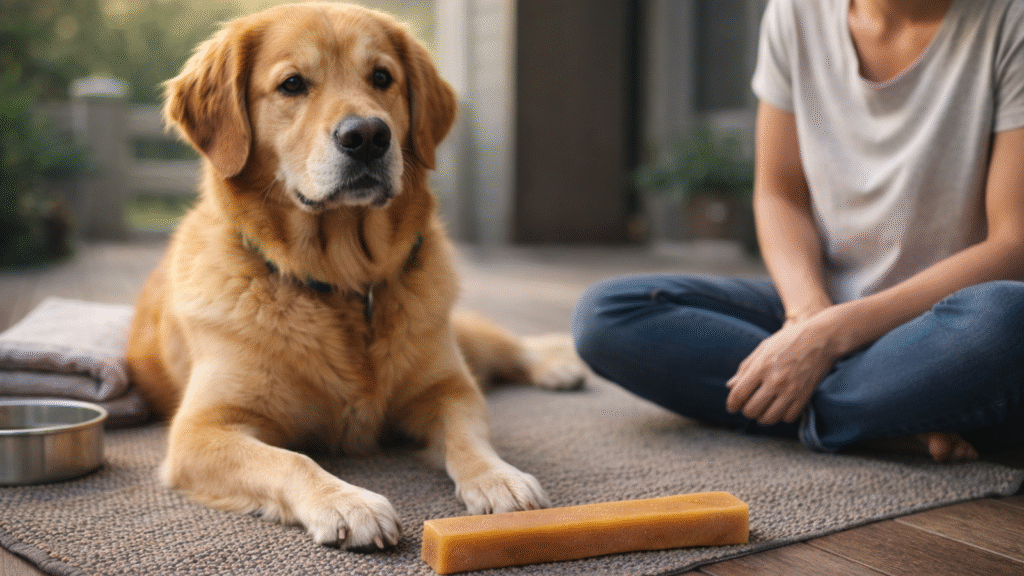
Start by choosing a chew that matches your dog’s weight range, then “size up” if your dog is between sizes or tends to gulp. A good yak chew should be longer than your dog’s snout and thick enough that they can’t fit the whole chew in their mouth. When in doubt, pick the larger size and keep the first session short so you can observe chewing behavior safely.
Weight-to-Size Mini Chart (Plus “If In-Between, Size Up” Rule)
Use this quick reference to identify your starting size, then apply the visual safety checks below:
- Under 10 lb (4.5 kg): Mini or Small (typically 20 to 40 grams, 3 to 4 inches long)
- 10 to 25 lb (4.5 to 11 kg): Small to Medium (40 to 70 grams, 4 to 5 inches long)
- 25 to 50 lb (11 to 23 kg): Medium to Large (70 to 120 grams, 5 to 6 inches long)
- 50 to 80 lb (23 to 36 kg): Large to X-Large (120 to 180 grams, 6 to 7 inches long)
- Over 80 lb (36 kg): X-Large or Jumbo (180 grams and above, 7 inches or longer)
Dogs hovering between two weight brackets benefit from the larger size. A 48 lb Springer Spaniel sits between Medium and Large; choose Large to prevent rapid consumption and extend chew sessions safely.
The Muzzle Rule: Chew Length Should Be Longer Than Your Dog’s Snout
Choose a chew that extends clearly beyond the sides of your dog’s mouth and jaw so it cannot be swallowed whole as it softens. A Dachshund with a 3-inch snout needs a minimum 4-inch chew; a German Shepherd with a 5-inch muzzle requires a 6-inch or longer piece. This overhang prevents your dog from swallowing the chew whole as it softens and ensures they must gnaw laterally rather than gulp vertically.
Thickness Rule for Safety: Preventing Gulping and Big Chunk Bites
Measure the chew’s narrowest diameter (most yak chews taper slightly). It should be wide enough that your dog cannot close their jaw fully around it in one bite. For a Beagle, a chew with a 1-inch diameter at the thinnest point is safer than a half-inch stick. For a Rottweiler, aim for at least 1.5 to 2 inches of thickness. Dogs who chew correctly will scrape and gnaw the surface; they should never be able to compress the chew completely between their molars and crack off large chunks.
When Yak Chews Are the Wrong Choice (Teeth Issues, Gulpers, Sensitive Stomach)
Before choosing a size, it’s worth knowing whether yak chews are the right option at all. Skip them entirely if your dog fits any of these profiles, and if you’re unsure:
- Puppies under 6 months or dogs with loose/diseased teeth: The extreme hardness can crack enamel or dislodge fragile teeth.
- Aggressive gulpers: Dogs who swallow rawhide or bully sticks in large pieces will attempt the same with yak chews, creating choking and obstruction risks even with holders.
- Chronic digestive sensitivity: The concentrated dairy protein and fat (even after fermentation) trigger diarrhea or vomiting in dogs with inflammatory bowel disease (IBD) or pancreatitis.
- Extreme power chewers who splinter antlers: These dogs generate bite forces that shatter hard chews into sharp fragments; consider softer alternatives like compressed yak-milk puffs or rubber toys.
Read our detailed guide on whether yak chews are safe for dogs before proceeding.
How Yak Chew Sizes Work (And Why Brands Don’t Match)
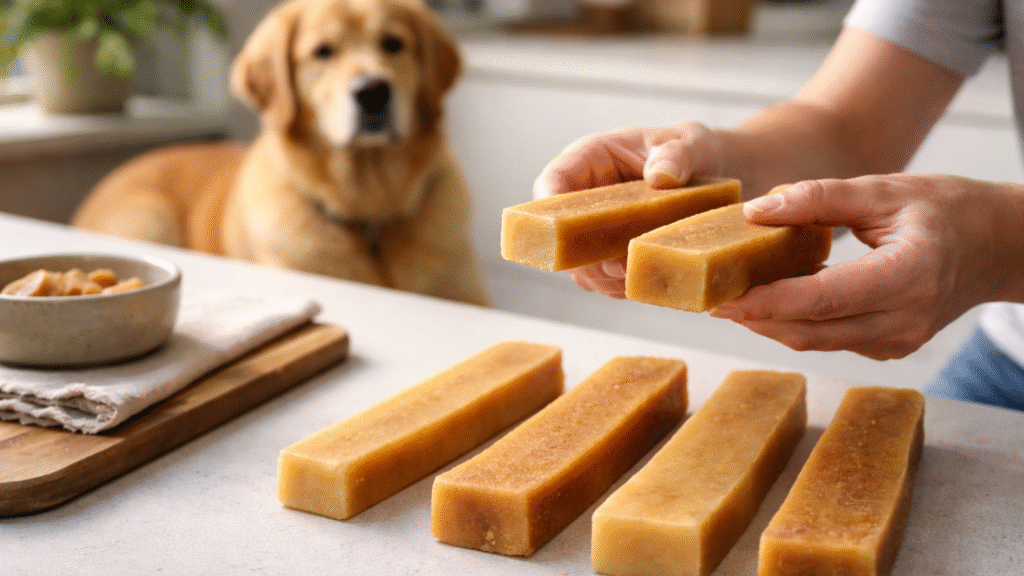
One brand’s “Medium” might be another brand’s “Large,” so it’s smarter to compare grams and dimensions instead of the label alone. Look for the package details like weight range, chew length, and thickness, and use global conversions (kg/lb, cm/in) if needed. If the chew feels unusually dense or rock-hard, that can change how “big” it chews, so match hardness to your dog’s teeth and chewing style, not just body size.
Common Size Names vs Real Measurements (Grams, Length, and Thickness)
A “Medium” chew from one Himalayan supplier might weigh 60 grams and measure 4.5 inches, while a competitor’s “Medium” weighs 90 grams and runs 5.5 inches. This variance stems from differences in curing time (longer curing reduces moisture and shrinks dimensions), cutting protocols (hand-cut versus machine-cut), and regional sourcing (yak milk fat percentages vary by herd altitude).
Here is what size names typically translate to in measurable terms:
- Mini/Puppy: 15 to 30 grams, 2.5 to 3.5 inches, 0.5 to 0.75 inches thick
- Small: 30 to 50 grams, 3.5 to 4.5 inches, 0.75 to 1 inch thick
- Medium: 50 to 80 grams, 4.5 to 5.5 inches, 1 to 1.25 inches thick
- Large: 80 to 130 grams, 5.5 to 6.5 inches, 1.25 to 1.5 inches thick
- X-Large: 130 to 200 grams, 6.5 to 7.5 inches, 1.5 to 2 inches thick
- Jumbo: 200 grams and above, 7.5 inches or longer, 2 inches or thicker
Always verify the product page lists actual weight and dimensions rather than relying solely on the size name.
How to Read Packaging: Weight Range, Chew Weight, and Dimensions
Look for three pieces of information on the label or product description:
- Dog weight range: The manufacturer’s recommendation (example: “for dogs 20 to 40 lb”). This is a starting guideline, not a strict rule.
- Chew weight: The individual piece weight (example: “each chew weighs approximately 75 grams”). Variability of ±10 grams is normal for handmade products.
- Dimensions: Length and diameter or thickness (example: “5 inches long, 1.2 inches in diameter”). Measure the actual chew when it arrives; shrinkage during shipping or storage can reduce stated dimensions by up to half an inch.
Packaging that omits any of these three data points should be treated with caution. Request specifications from the seller before purchasing.
Metric Conversions for Global Buyers (kg ↔ lb, cm ↔ in)
Use these conversions when product listings default to metric or imperial units:
- Weight: 1 kilogram (kg) = 2.2 pounds (lb); 1 pound = 0.45 kg. A 10 kg dog equals 22 lb; a 50 lb dog equals 22.7 kg.
- Length: 1 centimeter (cm) = 0.39 inches (in); 1 inch = 2.54 cm. A 15 cm chew equals 5.9 inches; a 6-inch chew equals 15.2 cm.
- Thickness/Diameter: Same as length. A 3 cm diameter chew equals 1.18 inches.
Bookmark a conversion tool or use these formulas when comparing international suppliers. European brands often list chews in grams and centimeters; North American brands default to ounces and inches.
Quality & Hardness Factors That Affect Sizing (Density, Moisture, Age of Chew)
Two chews with identical gram weights can deliver different chewing experiences based on these variables:
- Density: Chews made from higher-fat yak milk (typical in spring when pastures are lush) cure into slightly softer, greasier sticks. Lower-fat milk (common in winter) produces harder, drier chews that last longer.
- Moisture content: Freshly cured chews retain 8 to 12 percent moisture and soften faster during chewing. Aged chews (stored 6 months or longer post-cure) drop to 5 to 8 percent moisture and become rock-hard. Older inventory increases dental injury risk for moderate chewers.
- Storage conditions: Chews stored in humid environments reabsorb moisture and develop surface softness or mold. Chews kept in arid climates dry out further and become more brittle.
Ask suppliers about the cure date and storage recommendations. Chews cured within the past 3 to 6 months offer the best balance of hardness and safety.
Best Yak Chew Size by Age and Life Stage
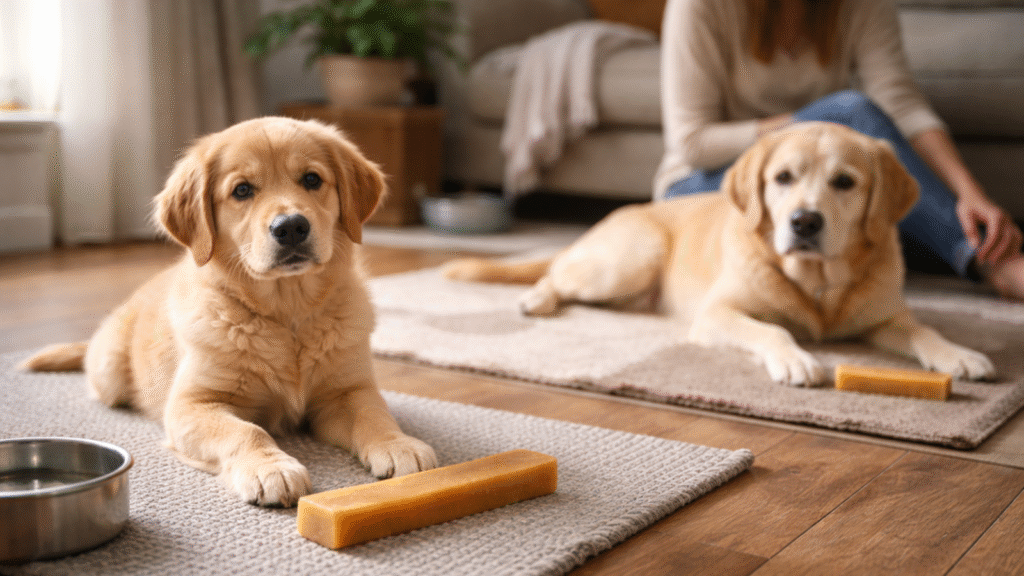
Puppies and seniors often need extra caution because their teeth and jaws are either still developing or more sensitive. For puppies, wait until they can chew safely (many owners choose to wait until adult teeth are coming in) and start with a larger, easier-to-hold size plus short sessions. For seniors, choose a size that’s safe to grip but not so hard that it encourages heavy biting. Short, supervised chew time usually works best.
Puppies: “Age Gate,” Adult Teeth Readiness, and Safest Starter Size
Do not offer yak chews to puppies younger than 6 months or before all adult teeth have erupted. Do not offer yak chews to puppies until all adult teeth have erupted. The Merck Veterinary Manual confirms that permanent teeth appear from 4–5 months onward, and all 42 adult teeth are present by 7 months (Merck Veterinary Manual, Dental Development of Dogs). Puppy teeth lack the enamel density to withstand the hardness of cured yak cheese; premature introduction can cause cracks to develop in molars and can cause permanent dental damage. Verify your puppy has lost all baby canines and premolars (typically complete by 5 to 7 months, depending on breed) before introducing any hard chew.
The safest starter size for a 6- to 12-month-old puppy is Mini or Small, even if the puppy’s adult weight will eventually place them in a higher bracket. A 7-month-old Golden Retriever puppy destined to weigh 70 lb as an adult should begin with a 30-gram Small chew. This allows you to monitor chewing mechanics, stool response, and session length before scaling up.
First-Time Protocol (7-Day Intro Plan): Session Length, Water, Stool Check
Introduce yak chews gradually to avoid gastrointestinal upset. Follow this 7-day protocol for any dog receiving their first yak chew:
- Day 1 to 2: Offer the chew for 5 to 10 minutes under direct supervision. Remove it even if the dog protests. Check stool within 24 hours for softness or mucus.
- Day 3 to 4: Extend sessions to 15 to 20 minutes if no digestive issues appear. Provide fresh water during and after the session; chewing generates heat and thirst.
- Day 5 to 7: Allow 20 to 30-minute sessions. Monitor for vomiting (indicates too much fat consumed too quickly) or straining during defecation (indicates mild obstruction from swallowed fragments). Normal stool should remain firm and fully formed.
Dogs with sensitive stomachs may require even slower introductions (5-minute sessions for 10 to 14 days). Discontinue use if diarrhea persists beyond 48 hours after the first exposure.
Adults: Choosing Size Based on Goal (Calm Time, Enrichment, Dental Support)
Adult dogs (1 to 7 years old with healthy teeth) can receive chews sized to their current weight and chewing intensity. Your goal dictates session length and sizing strategy:
- Calm-time enrichment (30 to 60 minutes): Match the dog’s weight to the standard size chart. A 40 lb Border Collie receives a Medium (70 to 100 grams) for a moderate session.
- Extended occupancy (90 minutes or longer): Size up one level. The same Border Collie gets a Large (100 to 130 grams) to prevent finishing too quickly and begging for more.
- Dental plaque control (daily 15-minute sessions): Use the standard size but limit frequency to once per day. Overfeeding yak chews adds unnecessary calories (approximately 35 to 40 calories per 10 grams). For a full breakdown of how regular chewing supports oral health, see the dental benefits of yak chews.
Regular chewing supports dental plaque control, a meaningful benefit given that AAHA data shows fewer than 14% of dogs receive annual professional dental care and fewer than 10% of owners brush daily (AAHA Dental Home Care Tips).
Rotate yak chews with other enrichment tools (puzzle feeders, sniff mats, frozen Kongs) to prevent boredom and overconsumption.
Seniors: Smaller Bites vs Safer Grip, Plus Gentler Session Planning
Senior dogs (7 years and older, or 5 years and older for giant breeds) face increased risks from hard chews. Age-related enamel thinning, gum recession, and arthritis in the jaw joint (temporomandibular joint or TMJ) make prolonged chewing painful or dangerous. Adjust sizing and session structure accordingly:
- Size down one level from the adult recommendation. A senior 60 lb Labrador Retriever who previously handled Large chews should drop to Medium to reduce jaw strain.
- Limit sessions to 10 to 15 minutes twice per week rather than daily. Shorter sessions lower the risk of tooth fractures and TMJ inflammation.
- Pre-soak option for very frail seniors: Submerge the chew in warm water for 10 minutes before offering. This marginally softens the outer layer and reduces initial hardness. Dry the chew with a towel to prevent mold growth if your dog does not finish it.
Discontinue yak chews entirely if your senior dog develops loose teeth, visible gum bleeding, or reluctance to chew despite previous enthusiasm. Switch to softer alternatives like dehydrated sweet potato or air-dried lung treats.
Best Yak Chew Size by Breed Group and Jaw Shape
Breed size is a helpful starting point, but jaw shape and mouth grip matter just as much. Small breeds often do best with smaller chews only if the chew still passes the snout-length rule and doesn’t become a swallowable piece too quickly. Large breeds often need thicker, longer chews to reduce gulping risk, but power-chewing breeds may need stricter session limits to protect teeth.
1. Toy & Small Breeds: Mini Sizes, Easy-Grip Shapes, and Chew-Holder Use
Toy breeds (under 10 lb), Chihuahuas, Pomeranians, Yorkshire Terriers, and small breeds (10 to 25 lb), Pugs, Miniature Schnauzers, and Cavalier King Charles Spaniels lack the jaw leverage to stabilize standard-diameter chews. These dogs benefit from:
- Mini to Small sizes (20 to 50 grams) that weigh less than 5 percent of the dog’s body weight. A 12 lb Shih Tzu should receive a 30-gram chew maximum.
- Cylindrical or bar shapes rather than irregularly shaped nuggets. Uniform diameter (0.75 to 1 inch) prevents the chew from rolling away during gnawing.
- Chew holders or clamps for dogs under 8 lb. Holders anchor the chew to the floor or a mat, allowing the dog to gnaw without using forepaws to brace. This prevents frustration and reduces the temptation to gulp.
Monitor small breeds closely for “overgrip”, attempting to hold the chew vertically in the mouth like a cigar. This position invites choking if the dog jerks their head or the chew snaps. Reorient the chew horizontally across the molars.
2. Medium Breeds: Standard Sizing, Calorie Control, and Upgrade Triggers
Medium breeds (25 to 50 lb), Beagles, Cocker Spaniels, Bulldogs, and Australian Shepherds fit cleanly into manufacturer weight ranges and can use Medium to Large chews depending on chewing aggression. Focus on these considerations:
- Standard sizing works well: A 35 lb Brittany Spaniel thrives on a 70 to 90-gram Medium chew. Check that the chew extends 1 inch past the nose tip.
- Calorie awareness for less-active dogs: Medium breeds prone to weight gain (Basset Hounds, Beagles) should receive chews no more than 3 times per week, with each session’s calorie contribution (approximately 50 to 70 calories for a 70-gram chew) subtracted from daily kibble portions.
- Upgrade triggers: If your medium-breed dog finishes a Medium chew in under 20 minutes, size up to Large. Fast finishers are either power chewers (see section 5.2) or the chew is too soft due to high moisture content.
Medium breeds with deep chests (Springer Spaniels, Setters) should chew in a sphinx position (lying down, elbows on the ground) rather than standing. This posture reduces the risk of gulping air alongside chew fragments, which can contribute to bloat in susceptible breeds.
3. Large & Giant Breeds: XL/Jumbo Sizing, Thickness Guidance, and Tooth-Safety Tips
Large breeds (50 to 80 lb), German Shepherds, Golden Retrievers, Boxers, and giant breeds (over 80 lb), Great Danes, Mastiffs, Saint Bernards, generate bite forces of 200 to 400 pounds per square inch (PSI). These dogs require chews engineered to withstand prolonged pressure:
- X-Large to Jumbo sizes (130 grams and above) with a minimum 1.5-inch thickness at the narrowest point. A 90 lb Bernese Mountain Dog needs a 200-gram Jumbo chew measuring 7 to 8 inches long and 2 inches thick. If you’re sourcing for large breeds specifically, explore the full range of YforYak dog chew manufacturer options sized for bigger dogs.
- Avoid “economy” or lightweight versions marketed for large breeds. These are often Medium chews repackaged with misleading labels. Verify the gram weight on the label matches true XL/Jumbo standards.
- Inspect for microfractures before each session: Large-breed dogs can create internal cracks in the chew during previous sessions. Hold the chew up to the light; if you see spiderweb lines or translucent weak points, discard it to prevent splintering.
Giant breeds should chew on non-slip surfaces (rubber mats, textured tile) to prevent the chew from sliding across hardwood or tile and causing jaw hyperextension injuries when the dog lunges to recapture it.
Special Jaw Types: Brachycephalic and Sighthound Adjustments (Grip and Leverage)
Brachycephalic breeds (flat-faced), Bulldogs, Pugs, Boston Terriers, French Bulldogs, and sighthounds (narrow-jawed), Greyhounds, Whippets, Italian Greyhounds, present unique biomechanical challenges:
Brachycephalic adjustments:
- Wider diameter chews (minimum 1.5 inches) compensate for shortened snouts and reduced leverage. A 50 lb English Bulldog should receive a Large chew sized for a 70 lb dog to ensure the chew does not slip toward the throat.
- Limit sessions to 15 minutes to prevent respiratory distress. Brachycephalic breeds overheat quickly during exertion; panting while chewing obstructs airflow further.
- Supervise for reverse sneezing or gagging. These breeds aspirate saliva more easily while chewing. Remove the chew immediately if coughing or choking sounds occur.
Sighthound adjustments:
- Thinner, longer chews (6 to 8 inches with a 1-inch diameter) suit narrow jaws. A 60 lb Greyhound handles a chew designed for a 40 lb dog if the length is extended to prevent swallowing.
- Avoid nugget or chunk shapes. Sighthounds lack the molar surface area to grind irregular shapes safely; they stick to uniform bars.
- Check for jaw soreness after the first session. Sighthounds have less muscle mass around the jaw joint; excessive chewing can cause inflammation. If your dog hesitates to eat kibble the next day, reduce yak chew frequency to once per week.
Match Yak Chew Size to Chewing Style (Most Important Safety Layer)
Two dogs of the same weight can need totally different sizes because chewing behavior changes everything. Gentle gnawers can often handle a right-sized chew more frequently, while power chewers may need a bigger chew plus shorter sessions to reduce the risk of cracking or chunking. If your dog gulps or tries to swallow pieces, go up a size, use a chew-holder, and remove the chew as soon as it becomes small enough to fit fully in the mouth.
1. Gentle Gnawers: Right Size Without Overfeeding (Duration > Portion)
Gentle gnawers nibble slowly, scraping thin layers of cheese over 45 to 90 minutes without aggression. These dogs, often seniors, low-energy breeds, or naturally cautious eaters, benefit from standard sizing matched to weight, but sessions should prioritize duration over chew mass:
- Use the smallest size within the recommended weight range. A 30 lb gentle gnawer (Cavalier King Charles Spaniel) receives a Small (40 to 50 grams) rather than a Medium.
- Allow longer sessions (60 to 90 minutes) since the consumption rate is slow. The dog extracts maximum enrichment without exceeding safe calorie intake.
- Track total weekly chew weight rather than session frequency. A gentle gnawer might safely handle 150 grams per week, split across three 50-gram sessions, whereas the same total given in two 75-gram sessions could cause loose stool.
Gentle gnawers rarely pose choking risks but can develop obsessive guarding behavior if the chew becomes a high-value resource. Rotate chew locations and practice “drop it” trades with high-reward treats during sessions.
2. Power Chewers: When to Size Up 1 to 2 Levels and Limit Session Time
Power chewers, Pit Bulls, Malinois, Cattle Dogs, working-line German Shepherds, attack chews with sustained pressure, generating visible saliva and jaw muscle engagement. These dogs pulverize standard-size chews in under 15 minutes and require aggressive upsizing:
- Size up 1 to 2 levels above the weight-based recommendation. A 55 lb power-chewing Malinois receives an X-Large (150 to 180 grams) intended for an 80 lb dog.
- Limit sessions to 20 to 30 minutes maximum. Longer sessions allow power chewers to reduce the chew to a small nub, which they will attempt to swallow whole.
- Inspect teeth and gums after every session. Power chewers crack enamel or fracture molars more frequently than other types. Look for pink-tinged saliva (indicates gum bleeding), visible chips on tooth edges, or reluctance to chew on one side of the mouth.
Power chewers who finish an X-Large chew in under 20 minutes should be transitioned off yak chews entirely. These dogs need softer alternatives (compressed yak puffs, rubber toys) or professional-grade nylon chews designed for extreme biters. For a deeper breakdown of which products suit different bite profiles, see our guide to the best yak chews by chewing style.
3. Gulpers: Red Flags the Chew Is Too Small, Holders, and “Takeaway” Rules
Gulpers swallow large pieces of food or treats without chewing, a behavior rooted in resource guarding, rapid eating habits, or breed predisposition (Labrador Retrievers, Beagles). Gulpers pose the highest choking and obstruction risk with yak chews:
Red flags: the chew is too small.
- Your dog swallows a 2-inch or larger piece without chewing within the first 10 minutes.
- The chew disappears in under 15 minutes with no visible gnaw marks or saliva buildup.
- Your dog holds the chew vertically in the mouth (like a sword) rather than positioning it horizontally across molars.
Interventions for gulpers:
- Use a chew holder or floor-mount clamp to immobilize the chew. This forces the dog to gnaw rather than manipulate the chew toward the throat.
- Enforce the “takeaway rule”: Remove the chew when it shrinks to a size smaller than a golf ball (approximately 1.5 inches in any dimension). Do not allow the dog to “finish” the chew.
- Size up aggressively, minimum 2 levels above weight recommendation. A 40 lb gulping Beagle receives an X-Large (150 grams) to extend session time and delay the point at which the chew becomes swallowable.
Gulpers who override holders by breaking the chew or who become aggressive when you remove the nub should not receive yak chews under any circumstances. These dogs require behavior modification before reintroducing high-value chews.
How Long Should a Yak Chew Session Be (Beginner Schedule by Dog Type)
Use this schedule for the first 30 days of yak chew introduction, then adjust based on your dog’s response:
- Gentle gnawers (toy, small, senior): 30 to 60 minutes, 2 to 3 times per week
- Moderate chewers (medium, low-energy large): 20 to 40 minutes, 3 to 4 times per week
- Power chewers (high-drive, working breeds): 15 to 25 minutes, 2 times per week maximum
- Gulpers (any size): 10 to 15 minutes with holder, 1 to 2 times per week
Extend session length by 5 to 10 minutes per week if your dog shows no digestive upset, dental issues, or behavioral problems. Cap sessions at 90 minutes regardless of dog type; beyond this point, jaw fatigue increases injury risk. For guidance on weekly frequency across dog types, read our full article on how often to give your dog a chew.
Size Chart, Troubleshooting, and Leftover Pieces (Buyer Confidence Section)
A clear size chart (weight range → chew size) builds confidence, but it should always be backed by real-life checks like snout length, thickness, and chewing speed. Watch for “wrong size” signals like quick chunking, frantic chewing, guarding, gagging, or repeated soft stool after sessions. For end pieces, convert them into safer puffs (or discard them) instead of letting your dog chew a small, swallowable nub.
Full Size Chart: Weight Range → Recommended Size and Breed Examples
| Dog Weight (lb / kg) | Recommended Size | Typical Weight (grams) | Length (inches) | Thickness (inches) | Breed Examples |
| Under 10 lb (4.5 kg) | Mini | 20–30 g | 2.5–3.5 | 0.5–0.75 | Chihuahua, Pomeranian, Yorkshire Terrier |
| 10–25 lb (4.5–11 kg) | Small | 30–50 g | 3.5–4.5 | 0.75–1 | Pug, Shih Tzu, Miniature Schnauzer |
| 25–50 lb (11–23 kg) | Medium | 50–80 g | 4.5–5.5 | 1–1.25 | Beagle, Cocker Spaniel, Border Collie |
| 50–80 lb (23–36 kg) | Large | 80–130 g | 5.5–6.5 | 1.25–1.5 | Labrador Retriever, German Shepherd, Boxer |
| Over 80 lb (36 kg) | X-Large / Jumbo | 130–250+ g | 6.5–8+ | 1.5–2+ | Great Dane, Mastiff, Saint Bernard |
Power chewers: Add 1 to 2 size levels.
Gulpers: Add 2 size levels and use holders.
Seniors: Subtract 1 size level.
“Wrong Size” Symptoms: Choking Risk, Splintering, Soft Stool, Vomiting, Guarding
Recognize these warning signs and adjust size or discontinue use:
Choking risk indicators:
- Your dog coughs, gags, or makes retching sounds during or immediately after chewing.
- The chew disappears in under 10 minutes with no visible gnaw patterns.
- You find large (1-inch or bigger) swallowed pieces in vomit or stool.
Splintering (wrong hardness or quality):
- Sharp shards or needle-like fragments appear on the floor after a session.
- The chew breaks into jagged pieces rather than softening gradually.
- Your dog’s gums bleed, or you see pink saliva.
Digestive upset (too much, too fast):
- Loose stool or diarrhea within 12 to 24 hours of the session.
- Vomiting undigested chew pieces 2 to 6 hours post-session.
- Straining during defecation or producing small, hard, mucus-coated stools (indicates partial obstruction).
Behavioral red flags (resource guarding or obsession):
- Your dog growls, snaps, or freezes when you approach while chewing.
- Your dog refuses to release the chew on cue or hides it.
- Your dog ignores food, play, or other rewards after the chew is removed.
Address choking and splintering by sizing up and verifying chew quality (request fresher stock, check cure date). Address digestive upset by reducing session frequency and duration. Address guarding through behavior modification with a certified trainer; do not force removal.
What to Do With the End Piece: Puff Method Step-by-Step (Soak → Microwave → Cool)
Yak chews shrink to a small, hard nub (1 to 2 inches) that poses a choking hazard if swallowed whole. Convert the end piece into a safe, crunchy puff using this microwave method:
- Soak the end piece in warm water for 5 to 10 minutes until it softens slightly and feels tacky to the touch. Pat dry with a towel.
- Place the piece on a microwave-safe plate. Do not cover.
- Microwave on high for 30 to 45 seconds. Watch through the microwave door; the piece will expand (puff) to 2 to 3 times its original size and emit steam.
- Stop immediately when puffing ceases. Over-microwaving burns the cheese and creates bitter, inedible char.
- Let cool for at least 3 to 5 minutes. The puffed piece is extremely hot internally; touching it too soon causes burns.
- Offer the crunchy puff as a low-value snack. The puff crumbles easily and dissolves faster than the original chew. Supervise consumption to ensure your dog does not gulp large fragments.
or follow our dedicated step-by-step tutorial on how to puff yak chews in the microwave for photos and timing tips.
The puff method reduces waste and provides a novel texture. Store unpuffed end pieces in an airtight container for up to 3 months; batch-process multiple pieces at once for efficiency.
Safe Alternatives if Yak Chews Don’t Fit Your Dog (Texture, Calories, Dental Needs)
Yak chews are not universally suitable. Consider these alternatives if your dog experiences persistent issues:
For softer texture (seniors, dental disease, gentle chewers):
- Compressed yak-milk puffs: Pre-puffed, lightweight, and dissolve quickly. Lower choking risk but offers less dental benefit.
- Dehydrated sweet potato or carrot slices: Soft enough for compromised teeth, low-calorie, high-fiber.
- Air-dried lung or trachea: Minimal hardness, novelty texture, moderate protein.
For lower calories (overweight dogs, treat-sensitive diets):
- Bully stick alternatives (pizzle, tendons): Similar chew duration, lower fat content (approximately 9 to 12 calories per inch vs 15 to 20 for yak chews). For a full comparison of both options, see our breakdown of yak chews vs bully sticks.
- Dental chews (Greenies, Whimzees): Purpose-built for plaque control, calorie counts printed on packaging for easy tracking.
For extreme power chewers (safety over duration):
- Rubber chew toys (Kong Extreme, West Paw Zogoflex): Indestructible for most dogs, reusable, fillable for enrichment.
- Nylon chews (Nylabone Power Chew): Designed for sustained gnawing, self-cleaning bristles prevent bacterial buildup.
For gulpers (immobilization required):
- Frozen Kong with kibble or wet food: Cannot be swallowed whole, thaws slowly, and provides mental stimulation.
- Lick mats with spreadable treats: Forces licking over chewing, eliminating choking risk.
Consult your veterinarian before switching treat types if your dog has a history of dietary allergies, pancreatitis, or gastrointestinal obstruction. Alternatives should match your dog’s specific health needs rather than default preferences.
Final Sizing Confidence Check
Choosing the right yak chew size protects your dog from preventable injuries while delivering the enrichment and dental benefits these Himalayan chews are known for. Combine weight-based sizing with the muzzle rule, thickness check, and chewing-style adjustments outlined here. Monitor every session for signs of incorrect sizing, choking attempts, rapid consumption, and digestive upset, and adjust immediately rather than waiting for a crisis. When sized correctly and supervised appropriately, yak chews become a safe, long-lasting tool that strengthens your dog’s jaw, scrapes plaque, and provides hours of calm, focused activity.
How do I know if my yak chew is too small for my dog?
A yak chew is too small if your dog can fit most of it in their mouth or attempts to swallow it whole. Remove chews that shrink to under snout length or break into large chunks. Always size up if in doubt and supervise all chew sessions to prevent choking.
What size yak chew should I buy for a puppy?
Buy a yak chew longer than your puppy’s snout and thick enough to prevent gulping. Avoid hard textures for young teeth and limit sessions to short, supervised periods. Wait until teething ends before offering firmer chews, and stop use if your puppy swallows large pieces.
Can large dogs eat small yak chews if they chew gently?
Large dogs should not eat small yak chews, even if they chew gently. The risk of accidental swallowing increases due to jaw size. Small chews turn into dangerous end pieces quickly. Always choose larger chews and limit chew time to avoid choking hazards.
Is it better to choose yak chew size by weight or by breed?
Choose yak chew size by weight first, since weight reflects chewing force and mouth size. Use breed as a secondary factor to adjust for jaw shape and bite strength. The best method combines weight, snout length, and chewing style to ensure the safest fit.
How long should my dog chew on a yak chew per session?
Limit yak chew sessions to 10–15 minutes, especially for first-time users or power chewers. Monitor stool and chewing behavior after each session. Stop if the chew gets small, breaks into chunks, or becomes sharp. Short, supervised sessions reduce health and choking risks.
What does “size up if in-between sizes” mean?
“Size up if in-between sizes” means choose the larger yak chew when your dog falls near the top of a size range. Larger chews are harder to swallow and promote safer gnawing. This helps reduce choking risk, especially for fast chewers or dogs with strong jaws.
Are yak chews safe for aggressive chewers?
Yak chews can be safe for aggressive chewers if you choose a larger, thicker size and limit chewing time. Avoid heavy crunching, which risks tooth fractures. Monitor closely and stop if your dog breaks chunks off. For chronic chunking, switch to a softer alternative.
My dog gets diarrhea after yak chews. Should I change the size?
Changing the yak chew size may help, but diarrhea is often caused by overeating, fast chewing, or ingredient sensitivity. Reduce session time and frequency. A larger chew can slow intake. If symptoms persist or worsen, stop use and consult your veterinarian.
What should I do with the leftover end piece of a yak chew?
Turn leftover yak chew ends into safe puffs by soaking briefly, microwaving until expanded, and letting them cool fully. If not, discard the piece to avoid choking. Never let your dog chew the final nub. The goal is safety while minimizing waste.
Do chew-holders really help with yak chew sizing?
Chew-holders help with yak chew safety by improving grip and preventing dogs from swallowing small end pieces. They don’t replace correct sizing but add an extra safety layer. Combine holders with larger chews and short sessions for best results, especially for gulpers.