
Yak chews (often called Himalayan cheese chews) can be a great long-lasting treat for puppies, but only when you choose the right texture and size for their age and chewing style. This guide breaks down the best yak chews for puppies by teething stage, breed size, and sensitivity, so you can avoid the two biggest beginner mistakes: giving a chew that’s too hard too early and letting a puppy chew unsupervised until the end-piece gets risky.
You’ll learn how to spot a puppy-safe option (including softer “starter” and puffed yak chews), what to look for on ingredient labels, and exactly how to use yak chews without tooth, choking, or tummy troubles. If you’re a first-time buyer, or a manufacturer wanting to educate customers, this article is built to help you pick confidently, use chews correctly, and know when to switch to safer alternatives.
Best Yak Chews for Puppies: Quick Picks by Age, Size, and Chew Style
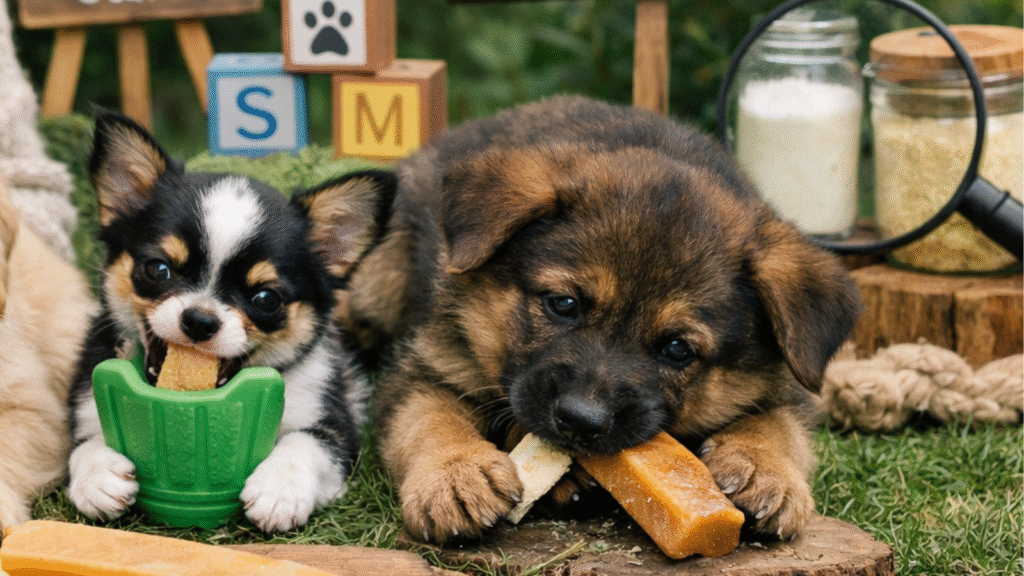
The “best” yak chew for a puppy depends on age, mouth size, and whether your pup nibbles gently or tries to crush and gulp. Teething puppies usually do better with softer textures (like puffed yak chews) and short, supervised sessions instead of classic ultra-hard chews. A quick decision map helps you match the chew to your puppy’s stage so you get the benefits without unnecessary risk.
1. Best Starter Yak Chew for Teething Puppies: Puffed or Softer Options First
Puffed yak chews are the safest first option for teething puppies aged 8 to 16 weeks. The puffing process (microwaving the dried chew block until it expands) transforms the hard, dense texture into a lighter, crunchier format that crumbles rather than fractures under pressure. Teething puppies get the chewing satisfaction they need without putting stress on deciduous (baby) teeth that are still anchored in soft gum tissue.
Look for puffed nuggets or puffed bars sized appropriately for the puppy’s mouth. A piece measuring roughly 3 cm to 5 cm (1.2 to 2 inches) works well for most puppies under 5 kg. Discard any piece that the puppy attempts to swallow whole without chewing.
2. Best Yak Chew for Small-Breed Puppies: Safer Sizing and Chew Holder Friendly Shapes
Small-breed puppies, those that will reach an adult weight under 10 kg (22 lbs), need thinner sticks or small-format bars, not the thick jumbo blocks designed for large breeds. The key safety rule is that the chew must be long enough that the puppy grips one end while chewing the other. Chew-holder-compatible shapes (flat sticks with consistent width) work well here because they keep the chew elevated and stable, reducing the risk of the puppy repositioning a short piece too far back in the mouth.
Thinner yak sticks in the XS to S size range (typically 50 g to 80 g) are the correct format. Avoid “value bags” of random-sized pieces for small breeds because size inconsistency creates unpredictable choking risk.
3. Best Yak Chew for Medium and Large-Breed Puppies: Durable, But Not “Ultra-Hard”
Medium and large-breed puppies (10 kg to 30 kg / 22 lbs to 66 lbs at adult weight) tolerate classic hard yak chew bars from around 4 to 5 months, once adult teeth begin arriving, but “ultra-hard” or “extreme hardness” labels are not appropriate at this stage. The adult teeth of large-breed puppies are fully erupted but not yet fully mineralized until 12 to 18 months of age. A standard classic yak chew bar in the M to L size range provides the right balance: durable enough to last 3 to 5 sessions, firm enough to satisfy power chewers, but still within safe hardness limits for developing dentition.
The “thumbnail test” applies here: press the surface of the chew with your thumbnail. A safe chew leaves a slight indent. A chew that leaves no mark at all is too hard for any puppy.
4. Best Yak Chew for Sensitive-Stomach Puppies: Simplest Ingredient Profiles
Puppies with documented food sensitivities or a history of gastrointestinal (GI) upset perform best with yak chews that contain 4 ingredients or fewer, specifically: yak milk, cow milk, lime juice, and salt. Any additional flavoring, coating, sugar, or binding agent raises the risk of a digestive reaction. Clean-label yak chews that rely entirely on the traditional Himalayan curing process (no additives, no flavor enhancers) are the correct choice for sensitive stomachs.
The YforYak manufacturing process uses exactly this 4-ingredient profile, which makes it a reliable benchmark when evaluating any yak chew for a sensitive puppy. Read labels every time because formulations change between production batches from different suppliers.
Quick Decision Map: Choose by Age, Weight, Chew Intensity, and Gulping Risk
Use this map to identify the right starting format before purchasing.
| Puppy Profile | Recommended Format | Avoid |
| 8 to 16 weeks, any size | Puffed nuggets | Classic hard bars |
| 4 to 6 months, under 10 kg | XS/S thinner sticks or puffed bars | Thick blocks, jumbo sizes |
| 4 to 6 months, 10 kg to 30 kg | M classic bar (thumbnail test passed) | Ultra-hard, extreme grades |
| Sensitive stomach, any age | 4-ingredient clean-label only | Flavored or coated chews |
| Known gulper | Puffed formats only with supervision | Any hard chew format |
| Active teething, sore gums | Puffed or frozen alternatives | Hard classic bars |
Are Yak Chews Safe for Puppies? Risks, Age Guidance, and Teeth Timeline
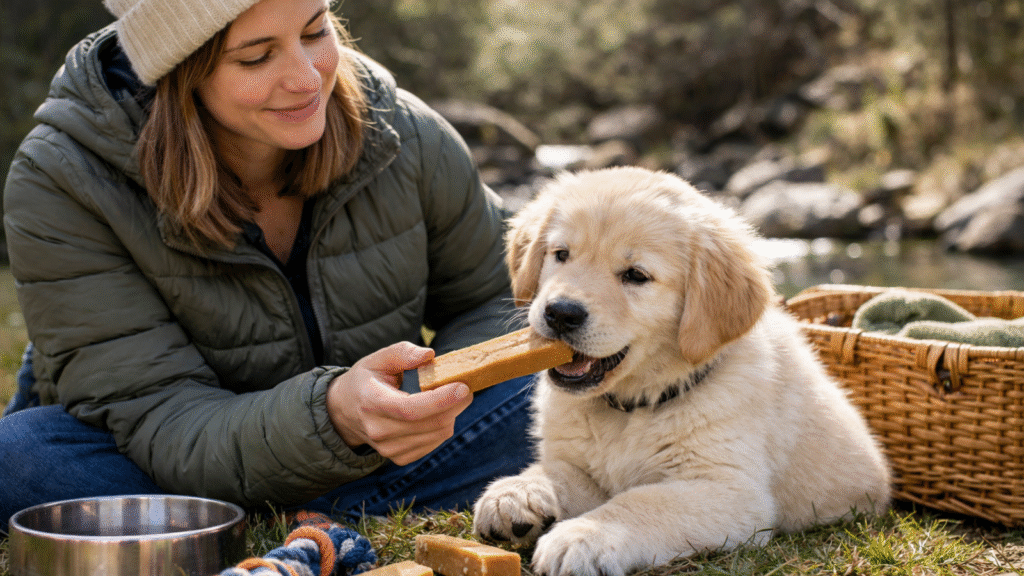
Yak chews can be safe for many puppies, but the risks are real: tooth damage, choking on small pieces, and stomach upset from over-chewing or swallowing chunks. The safest approach is to consider your puppy’s teeth stage, teething gums and newly erupting teeth generally need gentler options than adult teeth. This section explains when to start, who should avoid yak chews, and the rules that prevent most problems.
What Yak Chews Are (Himalayan Cheese Chews) and How They Are Made
A yak chew is a type of hard, dried cheese block produced from yak milk and cow milk using a traditional Himalayan curing method, also known commercially as a Himalayan dog chew or Himalayan cheese chew. The production process involves boiling the milk, curdling it with lime juice, pressing out the whey, molding the curd into blocks, and then slow-drying or smoking them over several weeks until a dense, rock-hard chew forms. This curing process naturally reduces lactose content, which is why most puppies with standard dairy sensitivities tolerate them without incident.
YforYak produces its chews in Tokha, Kathmandu using this exact 4-step traditional method. The result is a minimal-ingredient, high-protein chew with no synthetic preservatives, which matters for puppies whose immune systems are still developing.
The 4 Main Puppy Risks: Tooth Fractures, Choking, Digestion Upset, and Over-Chewing
Yak chews carry 4 specific risks for puppies that do not apply at the same severity to adult dogs.
- Firstly, tooth fractures occur because baby teeth and newly erupted adult teeth have softer enamel and higher pulp exposure, hard chews transmit more force to the root than adult dentition can.
- Secondly, choking risk increases because puppies have smaller tracheas and a stronger instinct to swallow chunks without fully chewing them.
- Thirdly, digestive upset happens when a puppy swallows large, incompletely chewed pieces that exceed the stomach’s processing capacity, leading to vomiting or diarrhea within 2 to 6 hours.
- Fourthly, over-chewing creates continuous gum inflammation and accelerates enamel wear on the chewing surface, which compounds with the natural wear of teething.
Each risk is manageable with supervision, correct sizing, and time limits, not by avoiding yak chews entirely.
Puppy Teeth Timeline: Teething Months vs When Adult Teeth Arrive
The puppy teeth timeline divides into 3 stages that directly determine which chew texture is appropriate.
- Firstly, the deciduous (baby teeth) stage runs from birth to approximately 12 to 16 weeks, no hard chews during this window.
- Secondly, the mixed dentition stage runs from 3 to 6 months, when baby teeth fall out and adult teeth erupt in sequence, soft to medium textures only, with frequent checks for loose teeth.
- Thirdly, the full adult dentition stage begins around 6 to 7 months, when all 42 adult teeth are present, classic hard bars become acceptable once the thumbnail test confirms appropriate hardness.
Large breeds mature more slowly than small breeds. A 6-month-old Great Dane puppy is not the same as a 6-month-old Chihuahua when it comes to dental readiness.
Safer Default Rule: Start Soft, Graduate to Classic Later
The safest default for any new puppy chewer is to start with puffed or softer textures and graduate to classic hard bars only after 5 to 6 months of age. This rule prevents the most common mistake in puppy chew selection: choosing based on durability (“it lasts longer so it is better value”) rather than dental stage. A chew that lasts longer is not necessarily safer, it is often harder, and hardness is the primary driver of tooth fracture risk in puppies.
Graduation to classic bars works best as a 2-week transition. Introduce the new texture in short 5-minute (300 second) sessions alongside the familiar softer format, then phase out the softer option once the puppy chews steadily without gulping or aggressive biting.
Puppies That Should Avoid Yak Chews Entirely
Certain puppies face elevated risk that makes yak chews inappropriate regardless of age. Puppies that gulp food without chewing present the highest choking risk with any hard chew format. Puppies with a documented malocclusion (misaligned bite) create uneven pressure on individual teeth that multiplies fracture risk. Puppies recovering from gastrointestinal surgery, pancreatitis, or food-allergy elimination trials need zero chew variables during the diagnostic period. Puppies fitted with palatal or orthodontic devices (rare but present in some breeds) must avoid all hard chews entirely until the device is removed by the veterinarian.
Ask your veterinarian for written clearance before introducing any chew to a puppy with a known health condition.
How to Choose the Best Yak Chew for Your Puppy

Choosing well starts with sizing: a yak chew should be longer than your puppy’s mouth and thick enough that it can’t be fully wedged between back teeth. Texture matters just as much, classic hard chews last longer, while thinner or puffed options can be safer “starter” formats for younger pups. You’ll also learn a simple “too hard” test and a label checklist so you don’t buy the wrong product.
Size and Shape Rules: Length, Thickness, and the “Cannot Fit Fully in Mouth” Test
The correct size rule is that a yak chew must be long enough that the puppy cannot fit the entire piece into its mouth at once. A chew that fits fully in the mouth becomes a choking hazard the moment the puppy attempts to swallow it whole. As a general guideline, the chew length should exceed the distance from the tip of the nose to the back of the jaw, typically 10 cm to 15 cm (4 to 6 inches) for small breeds and 15 cm to 20 cm (6 to 8 inches) for medium breeds.
Thickness matters separately. A thin stick-format chew that snaps under moderate bite pressure creates sharp shards that damage gum tissue and create swallowing hazards. Aim for a thickness that the puppy must work through progressively rather than snap.
Texture Options Explained: Classic Hard vs Thinner Sticks vs Puffed Yak Chews
3 main texture formats exist across the yak chew category, each suited to a different puppy stage.
- Firstly, classic hard bars are the traditional format, dense, long-lasting (3 to 7 sessions), and appropriate for puppies 5 months and older with confirmed adult teeth.
- Secondly, thinner sticks are a lighter version of the bar format with reduced cross-sectional density, which makes them suitable for small breeds and early-stage 4 to 5 month chewers transitioning out of puffed textures.
- Thirdly, puffed yak chews are the microwaved or factory-puffed version of the hard format, airy, crumbly, and the only appropriate texture for teething puppies under 4 months of age.
YforYak produces all 3 formats (bars, nuggets, puffed bars, puffed nuggets), which means retail buyers get access to the full puppy-through-adult product range from a single quality-controlled source.
Matching Chew Style: Gentle Chewers vs Power Chewers vs Fast Gulpers
A puppy’s chew style determines the appropriate product as much as its age or size does.
- Gentle chewers work a chew steadily over time and rarely attempt to swallow large chunks, they tolerate classic bars well from 5 months onward.
- Power chewers attack the chew aggressively, shearing off larger-than-expected pieces, they need a thicker, denser format with close supervision, and size up rather than down.
- Fast gulpers are the highest-risk profile: they make minimal chewing effort and attempt to swallow pieces quickly, they require puffed-only formats, a chew holder, and active monitoring during the entire session with no unsupervised access.
Observe the puppy’s behavior with a low-risk chew toy first. The behavior pattern visible at 10 minutes into a session reflects the puppy’s natural chew style.
How to Tell if a Chew Is Too Hard: Simple Tests and When to Switch Softer
The 2 practical hardness tests that work without any special equipment are the thumbnail test and the drop test. The thumbnail test involves pressing firmly with your thumbnail nail into the surface of the chew. A safe chew dents slightly. A chew that leaves no mark is too hard for a puppy. The drop test involves dropping the chew on a hard floor from 30 cm (12 inches). A safe chew absorbs the impact without shattering or producing visible stress fractures. A chew that chips or splinters on impact is too hard and too brittle.
Switch to a softer format immediately if the puppy shows any of these signs during a session: pawing at the mouth, turning away from the chew after brief contact, crying or whimpering, or chewing only on one side of the mouth.
Buyer Checklist Before Purchase: What to Scan on the Label and Package
Before any purchase, review the product label against this 8-point checklist.
- Confirm the ingredient list shows 4 ingredients or fewer (yak milk, cow milk, lime juice, salt)
- Verify no added sugars, artificial flavors, or mystery “natural flavors” entries
- Check that the size designation matches the puppy weight range on the packaging
- Confirm the country of origin and manufacturing facility information
- Look for any quality or compliance claim (ISO, HACCP, FDA registration) and note whether these are verifiable
- Check the moisture level claim, below 15% indicates proper drying and longer shelf stability
- Confirm the expiry or best-before date is at least 12 months from the purchase date
- Note whether the package includes a microwave puffing guide for safe end-piece us
Ingredients, Nutrition, Quality, and Sourcing: What Separates “Good” from “Great”
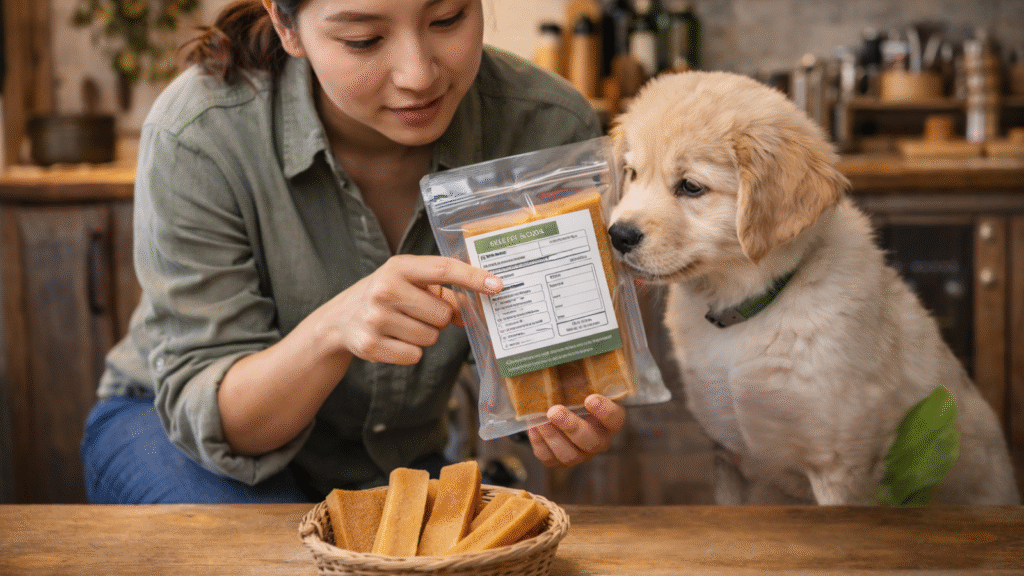
A puppy-friendly yak chew usually has a short ingredient list and avoids heavy coatings or mystery binders that can trigger sensitivity. Nutrition claims like “high protein” or “lactose reduced” can be helpful, but quality depends on how the chew is produced and dried, which affects hardness and break behavior. This section covers what to look for on labels, plus the trust signals that matter for both B2C buyers and B2B retail/wholesale partners.
Ideal Ingredient Profile: Milk Base and Minimal Additives
A clean yak chew ingredient profile contains exactly 4 components, yak milk, cow milk, lime juice, and salt, with no fillers, binders, or flavor enhancers. The yak milk provides high-altitude fat and protein density. The cow milk extends volume and smooths the texture. The lime juice acts as a natural acidulant that curdles the milk and contributes to lactose reduction. The salt acts as a natural preservative and mild palatability enhancer.
Anything beyond these 4 ingredients adds processing complexity and increases the probability of a reaction in sensitive puppies. “Natural smoke flavor,” “vegetable glycerin,” or “maltodextrin” on a yak chew label are all signals that the product has moved away from traditional Himalayan production methods.
Puppy Nutrition Lens: Protein, Calcium, Lactose-Reduced Claims, and Sensitivity Watch-Outs
Yak chews typically deliver 50% to 65% crude protein per 100 g dry weight, with calcium levels ranging from 1.5% to 2.5%, making them a nutritionally meaningful supplement, not just an enrichment item. For puppies, the calcium contribution matters because excess calcium during rapid skeletal growth (particularly in large breeds) correlates with developmental orthopedic disease according to veterinary nutrition consensus.
Yak chews are low in fat (typically 1% to 5%) and are described as lactose-reduced due to the curing process, which degrades lactose over the drying period. Puppies with confirmed cow milk protein sensitivity (not merely lactose intolerance) may still react, the protein fraction remains intact regardless of lactose reduction.
What to Avoid on Labels: Heavy Flavor Coatings, Sugars, Mystery Binders, and High-Odor Extras
The 4 label red flags for puppy-safe yak chews are heavy flavor coatings, added sugars, mystery binders, and high-odor extras (such as bacon or chicken flavoring).
- Heavy coatings mask poor base-product quality and add calorically dense, often poorly digested compounds to the chew surface.
- Added sugars accelerate dental plaque formation, especially problematic during the teething period.
- Mystery binders (“vegetable extract,” “binding agent”) indicate the chew did not hold its shape naturally during drying, which signals a manufacturing quality issue.
- High-odor flavorings drive over-excitement and faster, more aggressive chewing that increases gulping risk in puppies.
A clean chew smells mildly of aged cheese. A chew with a sharp, smoky, or meaty artificial smell has been flavored.
Quality Signals: Drying Process, Moisture Control, Break Behavior, and Consistency
4 observable quality signals distinguish a well-manufactured yak chew from a commodity product.
- Firstly, consistent color throughout the cross-section (pale yellow to tan, not white patches or dark streaks) indicates an even drying process with no moisture pockets.
- Secondly, a moisture level below 12% to 15% ensures shelf stability and prevents premature mold growth during distribution.
- Thirdly, break behavior under firm manual pressure should produce a clean fracture rather than crumbling into powder or splitting into sharp shards.
- Fourthly, batch-to-batch consistency in weight and hardness indicates that the manufacturer uses standardized milk sourcing and drying time protocols, not artisanal guesswork.
YforYak claims a production capacity of up to 50,000 kg per month from its Tokha facility under ISO 9001, HACCP, and DFTQC (Department of Food Technology and Quality Control) compliance protocols. Request batch-specific Certificates of Analysis (COAs) when ordering in bulk to verify protein, moisture, and pathogen test results.
Trust and Compliance Notes for B2C and B2B Buyers: Traceability, Testing, and HACCP Basics
B2B buyers sourcing yak chews for retail or private-label distribution require 3 categories of documentation before placing commercial orders.
- Firstly, facility-level certifications (ISO 9001 certificate number and issuing body, FDA facility registration number, HACCP plan summary) confirm that the manufacturer operates within a defined quality management system.
- Secondly, product-level testing documentation (COAs per batch covering protein, moisture, fat, ash, and microbiological markers) provides the evidence base for any label claims.
- Thirdly, export-level compliance documents (Certificate of Origin, veterinary health certificate, sanitary export certificate) confirm that the product meets the import requirements of the destination country.
YforYak states full support for export documentation including Certificates of Origin and sanitary certificates. Verify all certifications independently before the first commercial shipment, and request physical copies of audit reports rather than accepting unverifiable on-site claims alone.
How to Use Yak Chews Safely for Puppies (Step-by-Step)
Most yak chew issues come from usage, not the product itself: puppies need short sessions, supervision, and early removal of small end-pieces. A 7-day introduction plan reduces stomach upset and helps you gauge whether your puppy chews safely or tries to swallow chunks. You’ll also get a clear puffing/microwaving method for end-pieces, hygiene rules to prevent soggy re-feeding, and warning signs that should prompt a vet call.
The 7-Day Introduction Plan: Session Length, Frequency, and Monitoring
The 7-day introduction plan begins with a single 5-minute (300 second) supervised session on day 1, with a gradual increase of 3 to 5 minutes per session over the following 6 days. Day 1 establishes the baseline, observe how the puppy engages with the chew (gentle vs aggressive, gulping tendency, gum response). Days 2 to 4 extend sessions to 10 to 15 minutes. Days 5 to 7 establish the regular session length of 15 to 20 minutes, which is the maximum recommended duration for puppies under 6 months.
End every session by removing the chew before the puppy loses focus. A puppy that starts repositioning the chew in its mouth, chewing more aggressively, or making repeated swallowing attempts has entered the end-piece risk zone.
Session Rules That Prevent Problems: Time Limits, Breaks, and When to Take It Away
A 20-minute (1200 second) maximum session length applies to all puppies under 6 months, with no exceptions for breed, size, or chew style. Continuous chewing beyond this limit causes gum fatigue, increased mouth temperature, and a corresponding increase in the puppy’s compulsion to finish the chew quickly, which accelerates gulping behavior. Take the chew away at the 20-minute mark regardless of whether the puppy protests.
Remove the chew immediately in any of these 4 situations: the piece has worn down to a size smaller than the puppy’s muzzle width; the puppy begins pawing or gagging; the puppy starts chewing on one side only; visible tooth sensitivity (pulling away, licking the gum line repeatedly) appears.
Supervision Setup: Chew Holders, Safe Surfaces, and No Chewing in Crates
Every yak chew session for a puppy requires hands-on supervision, not passive monitoring from across the room. A chew holder that grips one end of the chew while the puppy works the other end reduces repositioning attempts and keeps the chew at a consistent angle relative to the mouth. Safe chewing surfaces are firm and flat (tile, hardwood, a mat) rather than soft surfaces (carpet, bedding) where the puppy buries the chew and positions it at dangerous angles.
Never leave a yak chew in a crate with a puppy. Crate chewing is unsupervised by definition and concentrates the highest choking risk precisely where emergency intervention is least accessible.
End-Piece Safety Rule: When a Yak Chew Becomes Too Small
Discard or puff any yak chew piece that reaches a size smaller than 5 cm (2 inches) in the shortest dimension, or that the puppy begins to fit entirely in its mouth without gripping the end. The end-piece phase is where most yak-chew-related choking incidents occur. The puppy has been chewing for a while, the piece has softened slightly with saliva, and the reduced size invites a swallowing attempt. Do not wait for the puppy to attempt this.
The safest outcome for an end piece is to convert it into a puffed treat using the microwave method described in the section below.
Puffing the End-Piece Safely: Steps, Timing, Cooling, and Common Mistakes
The correct microwave puffing process for a yak chew end-piece takes 45 seconds to 90 seconds (depending on microwave wattage and piece size) and requires a mandatory 2-minute (120 second) cooling period before giving the treat to the puppy. Follow these steps precisely.
- Place the end-piece on a microwave-safe plate (not a paper towel, the chew may spark)
- Microwave on high in 20-second intervals, checking after each interval until the piece puffs and expands
- Remove from the microwave immediately once expansion stops
- Allow to cool on the plate for a minimum of 2 minutes (120 seconds) before touching
- Break the puffed piece into 2 to 3 smaller fragments before giving to the puppy
The 2 most common mistakes in this process are over-microwaving (which creates a hard, brittle texture rather than a soft puff) and giving the treat without sufficient cooling (which causes mouth burns from the internally retained heat). The puffed end-piece is now a soft, digestible treat, not a choking hazard.
Storage and Hygiene: Keep It Dry, Avoid Soggy Re-Feeding, and When to Discard
Store used yak chews in a dry, ventilated container between sessions, not in a sealed plastic bag or damp bowl. Saliva introduces moisture that, trapped in a sealed environment, creates the ideal conditions for bacterial and mold growth within 24 to 48 hours. A breathable cloth bag, an open basket, or a paper bag in a cool dry location extends the hygienic life of the chew between sessions.
Discard a yak chew immediately when any of these 3 conditions appear: visible mold (white, green, or black surface patches), a sour or rancid smell different from the usual aged-cheese scent, or a softened or crumbly texture that indicates moisture absorption exceeding the safe threshold.
Hydration Rule: Why Fresh Water Matters During Every Chewing Session
Provide fresh water in a bowl accessible to the puppy at all times during a yak chew session. Chewing a dense, protein-rich, salty chew increases salivary output and drives mild dehydration over a 15 to 20 minute session. A puppy that does not rehydrate between chewing sessions experiences increased blood sodium concentration, which drives compulsive re-engagement with the chew, creating a cycle of over-chewing driven by thirst rather than enrichment.
The water bowl placement matters. Position it within 1 meter (3 feet) of the chewing area so the puppy does not lose focus on the chew while looking for water.
Dental and GI Warning Signs: Cracked Tooth Symptoms, Vomiting, Diarrhea, and When to Call a Vet
Contact a veterinarian within 24 hours of any yak chew session where the following signs appear: visible tooth fracture or darkening of the tooth surface, blood on the chew or in the mouth, pawing at the face or mouth after the session, vomiting within 2 to 6 hours, or diarrhea with undigested white or gray material. These signs indicate either a tooth injury or a GI obstruction, both of which require professional assessment rather than a wait-and-see approach.
The 3 warning signs that require an emergency vet visit rather than a next-day appointment are: the puppy stops eating entirely after the session, repeated dry heaving without producing vomit, or visible abdominal distension (bloating) within 4 hours of a chewing session.
Yak Chews vs Puppy-Safe Alternatives (and When to Choose Each)
Yak chews aren’t always the best fit, some puppies do better with softer edible chews or non-edible chew toys during peak teething. Comparing yak chews to bully sticks, antlers, rawhide, and rubber toys makes it easier to choose based on digestibility, hardness, odor, and supervision needs. This final section gives practical “switching rules” so you know when to rotate to safer options.
Yak Chews vs Bully Sticks: Digestibility, Odor, Calories, and Supervision Needs
Yak chews and bully sticks are both digestible, protein-rich chews, but they differ in 4 meaningful ways for puppy use.
- Firstly, digestibility: yak chews digest more slowly due to their dense structure, while bully sticks soften quickly and pass through the GI tract faster.
- Secondly, odor: bully sticks carry a strong, persistent odor that many owners find intolerable indoors, while yak chews produce a mild, neutral dairy smell.
- Thirdly, calories: a 50 g bully stick delivers approximately 90 to 110 kcal, while a 50 g yak chew delivers 55 to 70 kcal, relevant for puppies prone to weight gain.
- Fourthly, supervision needs: both require active supervision, but bully sticks soften into an end-piece faster, requiring more frequent monitoring for the swallowing-risk threshold.
For puppies in small homes or apartments where odor matters, yak chews are the practical choice. For puppies that find yak chews uninteresting, bully sticks provide higher aromatic engagement.
Yak Chews vs Rawhide and Antlers: Why Puppies Have Different Risk Priorities
Rawhide and antlers are both inappropriate for puppies under 12 months for opposing but equally serious reasons. Rawhide presents a high choking and intestinal blockage risk because it expands when wet and can lodge in the esophagus or stomach, a risk that proportionally exceeds the puppy’s smaller anatomy. Antlers present a tooth fracture risk that exceeds even the hardest traditional yak chews, antler hardness on the Mohs scale exceeds that of dental enamel, meaning contact pressure favors the antler over the tooth in every scenario.
Yak chews occupy the middle ground: harder than rawhide (lower blockage risk), softer than antler (lower fracture risk), and fully digestible when properly supervised. For puppies, that combination is the category advantage.
Edible Chews vs Chew Toys: What to Use During Teething vs Enrichment
Edible chews and chew toys serve different purposes and work best in combination rather than as replacements for each other. During active teething (3 to 5 months), the puppy’s gum discomfort drives a physical need to bite and apply pressure, this is where a puffed yak chew or a frozen carrot provides targeted dental relief. During non-teething enrichment (any age), a rubber chew toy satisfies the behavioral chewing drive without adding calories or creating GI load. Rotate between the 2 formats across the day to prevent the puppy from fixating on a single stimulus.
The practical rule: use an edible chew for 1 session per day (15 to 20 minutes maximum), and use a chew toy for all other chewing urges throughout the day.
Best Softer Alternatives for High-Risk Puppies: Rubber, Frozen Options, and Gentler Chews
4 softer alternatives work well for puppies that are not ready for any yak chew format.
- Firstly, rubber chew toys (such as KONG or similar food-grade rubber) are the lowest-risk mechanical option, no digestive load, no choking risk, and appropriate hardness for teething puppies.
- Secondly, frozen carrots (raw, peeled, and frozen at -18°C / 0°F for at least 2 hours) provide natural chewing resistance and mild anti-inflammatory relief for inflamed gums.
- Thirdly, frozen plain yogurt stuffed into a rubber toy (appropriate for puppies without confirmed dairy sensitivity) creates an extended licking engagement that slows down the feeding rate and reduces gulping.
- Fourthly, purpose-made puppy chew sticks in soft, baked formats (without rawhide, artificial colors, or propylene glycol) provide an entry-level digestible chew with reduced hardness risk.
These alternatives remain permanent options for gulpers and puppies with high-risk profiles, not just a temporary holding pattern before graduating to yak chews.
“Switching Rules”: When to Stop Yak Chews and Rotate to Safer Options
Rotate away from yak chews and toward softer alternatives during 4 specific windows in a puppy’s development. Firstly, rotate during the active tooth-loss phase (3 to 5 months) when multiple loose teeth create uneven bite pressure that hard chews exploit. Secondly, rotate during any veterinary-prescribed dietary restriction period, yak chews are food, not toys, and must be included in the daily caloric and ingredient count. Thirdly, rotate when the puppy displays signs of obsessive chew engagement (growling over the chew, guarding behavior, inability to disengage), this signals the chew has moved from enrichment to compulsion. Fourthly, rotate permanently for any puppy confirmed with a fractured tooth, malocclusion, or GI motility disorder.
Rotation keeps the chewing routine safe, sustainable, and mentally engaging for the puppy across the full first year of development.
Are yak chews safe for puppies?
Yak chews are safe for some puppies when sized correctly and used under supervision. Hard yak chews increase the risk of cracked teeth, choking on small end-pieces, and digestive upset from swallowed chunks. Choose a chew longer than your puppy’s mouth width and remove it before it becomes small enough to swallow.”
What age can puppies have yak chews?
Puppies can have hard yak chews after most adult teeth erupt at 4 to 6 months of age. Younger teething puppies benefit more from puffed yak treats or softer chews. Introduce any chew in short, supervised sessions and adjust based on chewing strength and dental development.”
Can yak chews break puppy teeth?
Yak chews can break puppy teeth because they are dense and hard. Aggressive chewing with back molars increases the risk of cracks or chips. Stop use if you see bleeding gums, tooth sensitivity, or one-sided chewing. Switch to a softer chew and consult a veterinarian if symptoms continue.”
What size yak chew should I buy for my puppy?
Buy a yak chew longer than your puppy’s mouth width and thick enough that it cannot fit fully between the back teeth. Larger sizes reduce choking and gulping risk when the chew shortens. If unsure between sizes, choose the larger option and supervise every session.”
Are puffed yak chews better for puppies?
Puffed yak chews are often better for puppies because they are lighter and easier to break down than hard chews. Softer texture lowers tooth-fracture risk during teething. Supervise use and remove small pieces early to prevent choking.”
How long should my puppy chew a yak chew each day?
Limit yak chew sessions to 5 to 15 minutes per session, 1 to 2 times per day for puppies. Short sessions reduce gum irritation, fatigue, and swallowing of chunks. End the session immediately if your puppy tries to gulp pieces or chew aggressively.”
How do I make a yak chew end-piece safer?
Make a yak chew end-piece safer by removing it when it becomes small and puffing it into a larger, crunchy treat. Puffing expands the piece and lowers choking risk. Let it cool completely before offering it again and discard sharp fragments.”
Do yak chews upset puppy stomachs?
Yak chews can upset puppy stomachs if puppies swallow chunks or chew too long. Overconsumption increases the risk of vomiting or diarrhea. Introduce slowly, provide fresh water, and stop use if digestive symptoms persist for more than 24 hours.”
How should I store yak chews to prevent mold or bacteria?
Store yak chews in a cool, dry place below 75°F (24°C) in a sealed container. Keep chews dry between sessions to prevent mold growth and bacterial contamination. Discard any chew that smells sour, looks moldy, or feels overly soft and tacky.”
What are the best alternatives to yak chews for teething puppies?
The best alternatives to yak chews for teething puppies include durable rubber chew toys, frozen teething toys, and soft edible chews designed for puppies under 6 months. Softer options reduce tooth-fracture risk while satisfying chewing needs. Reintroduce harder chews after adult teeth develop.”