
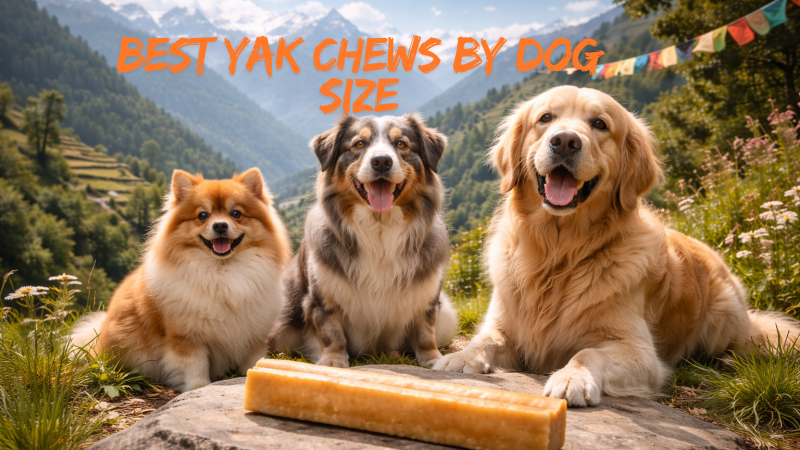
Yak chews, also called Himalayan yak chews or Himalayan cheese chews, are dense, long-lasting cheese bars designed for sustained canine chewing. The best yak chews by dog size are not the hardest bars available, but the ones correctly matched to a dog’s mouth width, molar gap, and chewing style, because proper sizing reduces tooth-fracture risk, prevents snap-break shards, and limits choking from small end-pieces. Size, thickness, and texture work together: small dogs need narrower, softer options; medium dogs need balanced density; large dogs and power chewers require thicker, longer bars that resist clean breaks.
This guide starts with fast, size-based picks for small, medium, large, and power chewers, then explains a practical three-signal sizing method using weight, muzzle length, and chew behavior (nibbler, cruncher, or gulper). You’ll also learn essential safety rules, including hardness checks, supervised time caps, and the 4–6 cm end-piece removal guideline, so every chew session stays long-lasting, digestible, and mechanically safe.
Quick Picks: Best Yak Chews by Dog Size
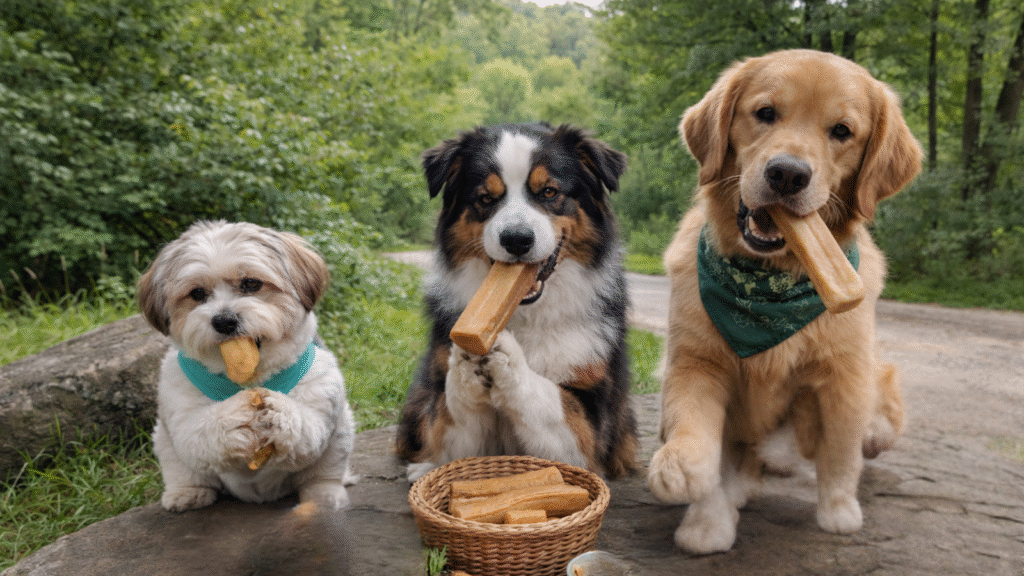
The fastest way to choose a yak chew is to match dog size, mouth width and chew style, not weight alone. Small dogs usually need safer sizing and often do best with puffed or softer starter chews, while medium dogs need a “balanced” chew that lasts without being rock-hard. Large dogs and power chewers typically need thicker, longer chews to reduce gulp risk, and in some cases a different texture or alternative is safer than “harder and bigger.”
Best yak chews for small dogs: safest sizes and textures
Small dogs, those weighing 2 to 10 kg (4 to 22 lbs), need yak chews sized for narrow muzzles and lighter bite pressure. The right pick for small dogs is a chew in the small to extra-small (XS) category, typically 1.5 cm to 2 cm (0.6 to 0.8 inches) thick and no longer than 8 cm to 10 cm (3 to 4 inches).
Puffed yak chews and starter-grade bars are the best texture entry point for small dogs. Puffed bars are lighter, crumblier, and gentler on enamel, making them ideal for toy breeds, seniors, and first-time chewers. Standard hard bars work well for small dogs that are confident chewers with healthy teeth.
The most overlooked detail: small-breed owners frequently buy “medium” chews assuming their dog will simply chew longer. In real-world use, medium chews create 3 key problems for small dogs, the bar is too wide to grip comfortably, the jaw applies uneven pressure, and the break-off pieces are too large to pass safely.
Best yak chews for medium dogs: the balanced pick that lasts
Medium dogs, those weighing 10 to 25 kg (22 to 55 lbs), are the most common yak chew buyer group, and they receive the most product options. The best pick is a medium (M) bar ranging from 2 cm to 3 cm (0.8 to 1.2 inches) thick and 12 cm to 15 cm (4.7 to 6 inches) long.
Medium dogs tolerate both standard hard bars and puffed options well. Standard bars last longer and deliver more dental benefit through consistent scraping action. Puffed bars are better for medium dogs with dental sensitivity or lighter chewing habits.
The most common mistake in this size group: buying the largest bar in the “medium” range under the assumption it gives better value. A bar that is too thick for the jaw width of the dog leads to frustration, disengagement, and wasted product.
Best yak chews for large dogs: long-lasting sizing for big mouths
Large dogs, those weighing 25 to 45 kg (55 to 100 lbs), need chews with significant thickness and density to resist quick destruction. The best pick is a large (L) to extra-large (XL) bar, typically 3 cm to 4 cm (1.2 to 1.6 inches) thick and 15 cm to 20 cm (6 to 8 inches) long.
Density matters as much as size here. A large yak chew without sufficient density gets cracked into gulpable chunks within minutes. Look for consistent color throughout the cross-section of the bar, pale patches or air pockets indicate uneven density and predict snap-break behavior.
Best yak chews for power chewers: when to size up or switch textures
Power chewers are not always large dogs. A 15 kg Staffordshire Bull Terrier with a wide, square jaw exerts far more bite force per square centimeter than a 35 kg Golden Retriever with a long, narrow muzzle. Jaw architecture, not body weight alone, defines the true chewing force of the dog.
For power chewers, size up by 1 category above their weight-based recommendation. A medium-weight power chewer gets a large bar. Thickness is the critical dimension, aim for bars 0.5 cm to 1 cm (0.2 to 0.4 inches) thicker than the standard recommendation for their weight class.
Texture switching is the second option. Extra-hard or “jumbo” compressed blocks survive power-chewer sessions better than standard bars of the same nominal size. The trade-off is that extra-hard chews require closer monitoring for tooth stress, particularly in dogs older than 7 years.
Quick sizing chart: weight and muzzle-length and chew style (the “3-signal” method)
The “3-signal” method uses 3 inputs (weight, muzzle length, and chew style) to produce a more accurate size recommendation than weight alone.
| Dog Weight | Muzzle Length | Chew Style | Recommended Size | Bar Thickness |
| 2 to 5 kg (4 to 11 lbs) | Under 5 cm (2 in) | Gentle nibbler | XS / Puffed | 1 to 1.5 cm |
| 5 to 10 kg (11 to 22 lbs) | 5 to 8 cm (2 to 3 in) | Moderate | S | 1.5 to 2 cm |
| 10 to 20 kg (22 to 44 lbs) | 8 to 12 cm (3 to 5 in) | Moderate to heavy | M | 2 to 3 cm |
| 20 to 35 kg (44 to 77 lbs) | 12 to 16 cm (5 to 6 in) | Heavy | L | 3 to 4 cm |
| 35+ kg (77+ lbs) | 16+ cm (6+ in) | Power | XL / Jumbo | 4+ cm |
Use this chart as a starting point. Adjust by 1 size category up for power chewers, or 1 size down for seniors, puppies under 12 months, or dogs with known dental issues.
How to Choose the Right Yak Chew Safely (Sizing, Hardness and Rules)
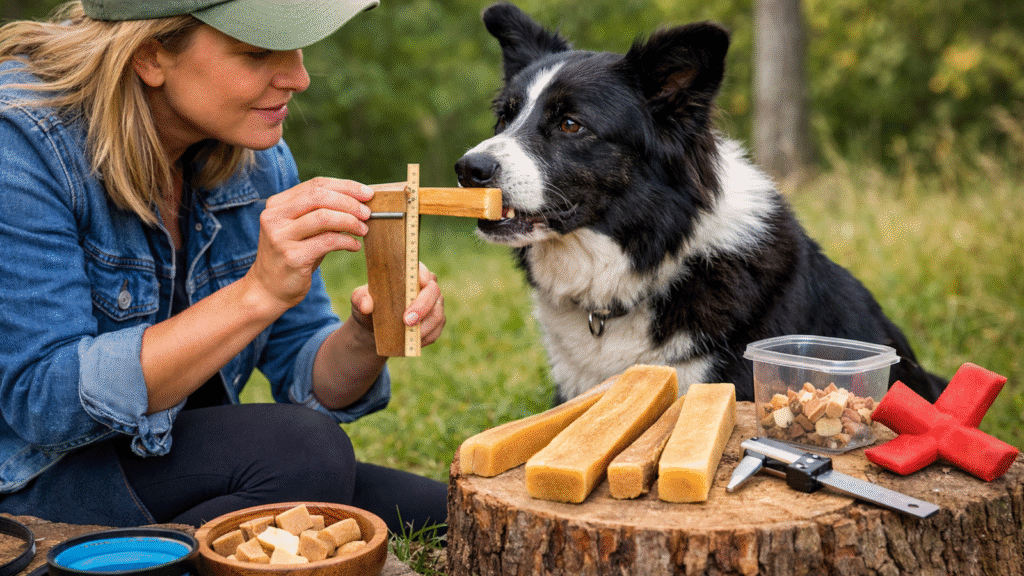
A smart sizing system uses three signals: muzzle length, chew thickness, and your dog’s chewing behavior (nibbler vs cruncher vs gulper). The right chew should be longer than the mouth width and thick enough that your dog can’t fully trap it between back teeth to crush. Add safety rules, shorter sessions, supervision, and removing the end-piece early, and you prevent most tooth, choking, and stomach issues.
Muzzle-length rule (more accurate than weight alone)
Muzzle length is a more reliable predictor of appropriate chew width than body weight alone. Weight captures body mass, not jaw architecture. A wide-skulled, short-muzzled breed like a French Bulldog weighing 10 kg needs a narrower, shorter bar than a 10 kg Whippet with a long, narrow muzzle.
The muzzle-length rule works like this: the bar width at its narrowest point stays at or below the muzzle length of the dog. A dog with a 9 cm (3.5 inch) muzzle uses a bar no wider than 9 cm. This prevents the dog from side-crushing the bar with the rear molars before the front teeth have worked through it, which is how most snap-breaks happen.
Thickness test: stop gulping and stop “snap in half” breaks
The thickness test has 2 goals. The first goal is to prevent the dog from positioning the entire chew in a way that allows a single swallow (gulping). The second goal is to prevent the chew from snapping cleanly in half, which creates sharp-edged chunks.
The bar thickness needs to exceed the gap between the upper and lower molars of the dog at rest. A bar that clears this gap makes it mechanically impossible to simply close the jaw and snap it cleanly. Measure the muzzle gap of the dog, most medium dogs have a 2 to 3 cm (0.8 to 1.2 inch) molar gap. A bar 0.5 cm thicker than this gap is the minimum safe thickness.
Is it too hard? thumbnail/knee-cap style checks and what to do next
The thumbnail test and the kneecap test are the 2 most practical hardness checks available to dog owners without lab equipment. Press your thumbnail firmly into the surface of the chew. The chew is too hard for safe chewing when your nail leaves no mark at all, no surface give, no tactile feedback.
The kneecap test is simpler: tap the chew firmly against your kneecap. The chew is too hard when tapping produces a sharp, high-pitched crack rather than a dull thud. Enamel fractures occur most frequently on chews that fail both tests simultaneously.
The right response to a failed test: replace the chew with a puffed bar, switch to nuggets, or soak the bar in warm water for 5 to 10 minutes to soften the surface before the session.
Tooth risk: warning signs of a fracture and when to call your vet
Slab fractures, where a vertical section of the tooth splits away, are the primary dental injury associated with hard chews. Watch for these 4 warning signs during any chew session:
- Sudden disengagement from the chew mid-session
- Pawing at the mouth or rubbing the face on the floor
- Visible sensitivity when the dog opens the mouth wide
- Blood traces on the surface of the chew
Contact a veterinarian immediately when 2 or more of these signs appear together. Do not continue the chew session. Slab fractures require professional dental evaluation and, in many cases, extraction.
End-piece rule: when to remove it and how to puff leftovers safely
The end-piece rule is straightforward: remove the yak chew remnant before it reaches 4 cm to 5 cm (1.5 to 2 inches) in length. At this size, the remaining piece is a gulping hazard for most dogs. The dog transitions from chewing to attempting to swallow the whole piece whole.
The puffing method gives leftover pieces a second life. Place the end piece in a microwave-safe bowl, microwave on high for 30 to 60 seconds, and the dense cheese puffs into a light, airy treat. Monitor closely, overheating creates a hard exterior layer. Let the puffed piece cool for 3 to 5 minutes before giving it back.
Best Yak Chews for Small Dogs (Toy and Small Breeds)

Small dogs benefit most from chews that are long enough to hold and thick enough to avoid gulping, even if the dog’s weight is low. For many toy and small breeds, puffed yak treats or gentler “starter” chews are safer than ultra-hard classics, especially for sensitive teeth. A chew holder and strict end-piece removal are the easiest upgrades to reduce choking risk for small mouths.
Best sizes for small mouths: real dimensions that reduce choking risk
Small-dog yak chews in the safest range measure 1 cm to 2 cm (0.4 to 0.8 inches) in thickness and 6 cm to 10 cm (2.4 to 4 inches) in length. These dimensions match the jaw span of toy breeds such as Chihuahuas, Pomeranians, and Shih Tzus, and small breeds such as Dachshunds, Beagles, and Miniature Schnauzers.
A chew at these dimensions is long enough to hold without the dog repositioning it toward the throat, and thin enough that break-off pieces remain manageable. Anything wider than the jaw span of the dog creates sideways pressure on the temporomandibular joint (TMJ), which causes discomfort and discourages use over time.
Best textures for small dogs: puffed/starter options first
Puffed yak chews are the best starting texture for small dogs. They are lighter, dissolve with less chewing pressure, and present no hard-edge risk during the first few introductions. After 3 to 4 sessions with puffed bars, transitioning to a standard extra-small hard bar gives better dental benefit.
The recommended starter sequence for small dogs with no chew history:
- Weeks 1 to 2: Puffed yak nuggets (supervised, 10-minute sessions)
- Weeks 3 to 4: Extra-small puffed bar (supervised, 15-minute sessions)
- Week 5 onward: Extra-small standard bar (supervised, 20-minute sessions)
This sequence reduces digestive upset, builds chewing confidence, and identifies any intolerance before it becomes a serious issue.
Choking prevention: chew holders, supervision, and stop-points
Supervision is non-negotiable for small dogs during the first 5 sessions with any new chew. Small dogs are more likely to attempt to swallow oversized pieces, they compensate for limited jaw size with persistent repositioning.
Chew holders, rubber or silicone grips that attach to the end of the bar, give small dogs better mechanical leverage and reduce frantic gulping attempts. Remove the chew at the 4 cm stop-point (see section 2.5) or the moment the dog displays gulping behavior.
Watch for these 3 observable gulping behaviors that signal the session needs to end: firstly, rapid head-tilting while chewing; secondly, an extended neck posture as the dog attempts to lengthen the throat; thirdly, repeated unsuccessful swallowing motions.
Sensitive tummy plan: introduce slowly and portion control
Yak chews are high in protein and low in fat, which makes them generally well-tolerated. However, dogs with sensitive digestion respond better to gradual introduction. A common mistake is allowing full chew access on day 1 and attributing subsequent loose stools to the chew type rather than the quantity consumed.
The sensitive tummy introduction plan uses timed sessions: firstly, limit to 5 minutes on days 1 to 3; secondly, extend to 10 minutes on days 4 to 7; thirdly, assess stool consistency before extending to full sessions. Store the chew between sessions in a cool, dry place below 25°C (77°F) to prevent bacterial growth on the softened surface.
Best Yak Chews for Medium Dogs
Medium dogs sit in the “sweet spot,” but the best yak chew still depends on whether your dog gnaws steadily or tries to crack chews with molars. The ideal medium option is durable but not brittle, with a thickness that slows down crunching and reduces sharp break pieces. A simple rotation plan, short sessions, rest days, and consistent end-piece rules, keeps chewing fun without creating digestion or dental problems.
Best medium sizes: durability without turning rock-hard
Medium-sized yak chews for dogs in the 10 to 25 kg (22 to 55 lbs) range perform best at 2 cm to 3 cm (0.8 to 1.2 inches) thick and 12 cm to 16 cm (4.7 to 6.3 inches) long. This range delivers enough density to last 3 to 5 sessions for a moderate chewer while staying workable enough that the dog engages consistently.
What turns medium chews into a dental risk is poor batch consistency. A bar labeled “medium” that arrives at 3.5 cm thick due to production variation crosses into the hard-chew risk zone for a 12 kg dog. Buying from manufacturers with documented quality control (QC) processes reduces this variability significantly. Visit YforYak Dog Chews to review batch specification standards before placing a wholesale order.
Chewing styles: nibblers vs crunchers vs gulpers (best match for each)
Medium dogs fall into 3 distinct chewing styles, and each style has a best-match product format.
- Nibblers work the surface of the chew methodically. They are best matched to a standard medium bar, which lasts the longest for this style and delivers consistent dental abrasion.
- Crunchers attempt to break the chew into smaller pieces. They are best matched to a slightly thicker bar, toward the upper end of the medium range, to resist clean snaps, combined with close monitoring for break-off pieces larger than 2 cm (0.8 inches).
- Gulpers try to swallow pieces as quickly as possible. They are best matched to extra-thick medium bars or jumbo blocks, combined with a chew holder and strict session time limits of 15 to 20 minutes.
End-piece management: remove early and storage between sessions
For medium dogs, remove the chew at the 5 cm to 6 cm (2 to 2.4 inch) mark, not at the 4 cm guideline for small dogs. The increased jaw force of a medium dog means a 5 cm piece already represents a high-risk swallow attempt.
Between sessions, wrap the chew in a paper towel and store at room temperature below 25°C (77°F). Do not store in airtight plastic bags, trapped moisture encourages mold growth on the softened surface. The chew lasts 2 to 3 days between sessions at room temperature, or up to 7 days in the refrigerator.
Rotation strategy: reduce dental and digestion stress over the week
A 3-session weekly rotation works well for medium dogs. Schedule one session on day 1, one session on day 3, and one session on day 5. This gives the enamel and jaw muscles sufficient recovery time while maintaining the dental benefit of regular mechanical abrasion.
On non-chew days, substitute with a lighter chew, puffed nuggets, for example, to maintain engagement without cumulative wear. This rotation also makes it easier to identify any digestive changes that correlate with yak chew sessions, which is useful data for owners managing dogs with recurring gastrointestinal (GI) sensitivities.
Best Yak Chews for Large Dogs and Power Chewers
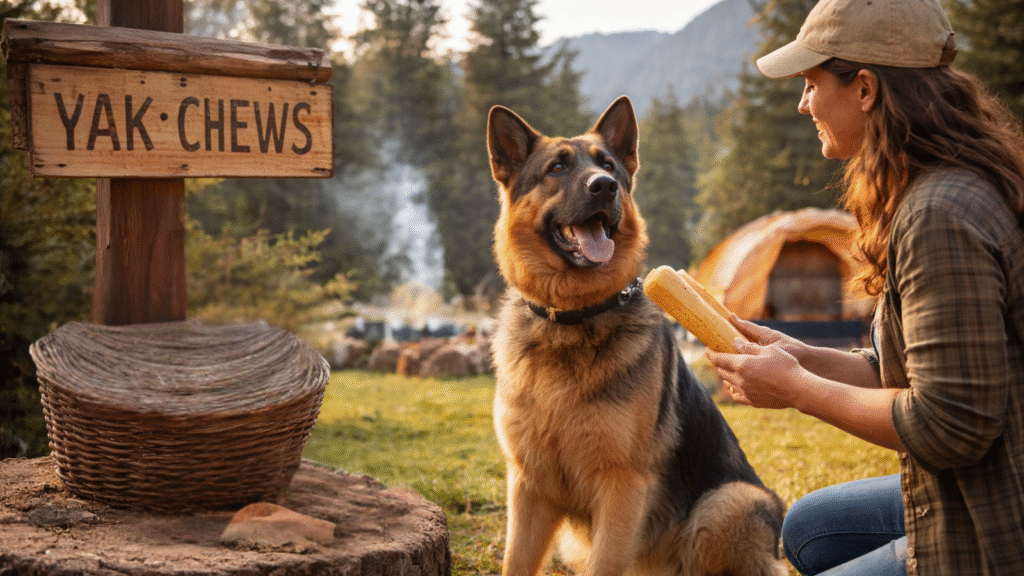
Large dogs and power chewers need length and thickness first, because small chews become swallow hazards quickly and thin chews can snap. If your dog is a heavy cruncher, the “best” choice may be a different texture (or a safer alternative) rather than simply buying the hardest chew available. The safest plan is controlled sessions, frequent checks for cracking, and converting the last stub into a safer puffed treat.
Best large sizes: extra-long and thick options that reduce gulp risk
The safest large-dog yak chews measure 3.5 cm to 5 cm (1.4 to 2 inches) thick and 18 cm to 25 cm (7 to 10 inches) long. At these dimensions, the chew remains physically unswallowable for most large-breed dogs even as it wears down, buying a critical safety margin on the back end of the session.
Jumbo blocks, compressed, high-density formats, offer an additional advantage for large dogs: they resist the side-crush that standard bars are vulnerable to. A German Shepherd or Rottweiler with powerful rear molars cracks a standard bar in a single session. A jumbo block deflects this pressure more evenly across its surface and extends session value significantly.
Who should avoid hard chews: dental issues, seniors, aggressive crushers
Not every large dog is a suitable candidate for hard yak chews. These 4 categories of dogs need safer alternatives:
- Dogs with existing tooth fractures, chips, or recent extractions
- Senior dogs aged 8 years and older with reduced enamel density
- Dogs diagnosed with periodontal (gum) disease
- Aggressive crushers with a documented fracture history on other hard chews
For these dogs, puffed yak bars or yak cheese powder mixed into food deliver the nutritional benefits without the fracture risk. Puffed bars are structurally aerated, they crumble under moderate pressure rather than fracturing under high pressure, making them significantly safer for vulnerable chewers.
Safe chew sessions: breaks, time caps, and “watch for these signs”
Large dogs benefit from structured sessions. The recommended framework is 20 to 30 minutes of active chewing, followed by a 10-minute break, with a maximum of 2 sessions per day. Back-to-back chewing without breaks accelerates enamel wear and increases the likelihood of stress fractures.
Stop the session immediately and watch for these 4 signs:
- Excessive salivation combined with gagging motions
- Frantic pace change (from slow, deliberate chewing to rapid biting)
- Visible chip or crack in the chew with sharp edges
- Limping, head shaking, or face pawing during or after the session
Safer finishing method: puffing the last piece step-by-step
Puffing the end piece is the single best way to eliminate the choking risk of the last 4 cm to 6 cm (1.6 to 2.4 inches) of a large-dog yak chew. The process takes 60 seconds and requires nothing more than a microwave.
Follow these 4 steps:
- Remove the end piece before it reaches 5 cm (2 inches) for large dogs.
- Place the end piece on a dry, microwave-safe plate, not a bowl, as a flat surface allows even heat distribution.
- Microwave on full power for 45 to 90 seconds. Larger pieces need closer to 90 seconds; watch through the glass to prevent over-expansion.
- Allow the puffed piece to cool for a full 5 minutes before offering it. The interior retains heat longer than the exterior.
The puffed piece is now a light, digestible snack rather than a dense choking hazard, zero waste, zero risk.
“Good vs Great” Yak Chews: Quality, Labels, Storage, and Buying Guidance
Great yak chews usually have a short ingredient list, consistent drying, and predictable break behavior, meaning fewer sharp shards and fewer “mystery batches.” For B2C, quality means better safety and fewer tummy issues; for B2B, it means fewer complaints, fewer refunds, and clearer sizing confidence at the shelf. Add smart packaging guidance (size, texture, chew style) and basic storage tips, and you build trust while reducing customer problems.
Ingredient label checklist: what authentic yak chews should include
An authentic Himalayan yak chew contains exactly 4 ingredients: yak milk, cow milk, lime juice, and salt. That is the complete list. No binders, no preservatives, no artificial flavors. The ingredient profile reflects a centuries-old churpi-making process that uses acidity from lime juice and sustained pressure-curing to extract moisture and harden the cheese.
The ingredient label checklist for any buyer:
- Ingredient count: 4 (any additions warrant scrutiny)
- Protein content: 60% to 75% on a dry matter basis
- Fat content: below 5%
- Moisture content: below 10% (above this, the chew softens faster and presents a higher mold risk once opened)
- Country of origin: Nepal, India, or a certified equivalent with full traceability
The manufacturing process of authentic chews includes extended cold-pressing and drying, a process requiring 4 to 6 weeks minimum. Products labeled “Himalayan-style” without origin documentation often skip the full curing process and produce a softer, less consistent bar that breaks unpredictably.
At YforYak Dog Chews Manufacturer, every bar uses a verified 4-ingredient recipe sourced from Himalayan herder communities. Batch specifications are available on request for wholesale and private-label buyers.
Break behavior and batch consistency: what “safer chew” looks like in real life
In real-world use, a high-quality yak chew breaks in a predictable, controllable way, it shreds and crumbles under sustained pressure rather than snapping into sharp-edged shards. The difference between these 2 behaviors comes down entirely to batch consistency: uniform density throughout the bar produces uniform break behavior.
Run a quick visual check on any new batch: snap 1 bar from the batch and inspect the cross-section. A quality bar shows consistent amber-to-golden color throughout, with no pale or white patches. Pale patches indicate air pockets or incomplete curing, and are the leading predictor of snap-break behavior.
For retailers and distributors purchasing at scale, requesting a Certificate of Analysis (COA) for each production batch is the only reliable way to verify protein, fat, and moisture content against labeled claims. Reputable manufacturers provide COAs without hesitation and treat this as a standard step, not a special request.
Storage and freshness: temperature/humidity basics to prevent quality issues
Yak chews are naturally shelf-stable, but the wrong storage conditions degrade quality faster than most buyers realize. The 3 enemies of yak chew freshness are heat, humidity, and airtight enclosure.
Store yak chews at 15°C to 25°C (59°F to 77°F) in a dry environment with relative humidity below 60%. Above 25°C (77°F), the fat content, even at sub-5%, begins to oxidize, producing a rancid smell. Above 60% humidity, the surface absorbs moisture, becomes soft, and accelerates mold risk on any partially chewed bars.
For retail shelf display, keep yak chew products away from direct sunlight and heating vents. A cool, shaded display position at moderate room temperature maximizes shelf life up to 24 months on intact, unopened bars.
For wholesale buyers storing large volumes: palletized stock benefits from a climate-controlled warehouse below 20°C (68°F) with active humidity management. Individual bars in retail-ready packaging maintain stated shelf life as long as the primary packaging seal stays intact.
Wholesale trust signals: COAs, traceability, packaging clarity for global buyers
Business buyers, retailers, distributors, private-label brands, and e-commerce operators, face a different set of risks than individual dog owners. The quality of the yak chew supply chain determines product consistency across hundreds or thousands of units. These are the 6 trust signals that separate a reliable manufacturer from a high-risk one.
- Firstly, a Certificate of Analysis (COA) for each production batch, covering protein, moisture, fat, and pathogen testing, demonstrates that the manufacturer verifies what they claim.
- Secondly, ingredient traceability documentation, which links raw milk sourcing to specific herder cooperatives or farms, establishes supply chain integrity at the source level.
- Thirdly, facility certifications verified by a named third-party body, such as an ISO 9001 certificate number, a U.S. Food and Drug Administration (FDA) facility registration number, and Hazard Analysis and Critical Control Points (HACCP) documentation, establish baseline food-safety credibility.
- Fourthly, packaging clarity, ingredient lists, country of origin, net weight, lot numbers, and expiry dates printed on every retail unit, confirms that the manufacturer understands destination-market labeling requirements.
- Fifthly, documented export experience with your target market, specifically, familiarity with U.S. FDA import requirements, European Union (EU) feed hygiene regulations, or the specific regulatory lane you import under, reduces customs friction significantly.
- Sixthly, a sample program with a realistic minimum order quantity (MOQ), typically 100 kg for a trial run, allows quality verification before committing to full container volumes.
Nepal’s churpi-to-dog-chew export market reached approximately USD $22 million in the 2021 to 2022 fiscal year, with over 30 producers active in the sector. This scale of market activity means both genuine expertise and significant variation in quality exist side by side. Due diligence is not optional, it is the most cost-effective step in the sourcing process.
YforYak Dog Chews operates with ISO 9001 certification, FDA-registered facility status, and HACCP compliance, all from the company headquarters in Tokha, Kathmandu. COAs, ingredient traceability records, and full export documentation are available for all wholesale and private-label inquiries. Start a conversation about your supply requirements at Yforyak Dog Chews or reach the team directly at dogchews@yforyak.com.