

Every dog owner faces this choice at some point. Two of the most popular natural chews on the market, Himalayan yak chews and bully sticks, sit side by side on pet store shelves, and the difference between them matters more than most packaging suggests. The right pick depends on the size of your dog, the chewing style, dietary needs, and your household preferences.
This guide breaks down the real differences, not just the marketing claims, so that you can make a confident, informed decision for your specific dog.
Which Chew Is Better for Your Dog?
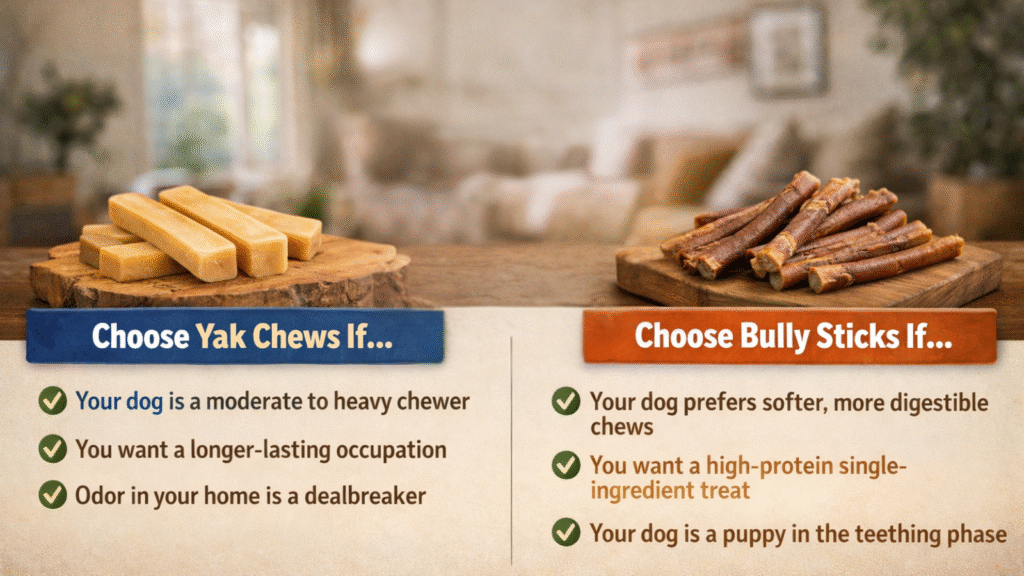
The better chew depends entirely on your dog’s chewing profile, your home environment, and your feeding goals. Neither product is universally superior. Each one wins in specific scenarios, and understanding those scenarios is the fastest path to the right answer.
Choose Yak Chews If… vs. Choose Bully Sticks If…
Choose yak chews if your dog is a moderate to heavy chewer, you want a longer-lasting occupation, or odor in your home is a dealbreaker. Choose bully sticks if your dog prefers softer, more digestible chews, you want a high-protein single-ingredient treat, or your dog is a puppy in the teething phase.
The 30-second decision works like this. Yak chews win on durability, odor control, and indoor friendliness. Bully sticks win on digestibility, flavor appeal, and nutritional density per bite.
Comparison Table
| Feature | Yak Chews | Bully Sticks |
| Chew Time | 30 minutes to several hours | 10 to 30 minutes (average) |
| Odor Level | Very low | Strong to moderate |
| Calories (per serving) | 70 to 100 kcal per 1-inch piece | 80 to 120 kcal per stick |
| Digestibility | Low to moderate | High |
| Choking Risk | Moderate (hard stubs) | Low to moderate |
| Best For | Power chewers, indoor use | Moderate chewers, high-protein needs |
| Single Ingredient? | No, typically 4 ingredients | Yes, 100% dried bull pizzazz |
The 3 Biggest Risks to Know First
Before reaching for either chew, be aware of 3 risk categories that apply to both products.
- Firstly, choking on hard stubs occurs when a yak chew or bully stick wears down to a small, swallowable piece. This is the number 1 emergency reason dogs visit vets after chewing sessions.
- Secondly, Yak chews carry a higher tooth-fracture risk than bully sticks due to their density. Traumatic dental fractures affect up to 26% of dogs seen in veterinary practice, with hard chewing objects identified as a primary cause, a figure documented in a 2024 peer-reviewed article by board-certified veterinary nutritionists (The Benefits and Risks of Chew Treats, Today’s Veterinary Practice Jan/Feb 2024).
- Thirdly, tummy trouble strikes dogs that swallow large chunks, especially gulper-type chewers who do not break food into small pieces before swallowing.
How to Use Chews Safely
Supervise your dog during every chewing session, especially for the first few times with a new chew. Set a time limit of 15 to 20 minutes per session for most adult dogs. Take the chew away when it shrinks to a size that fits entirely in the back of the mouth of your dog. This is the “last inch” rule, and it saves lives. If you want a deeper breakdown of what makes these chews safe or risky for different dogs, the full guide on are yak chews safe for dogs covers the topic in detail.
What They Are: Ingredients, Terms, and Quality Differences
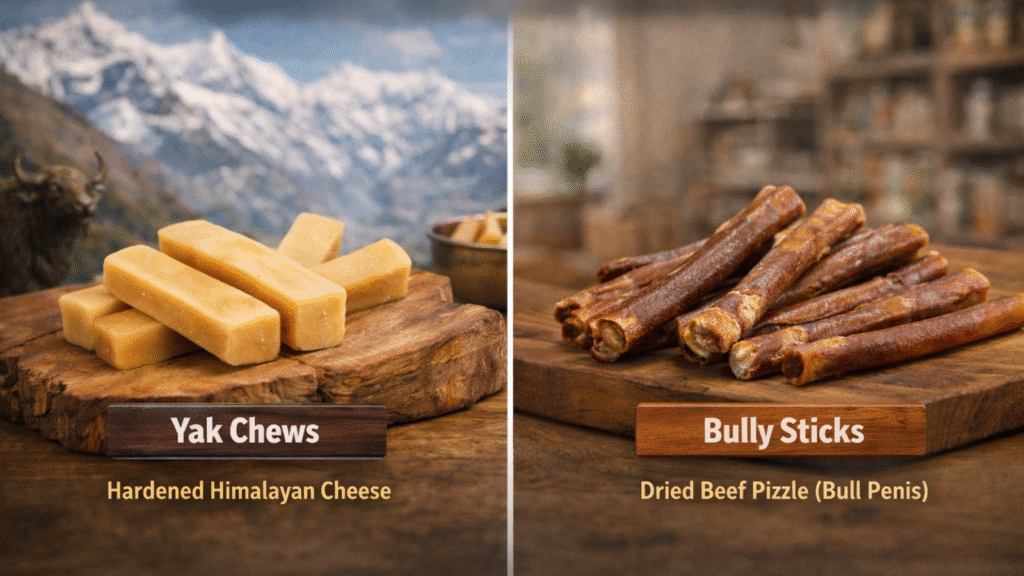
Yak chews are typically made from hardened milk-based cheese, while bully sticks are beef-based chews with different textures and odor levels. Processing varies a lot, which is why two products can look similar but behave very differently once your dog starts chewing. A good product is simple, consistent, and clearly labeled, avoiding mystery coatings, heavy flavor sprays, or vague ingredient lists.
Are Yak Chews the Same as Himalayan Cheese Chews?
Yes, yak chews and Himalayan cheese chews refer to the same product category. The terms get used interchangeably across brands, but the underlying product is identical. These chews originate from a traditional Nepali food called churpi, which is a hard, dried cheese made from yak milk (sometimes blended with cow milk). Manufacturers adapted the churpi-making process specifically for dogs, removing or reducing ingredients that were unsafe for canine consumption.
The “Himalayan” label in the name refers to the geographic origin of the recipe and the milk sourcing, not a legal designation. Products labeled “yak chews,” “Himalayan dog chews,” or “yak cheese chews” all fall into this single category. The quality differences between them come from sourcing and processing, not the name on the package.
What Bully Sticks Are Made From
Bully sticks are a single-ingredient chew made from the dried, cooked reproductive organ of a bull. That specific organ is called the bull pizzazz (also referred to as bull pizzazz or bull penis in veterinary contexts). The term sounds unfamiliar, but it matters for buyers because it explains the product’s nutritional profile, digestibility, and why quality variation exists across brands.
The organ is a muscle-dense tissue. Once dried and cooked, it becomes a firm, chewy, fully digestible treat. Dogs find the smell irresistible, which is also why bully sticks rank among the smelliest chews on the market. The smell is a byproduct of the drying process, not a sign of poor quality.
Processing and Variations: What Changes and Why
Both yak chews and bully sticks come in multiple forms, and processing choices directly affect the experience your dog has.
Yak chews arrive in standard bars, nugget-sized pieces, and puffed versions. The puffed yak chews use a microwave technique; heating the chew causes it to expand into a lighter, crunchier texture that many dogs find easier to chew. Standard bars are the hardest and longest-lasting format.
Bully sticks come in straight, braided, and flavored varieties. Braided sticks are thicker and take longer to finish, making them a better match for power chewers. Flavored bully sticks (chicken, beef, peanut butter) add appeal but also introduce additional ingredients, which means they are no longer truly single-ingredient products. “Odor-free” bully sticks undergo extra processing to reduce smell; this works to varying degrees, and the smell reduction does not equal zero odor.
Quality Checklist: What to Look For and What to Avoid
The quality of both chew types varies dramatically across brands. A reliable checklist for evaluating any yak chew or bully stick includes these 4 factors.
- Sourcing transparency tells you where the raw materials came from. Reputable manufacturers disclose their supply chain or, at a minimum, their country of origin. Brands rooted in Himalayan sourcing, like a dedicated Yak chew manufacturer based in Nepal, trace directly back to herder communities, which adds both ethical credibility and traceability.
- Single-ingredient accuracy matters most for bully sticks. The label lists one ingredient only. The presence of preservatives, fillers, or artificial flavors is a red flag.
- Certifications and registrations, such as FDA facility registration, ISO 9001 quality standards, and HACCP compliance, signal that a manufacturer takes food safety seriously. These do not guarantee perfection, but their absence is a warning sign.
- Avoid any chew that smells rancid (not just strong), has a sticky or oily texture after opening, or lists a vague ingredient like “meat byproduct” without specifics.
Safety Deep Dive: Teeth, Choking, and Hygiene
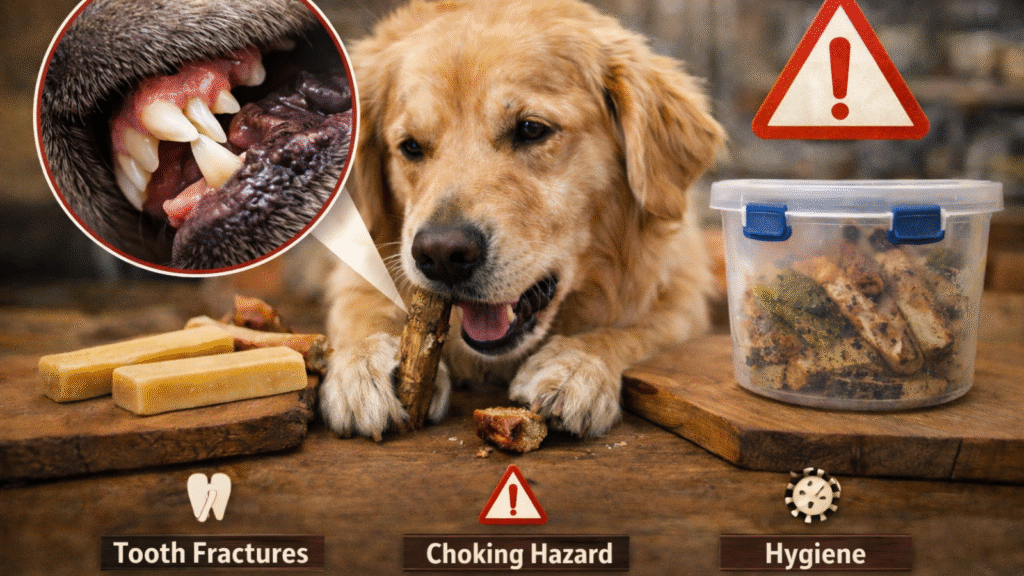
The biggest safety issues are tooth fractures from overly hard chews, choking on small end pieces, and stomach upset from swallowing chunks too quickly. Use a simple rule: if your dog can crack it like a rock or gulp pieces, it’s not the right match, even if they love it. For extra safety, supervise chewing, remove the last small stub, and store chews hygienically between sessions.
Choking Prevention: Sizing, the “Last-Inch” Rule, and Chew Holders
Choking is the single most dangerous risk associated with any natural chew, and it is entirely preventable with the right habits. Match the chew size to your dog’s mouth. A chew designed for a small dog placed in front of a large dog creates an instant hazard; the large dog finishes it in seconds and swallows the remainder whole.
The “last-inch” rule is simple and critical. Remove the chew before it shrinks to a piece smaller than the width of the molars of your dog. That threshold varies by breed, but a general guide works like this: the chew becomes dangerous when your dog stops actively working on it and starts trying to swallow it whole.
Chew holders, devices that grip the chew and prevent your dog from swallowing the final stub, add a practical safety layer. These tools are inexpensive and remove the guesswork entirely. They are especially worth owning for power chewers and small dogs.
Tooth Safety: How to Tell If a Chew Is Too Hard
A chew is too hard for your dog if pressing it firmly with your thumbnail leaves no visible dent. This is the standard hardness test endorsed by veterinary dentists and is consistent with guidance from the World Small Animal Veterinary Association, which formally warns against dental abrasions, attrition, and tooth fractures from very hard animal-derived chew products.
Yak chews, particularly the standard bar format, fail this test more often than bully sticks. If you are unsure whether the hardness level is appropriate, the detailed breakdown of when yak chews are too hard for your dog is worth reading before your next purchase. Dogs with dental disease, senior dogs with worn teeth, and puppies with developing dentition all face elevated fracture risk with hard yak chews. The puffed yak chew format is softer and passes the thumbnail test more reliably, making it the safer option for these groups.
Red flags after a chewing session include your dog pawing at their mouth, drooling excessively, refusing food, or showing discomfort when you touch their jaw. Any of these signals warrants a vet visit.
Digestive Safety: Gulpers, Blockage Risk, and Swallowed Pieces
Dogs fall into 3 distinct chewing categories: chewers, moderate chewers, and gulpers. Understanding which category your dog belongs to changes how you select and supervise chews. Gulpers, dogs that bite off chunks and swallow without thorough chewing, face the highest risk of gastrointestinal (GI) blockage from both yak chews and bully sticks.
Bully sticks digest fully in most dogs because the tissue breaks down easily in stomach acid. Yak chews do not fully digest, which means swallowed chunks pass through the digestive tract largely intact. A large piece of yak chew lodged in the intestine creates a blockage scenario that requires emergency veterinary intervention.
The moment your dog swallows a piece larger than a marble, watch for these symptoms over the next 12 to 24 hours: vomiting, lethargy, refusal to eat, abdominal swelling, or straining during bathroom breaks. Contact your vet immediately if any of these appear.
Hygiene and Bacteria Handling: Bully Sticks Deserve Extra Attention
Bully sticks carry a higher risk of bacterial contamination than yak chews due to their animal-tissue origin and the way they are dried. Bully sticks carry a higher risk of bacterial contamination than yak chews due to their animal-tissue origin. A 2021 peer-reviewed review of EU RASFF safety notifications found that microorganisms, including Salmonella, E. coli, Listeria monocytogenes, and Staphylococcus aureus, accounted for approximately 20% of all reported hazards in dry dog chews between 2017 and 2020 (Microbiological Hazards in Dry Dog Chews and Feeds, Animals MDPI 2021). Imported products showed higher contamination rates than domestically produced chews.
Store bully sticks in an airtight container at room temperature or in the refrigerator. Keep them away from food preparation surfaces. Wash your hands after handling them. Replace any stick that develops a wet, slimy texture or an off-putting smell beyond the normal bully stick odor.
Yak chews present far fewer hygiene concerns due to the curing and drying process used in their production. Still, store them in a dry, sealed container and discard any piece that develops mold.
Nutrition and Performance: Calories, Digestibility, and Real-World Trade-Offs
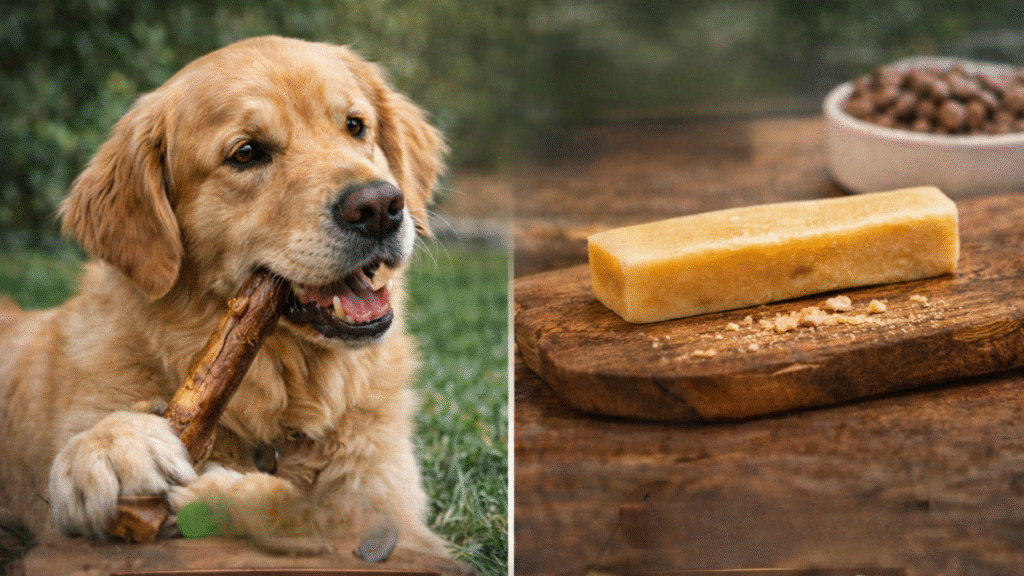
Bully sticks can be more calorie-dense than people expect, so treat them like a treat-meal hybrid rather than an unlimited snack. Yak chews are often longer-lasting but can be tougher on teeth if your dog is an aggressive chomper. Digestibility varies by dog; watch for stool changes, gas, or vomiting as your personal “tolerance signal.”
Calories Explained with Practical Math
Treat budgeting is a habit every dog owner needs, and chews are one of the easiest categories to accidentally overfeed. The calorie counts for yak chews and bully sticks are close on the surface, but the way dogs consume them creates very different caloric outcomes.
A standard bully stick delivers roughly 88 kcal per treat, and a large (8-inch) stick fed to a 50-lb dog can supply approximately 120 kcal, or about 11.8% of that dog’s daily energy needs, which actually exceeds the AAHA-recommended 10% treat limit. Notably, 50% of dog owners underestimate the caloric content of bully sticks, according to a 2024 peer-reviewed analysis by board-certified veterinary nutritionists (The Benefits and Risks of Chew Treats, Today’s Veterinary Practice 2024).
Yak chews deliver roughly 70 to 100 kcal per 1-inch segment. A standard yak chew bar contains multiple segments, and dogs work through them slowly. The total caloric intake per session stays similar to a bully stick, but the longer chew time means fewer treats feel satisfying, which is one reason yak chews work well for weight-conscious owners.
Build treat calories into your dog’s daily food budget. According to the 2021 AAHA Nutrition and Weight Management Guidelines, treats, including chews, should account for no more than 10% of a dog’s total daily caloric intake. Exceeding this threshold over time contributes to weight gain and the health complications tied to it.
Protein, Fat, and Which Dogs Need to Be Careful
Bully sticks are protein-dense and relatively low in fat, making them a popular choice for dogs on high-protein diets. A single bully stick delivers roughly 9 to 11 grams of protein per stick.
Yak chews contain protein as well, but they also include a small amount of fat from the milk used in production. This fat content is minimal, typically under 2 grams per serving, but it registers for dogs with specific health concerns.
Dogs with a history of pancreatitis require extra caution with any fat-containing treat. Pancreatitis in dogs is associated with high-fat dietary exposure and is confirmed as a diet-related risk in a 2022 comprehensive review by leading pancreatology researchers published in the Journal of Veterinary Internal Medicine, the field’s top journal. Even the small fat content in yak chews can be significant for dogs with a known diagnosis.
Dogs on weight-loss plans benefit from the slower consumption pace of yak chews. The extended chew time creates a sense of satisfaction that a quick bully stick does not replicate.
Odor, Mess, and Indoor Usability
The smell difference between yak chews and bully sticks is one of the most underestimated factors in the purchase decision. Dog owners who have used both products universally rank bully sticks as the stronger odor offender.
The smell of bully sticks intensifies as the dog chews; the warmth of saliva and the friction of chewing release more of the dried tissue smell. In an enclosed space like an apartment or a small room, this becomes noticeable within minutes. Yak chews produce almost no odor during chewing, which makes them the clear winner for indoor use, small living spaces, and households where odor sensitivity is a factor.
Manage bully stick smell by designating a specific chewing spot, a towel, a chew mat, or an outdoor area. Clean the surface after each session. Store unused sticks in a sealed bag or container.
Enrichment Value: Boredom, Anxiety, and How Long Each Chew Really Lasts
Chews serve a purpose beyond nutrition. They satisfy the instinct to gnaw and reduce destructive behaviour tied to boredom and separation anxiety. A 2021 peer-reviewed survey found that 94% of dog owners provided edible chews and that owners commonly offered them during anxiety-linked situations such as being left alone (Chewing Behaviour in Dogs, Appl Anim Behav Sci 2021). Separation-related problems are estimated to affect 22–55% of dogs (Flint et al., Animals 2023). For this group, the longer engagement time of yak chews is not a minor perk; it is clinically meaningful.
Yak chews, especially standard bars, deliver significantly more enrichment time than bully sticks. A medium-sized dog works through a standard yak chew bar for 30 minutes to over an hour. That same dog finishes a bully stick in 10 to 20 minutes.
For dogs that exhibit chewing-related anxiety behaviors, yak chews provide longer mental engagement. Bully sticks still offer enrichment, but the shorter duration means they work better as a pre-event calming treat (before a walk, a car ride, or a thunderstorm) rather than a long-duration boredom solution.
The Best Choice by Dog Type and Feeding Plan
Puppies, seniors, and dogs with dental issues usually do better with softer chews that don’t challenge teeth. Power chewers need the right thickness and a chew that won’t splinter into swallowable chunks, while gulpers need a chew-holder and strict end-piece rules. If your dog has allergies or a sensitive stomach, start with short sessions and introduce only one new chew type at a time.
Best for Puppies, Adults, and Seniors
Puppies in the teething phase (roughly 3 to 6 months of age) benefit most from bully sticks. Their developing teeth are too fragile for standard yak chew bars, and the softer texture of bully sticks satisfies the urge to chew without fracture risk. Puffed yak chews represent a middle-ground option for puppies past the peak teething stage. For a full age and breed breakdown, the guide on yak chews safe for puppies covers what to look for at each developmental stage.
Adult dogs with healthy teeth tolerate both chew types well. The choice for adults comes down to chewing style, household preferences, and dietary needs rather than dental capability.
Senior dogs (typically 7 to 10 years, depending on breed) often have worn or sensitive teeth. Standard yak chew bars pose a real fracture risk for seniors. Bully sticks and puffed yak chews are the safer selections for this age group. A conversation with your vet before introducing any hard chew to a senior dog is a smart precaution, especially for breeds prone to dental disease.
Best for Gentle Chewers vs. Power Chewers vs. Gulpers
Your dog’s chewing style is the single most important factor in chew selection. Use this decision framework to match the right product to the right chewer, or go straight to the dedicated resource on best yak chews by chewing style for a format-by-format breakdown.
- Gentle chewers, dogs that nibble slowly and methodically, do well with both chew types. Bully sticks provide a satisfying texture for this group, and the digestibility removes most of the risk associated with gentle, slow consumption.
- Power chewers, dogs that attack chews aggressively and wear them down fast, need the durability of yak chews. A bully stick disappears too quickly to provide real value for a power chewer, and the rapid consumption increases the choking risk on the stub. Standard or braided yak chews hold up to this chewing style.
- Gulpers, dogs that bite off large chunks and swallow with minimal chewing, require the most careful approach. Bully sticks are the safer choice for gulpers because the tissue digests fully. Yak chews are risky for this group due to the blockage potential of undigested chunks. Supervision is non-negotiable for gulpers with any chew type.
How Often to Give Chews: Frequency, Time Limits, and Rotation
A practical feeding plan for most adult dogs looks like this: 3 to 4 chew sessions per week, each lasting 15 to 20 minutes, with the chew removed at the last-inch threshold. For a more tailored schedule based on weight, activity level, and chew type, the full guide on how often to give your dog a chew is a useful follow-up read.
Daily chewing is fine for dogs with healthy digestion and appropriate supervision, but rotating between chew types prevents boredom and reduces the risk of sensitivity to any single product. A simple rotation plan alternates yak chews and bully sticks across the week.
Stop giving chews entirely when your dog shows repeated signs of digestive upset after chewing sessions, bloating, loose stool, or vomiting. These symptoms indicate that the specific chew type does not suit the digestive system of your dog.
Safer Alternatives, When to Call a Vet, and Dental-Chew Options
Not every dog thrives on natural chews. Dogs with severe dental disease, chronic GI issues, or known food allergies benefit from veterinary-grade dental chews instead. These products are formulated to clean teeth while being gentle on digestion, and they carry a lower risk profile than raw natural chews.
Other safe alternatives include frozen rubber toys, deer antler chews (sized appropriately), and baked sweet potato chews, each offering a different texture and enrichment experience.
Call your vet promptly if your dog displays any of these symptoms after a chewing session: vomiting that does not stop within 1 hour, visible blood in the stool, inability to eat or drink, abdominal pain or bloating, or lethargy lasting more than 2 hours. These are not “wait and see” situations.
Is a yak chew or a bully stick better for puppies?
Bully sticks are usually better for puppies because they are softer and easier to chew. Puppies have developing teeth and jaws, so yak chews may be too hard and risk damage. Choose bully sticks sized to prevent swallowing, supervise chewing, and monitor for digestive issues when introducing new treats.
Are bully sticks safe, or do they cause stomach problems?
Bully sticks are safe for most dogs, but can cause stomach upset if chewed too fast or consumed in large amounts. Rich treats may trigger vomiting or diarrhea. Introduce them slowly and stop use if soft stool persists. Contact your vet if symptoms last longer than 24 hours.
Do yak chews crack teeth?
Yak chews can crack teeth if they are too hard or if a dog bites down aggressively. Dogs that chomp instead of gnaw increase fracture risk. Choose chews with some give, and monitor for chipped teeth, drooling, or one-sided chewing. See a vet if signs appear.
Which lasts longer: yak chews or bully sticks?
Yak chews usually last longer than bully sticks because they are denser and wear down slowly. Bully sticks are often consumed faster, especially by strong chewers. Durability depends on chew size, quality, and your dog’s chewing style. Choose based on safety, then longevity.
Which smells more: yak chews or bully sticks?
Bully sticks smell more than yak chews, especially when moist from chewing. Yak chews are low-odor and better suited for indoor use. “Odor-free” bully sticks still emit some scent. Store all chews in airtight containers to reduce smell.
How often can I give my dog yak chews or bully sticks?
Give yak chews or bully sticks a few times per week in short supervised sessions. Frequency depends on your dog’s size, activity level, and calorie needs. Start with brief sessions, watch stool quality, and adjust based on digestion or weight.
What size chew should I buy for my dog?
Buy a chew that is longer and thicker than your dog’s mouth to prevent choking. Oversized chews reduce the risk of gulping. For aggressive chewers, prioritize thickness over length. Always supervise during the first few sessions.
Are yak chews safer for dogs with allergies?
Yak chews are not always safe for allergic dogs because they contain milk. Dogs with dairy sensitivities may react. Bully sticks are beef-based and can also trigger allergies. Introduce one chew at a time and watch for itching or stomach upset. Ask your vet for hypoallergenic options.
What do I do with the last small piece to prevent choking?
Remove the last piece of any chew once it becomes small enough to swallow. Use a chew-holder to keep the stub from becoming a choking hazard. Never allow a gulper to finish a small chew. Replace it with a safe, high-value treat.
What’s the best chew for aggressive power chewers?
The best chew for power chewers is one that matches bite strength without risking broken teeth. Choose thick, durable options with a safer texture. Avoid rock-hard chews. Begin with supervised sessions to test how your dog chews.
Conclusion
If you’re choosing between yak chews and bully sticks, the “best” option isn’t a brand; it’s the chew that matches your dog’s chewing style, teeth, and stomach. Yak chews are usually the go-to for a low-odor, long-lasting gnaw that keeps calm chewers busy, while bully sticks often win for dogs who want a softer, more enticing chew but may need tighter portion control and hygiene.
The real takeaway is this: safety beats durability every time. Pick the right size, supervise every session, remove the last small piece, and stop if your dog shows signs of cracked teeth or digestive upset. When you use chews as a smart, controlled enrichment tool, not an all-day snack, you’ll get the benefits (less boredom, better focus, happier dogs) without the preventable risks.
Dogs deserve chews that are genuinely good for them, not just good for the shelf. Himalayan yak chews, made from traditional churpi recipes with traceable sourcing, represent one of the most durable and odor-friendly natural chew options available today. Explore the full range of yak chew formats and find the right fit for your dog at yforyak Dog chew manufacturer.