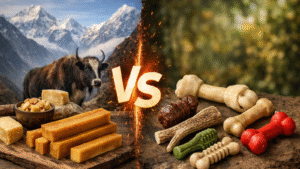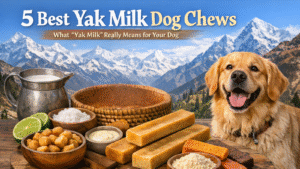
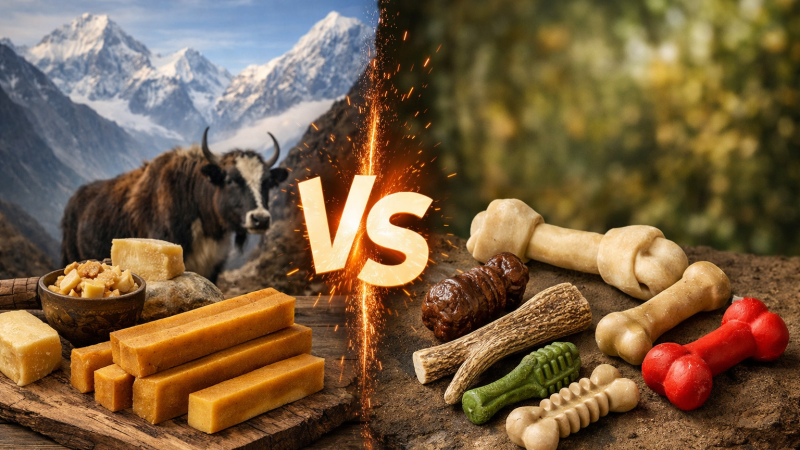
Yak chews, also called Chhurpi dog chews, are traditional Himalayan hard cheese chews made from yak milk, cow milk, lime juice, and salt using an extended smoke-drying method developed in the mountain regions of Nepal. These long-lasting dog chews stand out for their high protein content, very low fat, natural digestibility, and chemical-free ingredient profile, making them a strong alternative to many mainstream chew options. Genuine Himalayan yak chews also offer a rare combination of nutrition, chewing satisfaction, and simple food-grade composition, which is why they have become a popular rawhide replacement for adult dogs.
This guide compares yak chews vs rawhide, bully sticks, antlers, nylon chews, rubber chews, and dental chews across the factors that matter most to dog owners: safety, chew duration, calorie load, protein quality, tooth risk, digestibility, and ingredient integrity. It also explains which dogs benefit most from yak chews, how to choose the right size, how veterinarians view different chew categories, how to identify authentic Himalayan Chhurpi, and when softer options such as yak nuggets or bully sticks may be better suited for puppies, seniors, or dogs with dairy sensitivity.
What Are Yak Chews (Chhurpi Dog Chews) and Where Do They Come From?
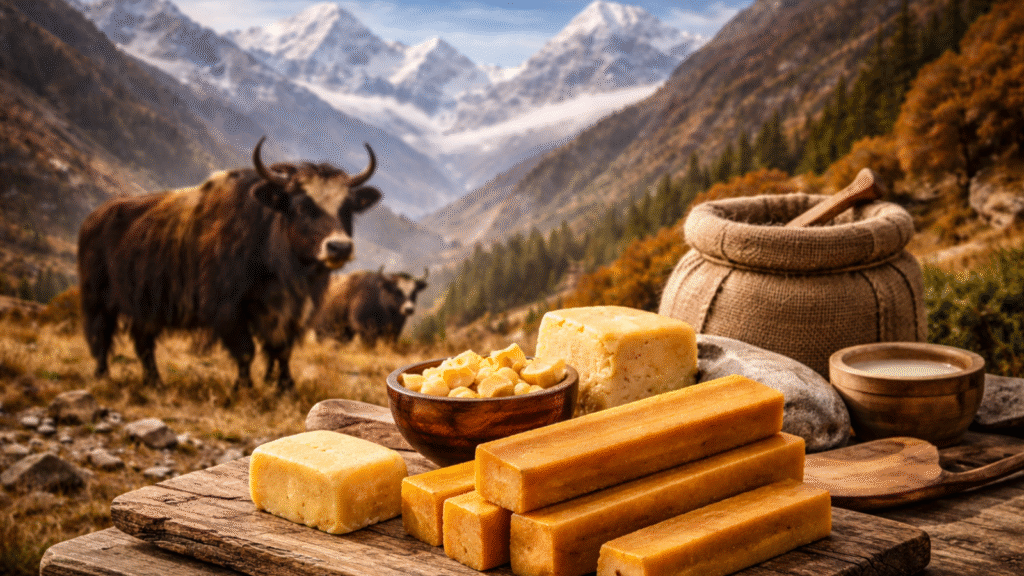
Yak chews are compressed, smoke-dried Himalayan cheese bars crafted using a centuries-old Nepali food preservation method called Chhurpi production. Yak herding communities in the Himalayan highlands developed this process to preserve high-altitude dairy through extended dry-curing without refrigeration. The resulting hard cheese block became a long-chewed snack for both people and working animals.
The Origin and History of Chhurpi in Nepal
Chhurpi (छुर्पी) is a traditional Nepali dairy product produced in the mountain villages of Nepal, Tibet, Bhutan, and the Darjeeling region of India. Communities at altitudes above 3,000 meters have produced it for over 400 years.
The production process follows 4 core steps:
- Milk collection: Raw yak and cow milk sourced from highland herds
- Curdling: Lime juice and salt trigger natural protein coagulation
- Pressing: Moisture is mechanically extracted from the curd blocks
- Smoke-drying: Blocks cure over low heat for 4 to 6 weeks, producing extreme hardness
Nepal’s Chhurpi-to-dog-chew export segment reached an estimated USD 22 million in fiscal year 2021–22, with more than 30 active manufacturers supplying global markets. This scale validates Chhurpi as a commercially established ingredient category, not a passing trend.
At YforYak Dog Chews, we manufacture Himalayan yak chews using this exact traditional method at our FDA-registered, ISO 9001-certified facility in Tokha, Kathmandu, producing up to 50,000 kg per month for pet brands across 20+ countries.
What Ingredients Are Inside a Yak Chew?
A genuine Himalayan yak chew contains exactly 4 ingredients:
- Yak milk (primary dairy base)
- Cow milk (secondary dairy base)
- Lime juice (natural curdling agent)
- Salt (preservation and flavor)
No preservatives. No artificial binders. No chemical additives. The drying process lowers lactose content, so many dogs digest yak chews well, but they should not be described as lactose-free.
How Do Yak Chews Compare to Rawhide Chews?
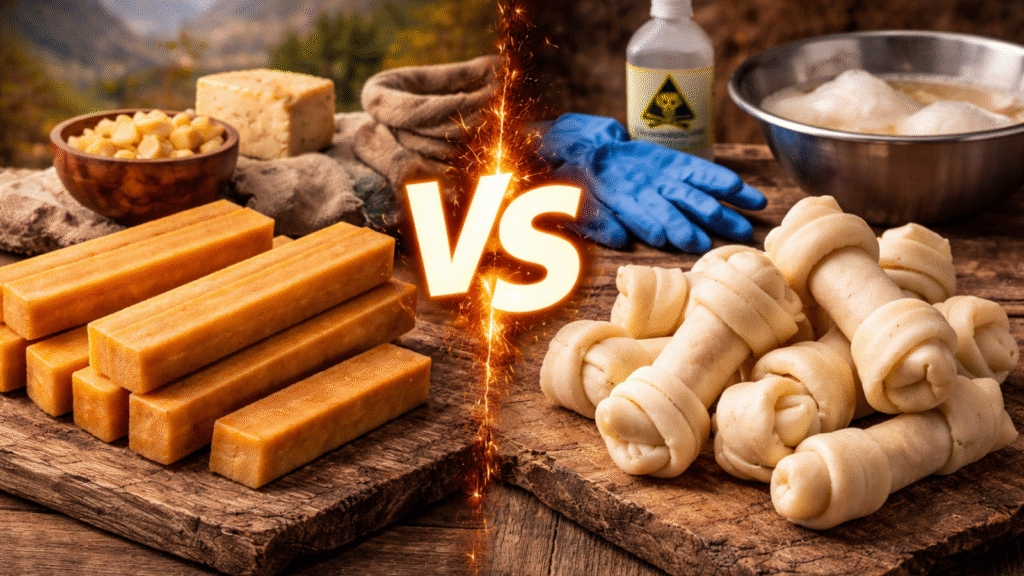
Yak chews are often used as a rawhide alternative, but safety depends on the dog’s chewing style, the chew’s size, and close supervision. Rawhide remains the most widely purchased dog chew in North America and Europe, yet veterinary concern about rawhide safety has grown steadily over the past decade.
What Is Rawhide and How Is It Made?
Rawhide is the inner layer of animal skin, most commonly cattle hide, that has been chemically treated, bleached, and pressed into chew shapes. The manufacturing process involves:
- Lime solution soaking to strip hair and fat
- Hydrogen peroxide or bleach whitening
- Preservative application (sodium benzoate, titanium dioxide in some batches)
- High-temperature pressing into bones, rolls, or chips
The result is a product that looks clean but carries chemical processing residues not present in food-grade ingredients.
5 Key Differences Between Yak Chews and Rawhide
| Factor | Yak Chew (Chhurpi) | Rawhide Chew |
| Ingredients | 4 natural food-grade ingredients | Chemically treated animal skin |
| Digestibility | High, breaks into digestible protein fragments | Low, large undigested chunks cause blockages |
| Choking risk | Low, softens gradually, no sudden breakage | High, large pieces break off unexpectedly |
| Chemical exposure | Zero, no processing chemicals | Potential, bleach, preservative residues possible |
| Protein content | High (dairy protein) | Low, hide collagen, not a complete protein source |
Veterinary nutritionists at the American Kennel Club have documented rawhide’s association with gastrointestinal obstruction, particularly in power-chewing breeds like Labradors, Rottweilers, and Pit Bulls.
Yak chews soften progressively at the chew tip. The texture transitions from hard cheese to a pliable paste before fully dissolving. Dogs consume the chew in controlled micro-doses of softened protein, not in large chunks that bypass digestive capacity.
The Microwave Puff Bonus Rawhide Cannot Offer
When a yak chew reduces to a small residual piece (approximately thumb-sized), you can microwave it for 30–45 seconds. The cheese puffs into a light, crunchy treat your dog can finish completely. Rawhide offers no equivalent end-of-chew usage, the remnant goes in the bin.
How Do Yak Chews Compare to Bully Sticks?
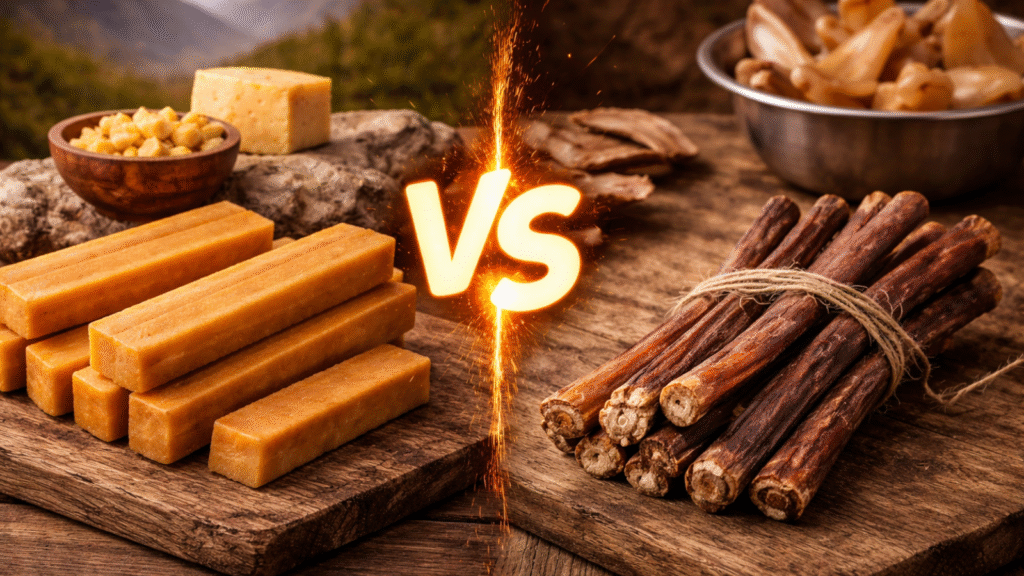
Yak chews and bully sticks are both natural, high-protein dog chews, but yak chews last 3 to 5 times longer per session, produce no odor, and carry significantly lower caloric load per gram consumed. The comparison between these two popular natural chews depends primarily on your dog’s size, chewing intensity, and your tolerance for smell.
What Are Bully Sticks?
Bully sticks are dried beef pizzle (bull penile muscle). They are single-ingredient chews and are fully digestible. Their protein content runs between 78–85% on a dry matter basis. They are considered a premium natural chew and are widely recommended by veterinarians over rawhide.
Where Bully Sticks Fall Short
Bully sticks carry 3 practical disadvantages that yak chews eliminate:
1. Odor: The drying process produces a sulfur-compound odor that many dog owners find difficult to tolerate indoors. Odorless bully sticks exist but command 40–60% price premiums.
2. Caloric density: A standard 6-inch bully stick delivers approximately 88–100 calories. For a 10 kg dog on a 400-calorie daily diet, a single bully stick represents 22–25% of total caloric intake. Yak chews deliver roughly 15–20 calories per hour of chew time because the cheese dissolves slowly rather than being consumed rapidly.
3. Chew duration: Average bully stick consumption time for a medium-breed enthusiastic chewer runs 15–30 minutes. A medium-sized yak chew bar provides 3–7 hours of chew engagement across multiple sessions.
When Bully Sticks Are the Better Choice
Bully sticks outperform yak chews in 2 specific scenarios:
- Puppies under 6 months whose deciduous teeth are not yet strong enough for hard cheese bars
- Senior dogs with dental fragility where hard chews risk tooth fracture
For healthy adult dogs between 6 months and 8 years, yak chews deliver superior value per gram, longer engagement, and zero odor.
How Do Yak Chews Compare to Nylon Chews, Antler Chews, and Dental Chews?
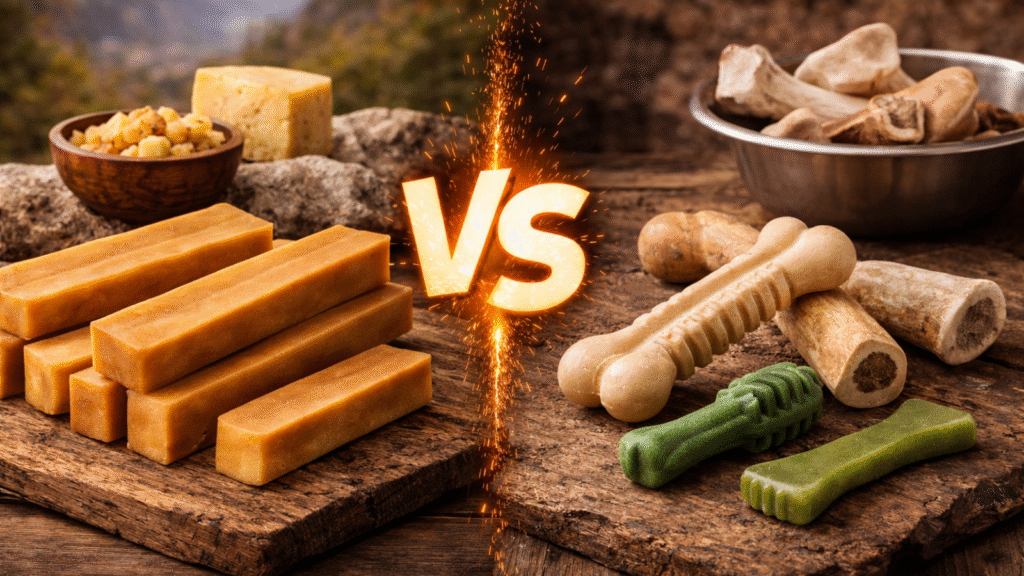
Nylon chews are indigestible synthetic products; antler chews are extremely hard and pose tooth fracture risk; dental chews are low-protein, high-starch snacks optimized for oral hygiene rather than chewing satisfaction. Yak chews occupy the intersection of all 3 categories, hard enough for extended engagement, digestible enough for safety, and abrasive enough for natural plaque reduction.
Nylon and Rubber Chews: Durable but Non-Digestible
Nylon chews (brands such as Nylabone, Benebone) are petroleum-derived plastic products. They resist destruction effectively and last indefinitely. Their core problem is indigestibility.
Dogs who consume nylon fragments, which power chewers regularly do, pass plastic through their digestive tract. Some fragments accumulate. Veterinary GI specialists classify nylon ingestion as a category 2 foreign body risk, meaning intervention is not always required but monitoring is necessary.
Rubber chews (Kong, West Paw) are more elastic than nylon, making fragment ingestion less likely, but they provide no nutritional value. They function as enrichment tools, not chews.
Yak chews are fully edible. Every gram consumed delivers dairy protein, calcium, and phosphorus.
Antler Chews: Natural but High-Risk for Tooth Fracture
Antler chews, elk antler, deer antler, water buffalo horn, are natural single-ingredient chews with no chemical processing. They score high on durability and zero digestive risk because most dogs cannot break them down.
The problem is hardness. Antlers are extremely hard, and veterinary sources warn that dogs can fracture teeth on antlers and other hard, non-bending chews. The slab fracture rate in dogs chewing antlers has been measured at significantly higher levels than softer chews in multiple veterinary dental studies. A fractured carnassial tooth requires surgical extraction.
Yak chews are hard, harder than bully sticks, but they soften progressively under saliva and chewing pressure. Yak chews may be less rigid than antlers, but they are still hard chews and can contribute to tooth fracture in some dogs.
Dental Chews: Oral Health Focus, Low Nutritional Value
Dental chews (Greenies, Dentastix, Whimzees) are formulated for tartar reduction and fresh breath. They carry VOHC (Veterinary Oral Health Council) seals validating plaque and tartar efficacy.
Their ingredient profiles reveal the trade-off: most dental chews contain wheat flour, corn starch, or potato starch as primary binders, making them high-carbohydrate, low-protein snacks. A standard Greenies Original treat provides approximately 54 calories with 12% crude protein, compared to yak chew’s 57–65% crude protein content.
Yak chews produce natural mechanical plaque reduction through abrasive contact. They do not carry a VOHC seal (because dairy chews are not submitted through that certification pathway), but the abrasive texture of hardened cheese removes surface plaque physically during chewing.
What Makes Yak Chews Nutritionally Superior to Most Dog Chews on the Market?
Yak chews deliver the highest protein-to-calorie ratio of any long-duration dog chew category, with 57–65% crude protein, less than 1% fat, and a full amino acid profile from dairy casein and whey fractions. No synthetic chew provides nutrition. No rawhide provides complete protein. No bully stick matches yak chew’s fat-to-protein ratio.
The Nutritional Profile of a Himalayan Yak Chew
A 100-gram yak chew bar contains approximately:
- Crude protein: 57–65 g
- Crude fat: 0.5–1.2 g
- Crude fiber: < 0.5 g
- Moisture: 9–13 g
- Calcium: 700–900 mg
- Phosphorus: 450–600 mg
- Calories: 280–320 kcal
The calcium-to-phosphorus ratio of 1.4:1 to 1.6:1 falls within the AAFCO-recommended range for adult dog maintenance. This ratio supports bone mineralization without the imbalance that excessive single-mineral supplementation creates.
Why Low Fat Matters for Active and Overweight Dogs
According to APOP’s 2022 report, 59% of dogs evaluated by U.S. veterinary professionals were classified as overweight or having obesity. High-fat chews, including most bully sticks and some dental treats, contribute to daily caloric surplus in dogs already carrying excess weight.
Yak chews, with sub-1% fat content, deliver chewing enrichment and protein without meaningful caloric contribution. A dog who chews a yak bar for 2 hours consumes roughly 30–40 calories, equivalent to approximately 2 commercial kibble pieces.
Protein Quality: Dairy Casein vs. Hide Collagen vs. Processed Starch
Not all protein sources in dog chews carry equivalent biological value. The 3 dominant protein types found across the chew market differ significantly:
- Dairy casein (yak chews): A complete protein containing all 10 essential amino acids for dogs. Biological value of 77–80. Supports muscle maintenance, immune function, and coat quality.
- Hide collagen (rawhide): An incomplete protein lacking tryptophan. Biological value below 55. Functions as a structural protein with limited systemic utility.
- Wheat/starch binders (dental chews): Non-protein energy sources classified as carbohydrates. Zero biological value as protein.
For dogs on low-protein diets due to kidney concerns, consult your veterinarian before introducing any high-protein chew. For healthy adult dogs, dairy-based protein from yak chews represents the highest-quality protein available in the long-duration chew category.
How Do Yak Chews Perform Across Different Dog Breeds and Chewing Styles?
Yak chews are appropriate for medium and large breed adult dogs who are moderate to aggressive chewers, and the correct size selection eliminates the primary safety variable in hard chew usage. Small breeds under 5 kg and puppies under 6 months require soft chew alternatives or appropriately sized yak nuggets rather than full bars.
Choosing the Right Yak Chew Size by Dog Weight
Yak chew manufacturers including YforYak categorize bars by dog weight range. Using an undersized chew for a large-breed power chewer creates a choking risk when the bar reduces to a swallowable piece rapidly.
The standard sizing guide follows this framework:
| Dog Weight | Recommended Bar Size | Average Session Duration |
| Under 5 kg (11 lbs) | XS / Nugget | 30–60 min |
| 5–15 kg (11–33 lbs) | Small | 1–3 hours |
| 15–30 kg (33–66 lbs) | Medium | 3–5 hours |
| 30–50 kg (66–110 lbs) | Large | 5–8 hours |
| Over 50 kg (110+ lbs) | XL | 6–10 hours |
Breed-Specific Considerations for Hard Chews
3 breed categories require additional evaluation before introducing yak chews:
- Brachycephalic breeds (French Bulldogs, Pugs, English Bulldogs): Their shortened jaw mechanics reduce biting efficiency. Hard cheese bars may cause jaw fatigue. Yak nuggets, smaller, puffed versions, suit these breeds better than full bars.
- Power-chewing breeds (Mastiffs, Rottweilers, Malinois, American Bulldogs): These dogs consume standard chews at accelerated rates. XL bars or extra-hard formulations appropriate for their bite force prevent premature reduction to swallowable remnants.
- Senior dogs over 8 years: Periodontal disease prevalence in dogs over 3 years old reaches approximately 80%, according to the American Veterinary Dental College. Senior dogs with confirmed dental health should use soft yak nuggets or puffed yak bars rather than hard cheese bars.
The Supervision Rule for All Hard Chews
Every chew category, yak, bully stick, antler, dental, carries a universal veterinary recommendation: supervise your dog during all chew sessions until you understand their chewing behavior pattern. Dogs who gulp rather than grind require monitored introduction to any hard chew.
Remove and replace a yak chew when it reduces to a piece smaller than the dog’s muzzle width. Microwave the remnant piece into a puffed treat the dog can finish safely.
What Do Veterinarians and Pet Nutrition Experts Say About Yak Chews vs. Other Options?
Veterinary consensus supports natural, digestible, single-or-minimal-ingredient chews over chemically processed alternatives. Yak chews consistently receive favorable mentions in veterinary blogs, breed-specific forums, and pet nutrition guides as a rawhide replacement that satisfies power chewers safely.
The Veterinary Position on Rawhide
The American Kennel Club’s veterinary health team explicitly lists rawhide among chews requiring caution, citing gastrointestinal obstruction, chemical contamination risk, and unpredictable breakage patterns. Multiple board-certified veterinary internists recommend rawhide-free households for dogs with prior GI obstruction history.
The VOHC Standard and Where Yak Chews Fit
The Veterinary Oral Health Council evaluates products specifically for plaque and tartar reduction efficacy under controlled clinical trial conditions. VOHC approval confirms oral health benefit for those specific products.
Yak chews are not listed among VOHC-accepted products, so you should avoid implying VOHC-validated plaque or tartar efficacy unless a specific product has earned that seal. This absence does not indicate inferiority, it reflects a submission gap, not an efficacy gap. The mechanical abrasion of hard cheese against tooth enamel demonstrably reduces surface plaque accumulation during chewing.
What Pet Nutritionists Identify as the Ideal Chew Profile
Certified Pet Food Nutritionists (CPFNs) evaluate chews across 5 criteria: digestibility, protein quality, caloric density, sourcing transparency, and ingredient simplicity. Yak chews score in the top tier across all 5:
- Digestibility: High, dairy protein digests at 90%+ efficiency
- Protein quality: High, complete amino acid profile
- Caloric density: Low, less than 320 kcal/100g with very slow consumption rate
- Sourcing transparency: High, single-origin Himalayan dairy, 4 declared ingredients
- Ingredient simplicity: Maximum, 4 ingredients, all food-grade
No other long-duration chew category achieves this scoring profile simultaneously.
How to Introduce a Yak Chew to Your Dog for the First Time
Introduce a yak chew during a calm, supervised 15-minute session, monitor chewing mechanics, and remove the chew if your dog attempts to swallow large intact pieces rather than grinding. First-time yak chew users benefit from a structured 3-session introduction protocol.
The 3-Session Introduction Protocol
- Session 1 (15 minutes): Offer the chew after a meal when your dog’s hunger drive is lower. Observe whether the dog grinds with back molars (correct) or bites transversely with incisors (less efficient). Retrieve the chew after 15 minutes.
- Session 2 (30 minutes): Allow 30-minute access. Note wear patterns on the bar. A correctly-sized bar shows graduated surface wear without any piece approaching swallowable size.
- Session 3 (60+ minutes): By session 3, you understand your dog’s chewing pattern. Adjust bar size upward if the dog has reduced a medium bar more than 30% in session 1.
Storing Yak Chews Between Sessions
Yak chews require no refrigeration due to their ultra-low moisture content (9–13%). Store in a dry, ventilated container at room temperature. Humid environments above 75% relative humidity promote surface mold growth on the cheese exterior. If mold appears, the affected layer can be trimmed; the interior remains unaffected due to its density.
Shelf life at proper storage conditions: 2 to 4 years from production date.
Why Himalayan Origin Matters: What “Authentic Yak Chew” Actually Means
An authentic Himalayan yak chew requires traceable high-altitude dairy sourcing, traditional Chhurpi production methods, and no substituted low-cost milk ingredients. The market contains products labeled “Himalayan chew” that use 100% cow milk with no yak milk content, a practice that reduces production cost but removes the unique protein ratios of genuine yak dairy.
How to Verify Authenticity When Buying Yak Chews
4 verification signals distinguish genuine yak chews from imitations:
1. Declared ingredient order: Yak milk listed before cow milk on the ingredient panel confirms higher yak dairy content. Cow milk-first listings indicate a budget formulation.
2. Color range: Authentic Chhurpi bars range from pale golden to medium amber. Uniform bright white coloring indicates high-heat pasteurization that reduces the smoke-drying authenticity.
3. Country of origin: Nepal, Bhutan, and the Darjeeling region of India are the 3 authentic production regions. Products labeled “Himalayan style” without country declaration warrant further scrutiny.
4. Manufacturing certifications: FDA facility registration (for US-market products), ISO 9001 quality management, and HACCP food safety compliance confirm production standards that protect against contamination and inconsistent batch quality.
At YforYak, our facility in Tokha, Kathmandu holds ISO 9001 certification, FDA registration, and HACCP/DFTQC compliance. We supply private-label yak chew brands across North America, Europe, Australia, and Asia with full origin documentation, batch testing, and export compliance paperwork.
The Fair Trade Dimension of Yak Chew Purchasing
Genuine Himalayan yak chew production supports pastoral yak-herding communities who have maintained high-altitude dairy traditions across generations. When manufacturers source directly from these communities at fair prices, the supply chain delivers economic sustainability to some of the world’s most remote rural economies.
YforYak’s sourcing model prioritizes direct relationships with Himalayan herder networks. Your dog’s yak chew connects to a supply chain that sustains cultural heritage and rural livelihoods, a dimension of the purchase that no synthetic chew, rawhide, or industrially produced treat can offer.
Are yak chews safe for puppies?
Yak chews in bar form suit puppies above 6 months with fully erupted adult teeth and body weight above 5 kg. Under 6 months, choose yak nuggets, smaller, softer puffed pieces that provide the same dairy protein in an appropriately-sized format. Always supervise puppies during any chew session.
Can dogs be allergic to yak chews?
Yak chews contain dairy protein. Dogs with confirmed milk protein allergy, a diagnosis requiring veterinary testing, react to casein and whey fractions regardless of source. Dairy allergy in dogs is rare (affecting an estimated 1–2% of dogs with food allergies) but real. Dogs with suspected food sensitivities should undergo an elimination diet trial under veterinary guidance before introducing any dairy-based chew.
How often can dogs have yak chews?
Most adult dogs tolerate daily yak chew sessions without digestive disruption. The low fat content and high digestibility make daily use practical. For dogs new to dairy protein, introduce 3 times per week in the first 2 weeks and observe stool consistency. Loose stools indicate too-rapid introduction; revert to twice weekly and extend the introduction period.
Are yak chews better than antlers for aggressive chewers?
Yak chews are safer than antlers for power chewers because the cheese substrate yields under sustained bite pressure, reducing tooth fracture risk. Antler hardness can exceed tooth enamel resistance, making it the highest tooth-fracture-risk chew available in the natural category. For aggressive chewers who destroy softer chews in minutes, select XL yak chew bars rather than escalating to antler.
Do yak chews cause bad breath in dogs?
Yak chews produce no sulfur compounds during digestion, the primary driver of post-chew odor in bully sticks. Dairy protein fermentation produces lactic acid compounds that are odor-neutral at normal chewing quantities. Most dog owners report no detectable odor change after yak chew sessions.
Making the Final Decision: Which Chew Is Right for Your Dog?
The right chew for your dog depends on 4 factors: age, body weight, chewing intensity, and any known dietary sensitivities. For most healthy adult dogs, yak chews provide the optimal combination of safety, nutrition, duration, and ingredient integrity.
Use this decision framework:
- Choose yak chews if your dog is between 6 months and 8 years old, weighs over 5 kg, has no confirmed dairy allergy, and you want a long-lasting, natural, odor-free, high-protein chew.
- Choose yak nuggets or puffed yak bars if your dog is a puppy, a senior, a small breed, or a brachycephalic breed where full-bar hardness exceeds comfortable chewing capacity.
- Choose bully sticks if your dog is under 6 months, has confirmed dairy sensitivity, or requires a softer texture for dental reasons.
- Avoid rawhide for all dogs, the combination of chemical processing, digestive risk, and choking probability produces a risk profile that no performance benefit justifies.
- Avoid antlers for aggressive power chewers, the tooth fracture risk documented in veterinary dental literature makes them a high-cost safety gamble.