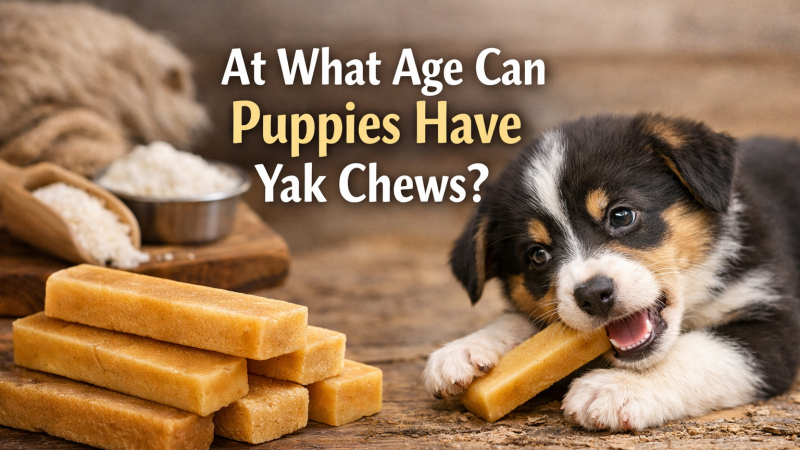
Yak chews are hard Himalayan dog chews made from yak milk and cow milk, traditionally known as churpi. Puppy owners often choose them because they are long-lasting, high in protein, and made with only a few natural ingredients. A common question new dog owners ask is: at what age can puppies safely have yak chews? Giving a chew too early can damage fragile baby teeth or create a choking risk, while introducing it at the right stage can support teething, jaw development, and healthy chewing habits.
Most veterinarians and canine dental guidelines agree that puppies can start chewing yak chews at around 12–16 weeks of age (3–4 months) when the teething phase begins and jaw strength improves. During this period, puppies develop stronger chewing instincts as baby teeth loosen and adult teeth start emerging. Choosing the correct chew size, selecting a softer grade designed for puppies, and supervising each chewing session are essential steps to ensure yak chews become a safe enrichment tool rather than a dental or digestive risk.
What Are Yak Chews and Why Do Puppy Owners Choose Them?
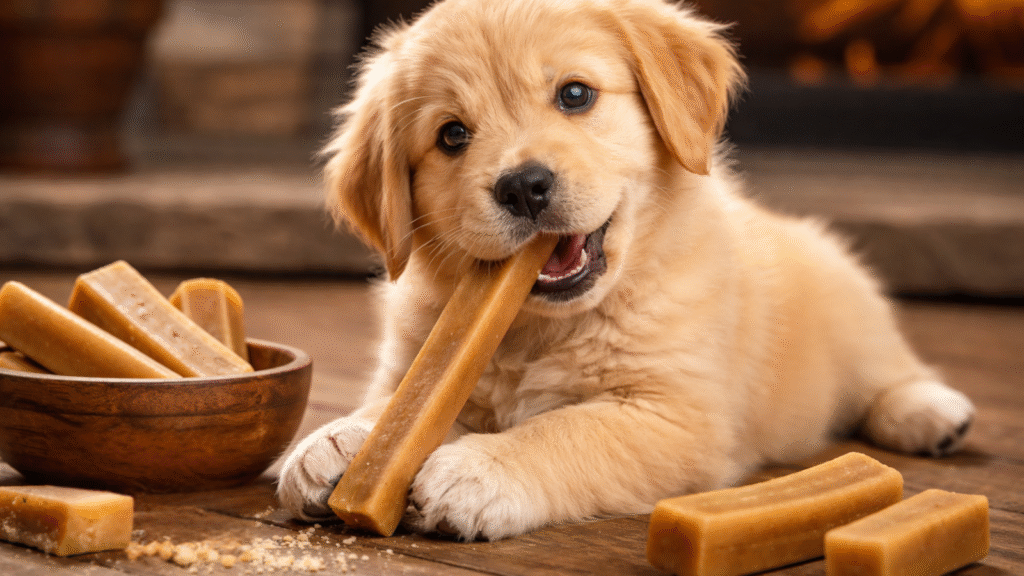
Yak chews deserve a proper introduction before we talk about age, because understanding what they are made of directly explains why age and size matter so much. Puppy owners choose them because they are natural, highly digestible, and far safer than rawhide or synthetic chews. The high protein content, clean ingredient list, and lasting chew time make them one of the most trusted treats for puppies during the teething phase.
What Is a Yak Chew Made From?
A yak chew is a hard, long-lasting dog chew made from 4 core ingredients: yak milk, cow milk, lime juice, and salt. That is it. No artificial preservatives, no synthetic binders, no chemical additives.
The production process is rooted in centuries-old Himalayan tradition. Yak milk and cow milk are blended, acidified with lime juice, and compressed into dense bars. The bars are then smoked and dried for weeks, sometimes months, until the moisture content drops to a level that creates the iconic rock-hard texture.
Why Yak Chews Appeal to Puppy Owners
Puppy owners choose yak chews for 3 primary reasons:
- Duration. A quality yak chew lasts far longer than rawhide, bully sticks, or rubber chews for most dogs. For puppies who are in a constant state of needing to chew something, this matters enormously.
- Ingredient simplicity. Parents of young dogs become hyper-aware of what goes into their puppy’s body during the critical growth phase. A chew with 4 recognizable ingredients removes a significant layer of anxiety from the purchase decision.
- Digestibility. Unlike rawhide, which swells unpredictably in the digestive tract, yak milk chews are cured through a natural process that makes them largely digestible in small quantities. When a puppy gnaws off a small piece, it does not expand and obstruct the gut the way raw animal hides can.
At What Age Can Puppies Start Having Yak Chews?
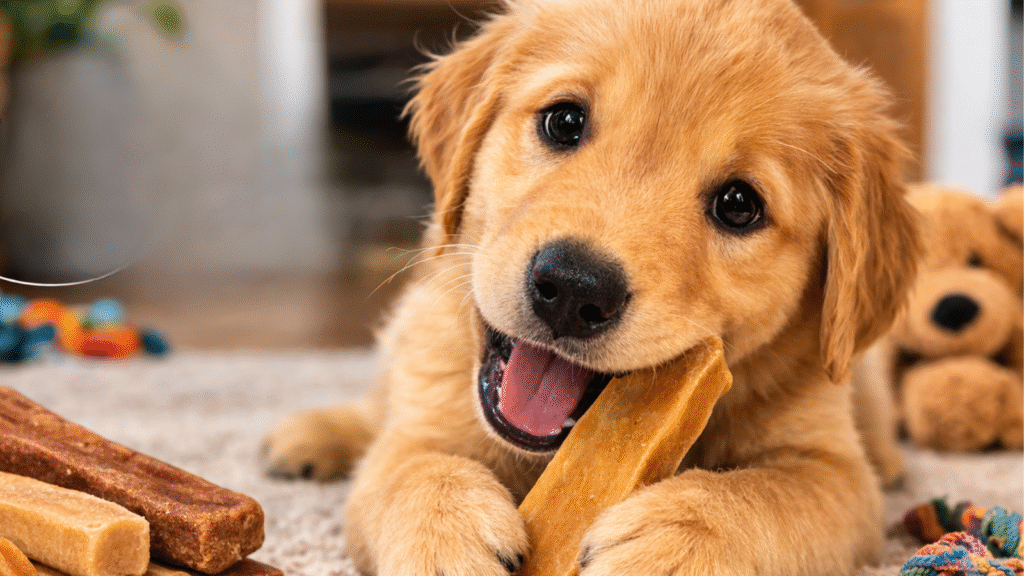
Puppies are ready for yak chews at 12 to 16 weeks old (3 to 4 months). This corresponds with the transition from baby teeth (deciduous teeth) to the active teething phase, when chewing behavior intensifies and the jaw muscles begin to strengthen meaningfully.
The Safe Starting Age: 12 to 16 Weeks Explained
Before 12 weeks, a puppy’s deciduous (baby) teeth are fully erupted but structurally fragile. The roots are shallow. The enamel is thin. A hard chew at this stage can fracture a tooth, cause pain, and interfere with the natural shedding process of baby teeth.
Between 12 and 16 weeks, 3 important changes happen simultaneously:
- Teething escalates: The 28 baby teeth begin to loosen, and the urge to chew intensifies dramatically. This is the peak destructive chewing phase.
- Jaw strength increases: The masseter muscles are developing quickly, giving puppies the ability to apply meaningful pressure to a chew.
- Digestive capacity matures: The puppy gut can handle small amounts of dairy-derived protein from the chew.
The 12-week threshold is not arbitrary. It aligns with standard veterinary guidance on the introduction of hard chews and with the developmental milestones documented in canine growth literature.
Why the Teething Stage Matters for Yak Chew Introduction
Puppies go through 2 distinct teething phases:
Phase 1: 3 to 6 weeks. Baby teeth erupt. This happens before most owners even bring their puppy home.
Phase 2: 12 to 24 weeks. Adult teeth begin pushing through. Baby teeth loosen and fall out. This phase is when chewing behavior peaks in intensity, duration, and frequency.
Introducing a yak chew during Phase 2 (starting at 12 weeks) gives the chew a legitimate purpose: it soothes sore gums, satisfies the chewing drive, and keeps the puppy occupied in a safe, constructive way.
What most owners overlook is that introducing a chew too early during Phase 2, say at 10 weeks, still carries risk if the chew is sized for adult dogs. The correct size is as important as the correct timing.
Puppy Teeth vs. Adult Teeth: What Changes at 6 to 8 Months?
By 6 to 8 months, most medium and large breed puppies have their full set of 42 permanent adult teeth. At this point, the considerations around yak chew hardness shift meaningfully:
- Adult teeth have deeper roots and harder enamel than baby teeth
- Jaw strength reaches approximately 60 to 70% of adult capacity by 8 months
- The risk of tooth fracture from appropriate-sized yak chews drops significantly
This is why you may notice the same puppy who was limited to a small soft yak chew at 4 months can graduate to a medium or regular hardness chew by 7 to 8 months. The teeth have changed. The jaw has changed. The chew selection should reflect that.
How to Choose the Right Yak Chew Size for Your Puppy’s Age and Weight
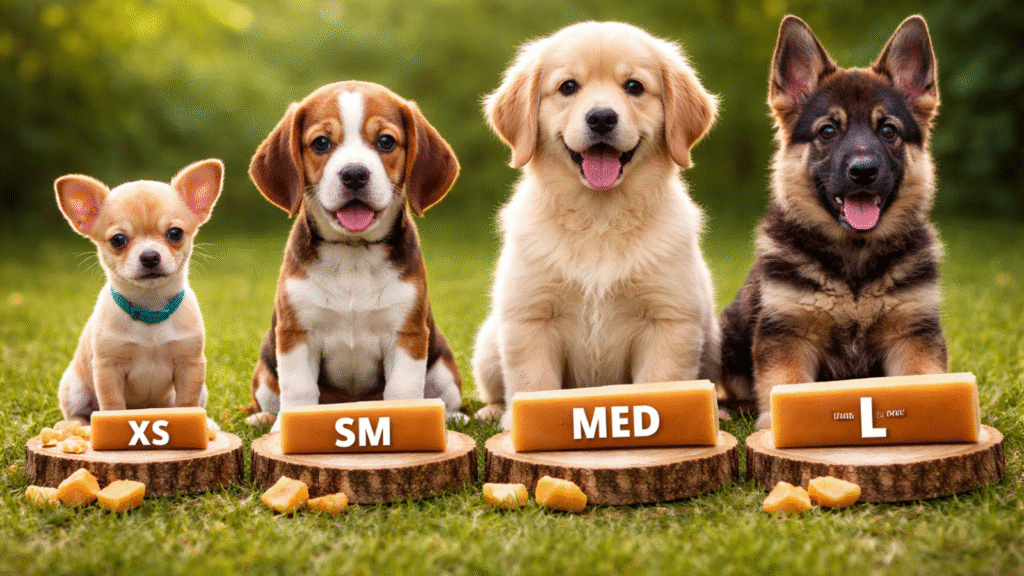
Getting the size right is the single most important safety decision you make when buying a yak chew for a puppy. Too large and it becomes a choking hazard when pieces break off. Too small and the puppy can get the entire chew in their mouth at once.
Size Guide by Puppy Weight and Breed
The general sizing framework used across the yak chew industry is weight-based. Here is the practical guide:
| Puppy Weight | Recommended Chew Size | Examples of Breeds at This Stage |
| Under 15 lbs (7 kg) | Small (XS) | Chihuahua, Pomeranian, toy breeds |
| 15–35 lbs (7–16 kg) | Small-Medium | Beagle, Cocker Spaniel, small Labrador pup |
| 35–55 lbs (16–25 kg) | Medium | Labrador, Golden Retriever (young), Border Collie |
| 55+ lbs (25+ kg) | Large | German Shepherd, Rottweiler, large breed pups |
One clarification worth making: these weights refer to your puppy’s current weight, not their projected adult weight. A 4-month-old Golden Retriever puppy weighing 20 lbs should receive a small-to-medium chew, not the large chew they will eventually graduate to at full size.
Hardness Levels: Soft vs. Regular vs. Extra-Hard Chews
Not all yak chews are identical in hardness. 3 hardness categories exist:
- Soft/Medium-Soft chews are the appropriate choice for puppies aged 3 to 6 months. They have slightly higher residual moisture, making them less likely to cause tooth fractures. They are also easier to work and gnaw, which reduces frustration-based chewing (where puppies overexert jaw muscles trying to make progress on something too hard).
- Regular/Standard chews work well for puppies aged 6 to 12 months as adult teeth come in. The texture is firm but not brittle.
- Extra-hard or large competition-grade chews are designed for strong adult chewers and should not be introduced until the puppy has their full permanent dentition, typically after 8 months, and even then only for large or power breeds.
Signs the Yak Chew Is Too Hard for Your Puppy
Most owners wait for a problem to identify a mismatch. These 5 warning signs indicate a chew is too hard:
- Puppy gives up quickly: not from boredom, but from inability to make progress
- Visible gum redness or bleeding around the teeth after a chewing session
- Pawing at the mouth or reluctance to eat after chewing
- Fractured or chipped tooth: visible as a dark spot or jagged edge on a tooth
- Whining during chewing: puppies vocalize discomfort; this is not normal excitement
A practical test veterinary dental specialists recommend: press your thumbnail firmly into the chew surface. If it leaves no indentation at all, the chew is likely too hard for puppies under 6 months. If it leaves a slight mark, the hardness is within the appropriate range.
Safety Rules Every Puppy Owner Must Follow When Giving Yak Chews
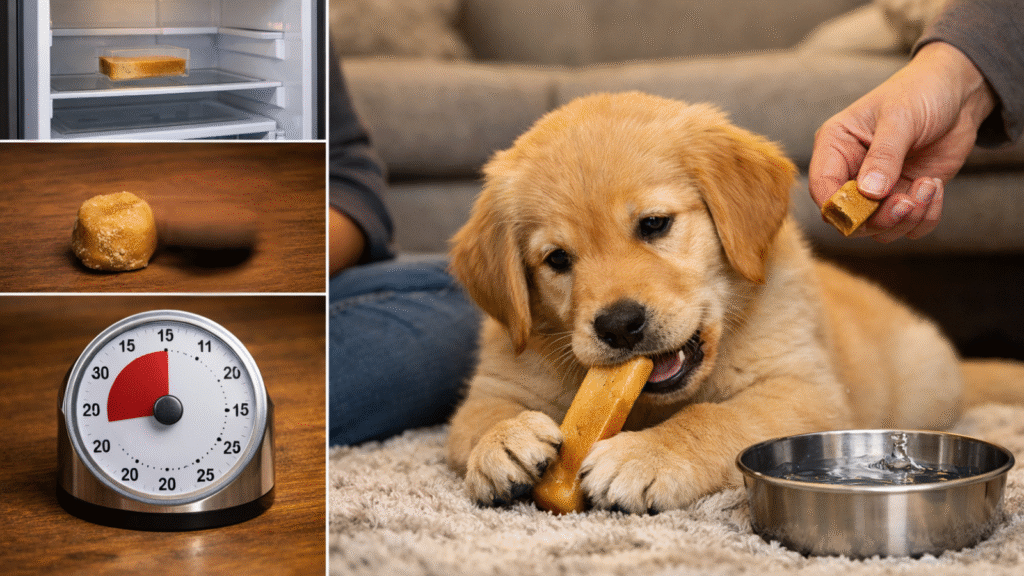
Age and size are the prerequisites. Supervision and safety practices are the ongoing responsibilities. Here are the non-negotiable rules.
The 5 Essential Safety Practices for Puppy Chewing
- Supervise every chewing session: Puppies are not miniature adult dogs. Their chewing patterns are erratic, they bite at angles, apply uneven pressure, and can dislodge unexpected pieces. Never leave a puppy alone with any chew, including yak chews. This is not an overreaction. It is standard guidance from every veterinary organization that has issued statements on chew safety.
- Set session time limits: 15 to 20 minutes per chewing session is sufficient for a puppy. Extended sessions (30+ minutes) cause jaw muscle fatigue, which paradoxically leads to harder, more forceful biting as the puppy compensates with poor mechanics. Take the chew away after 15 to 20 minutes and store it in a cool, dry place.
- Replace the chew when it reaches nub size: When the yak chew reduces to a piece small enough to fit entirely in your puppy’s mouth (roughly the size of a golf ball for most puppies), take it away immediately. At that point, it becomes a choking hazard regardless of how strong or experienced your puppy is.
- Keep the chew refrigerated between sessions: Yak chews kept at room temperature for extended periods can develop surface mold in humid climates. Refrigeration extends shelf life and maintains texture consistency between sessions. This is especially relevant for owners in tropical or subtropical climates.
- Offer fresh water before and after chewing: Chewing increases salivary activity and can mildly dehydrate a puppy. Always have clean water accessible. Puppies who chew without access to water also risk enamel abrasion from dry chew contact.
Common Mistakes Dog Owners Make With Yak Chews
In real-world use, 4 mistakes appear repeatedly:
- Mistake 1: Giving an adult-sized chew to a puppy. This is the most common error. Parents buy a large bag of mixed-size chews or order based on adult dog size recommendations. The puppy receives a chew that is too large, too hard, or both. Always order size-appropriate chews specifically matched to your puppy’s current weight.
- Mistake 2: Unsupervised access. Some owners treat yak chews like a stuffed Kong, something to keep the puppy occupied while they leave the room. Yak chews are not self-service items for puppies. They require active supervision.
- Mistake 3: Ignoring signs of gum sensitivity. Teething puppies already have sore, inflamed gums. A chew that is slightly too hard makes this significantly worse. Owners sometimes interpret the puppy stopping chewing as disinterest rather than pain. Inspect the gums and teeth briefly after each session.
- Mistake 4: Not transitioning hardness as the puppy ages. A chew that was perfect at 4 months may be too soft and fast-consuming at 8 months. Hardness and size graduation should happen alongside tooth development, not remain static until adulthood.
What to Do If Your Puppy Breaks Off a Large Piece
Even properly sized chews can produce an unexpected large fragment. The response matters.
Take the fragment away calmly and immediately. Do not reach into the mouth forcefully, this teaches the puppy to guard food and creates a resource-guarding problem. Instead, offer a high-value treat in exchange (a small piece of chicken or cheese works reliably) and remove the fragment while the puppy is focused on the treat.
Monitor the puppy for 24 hours for signs of gastrointestinal distress: vomiting, bloating, straining to defecate, lethargy, or loss of appetite. Small pieces of yak chew that are swallowed typically pass without issue due to their digestible nature. A piece that is thumb-sized or larger warrants a call to your vet.
The Microwave Trick: Turning Nubs Into Puffed Treats
This is one of the best-kept practical tips in the yak chew world, and it is especially useful for puppies.
When the yak chew reaches nub size, too small to chew safely, do not throw it away. Place the nub on a microwave-safe plate and heat it for 45 to 60 seconds on high. The moisture inside expands rapidly, causing the dense nub to puff up into a light, crunchy, cheese-flavored treat.
The puffed version is softer, digestible, and safe for puppies as a short-lived snack. It transforms the end-of-chew hazard into a bonus treat, eliminating waste and extending the value of every chew. Allow it to cool completely before offering it, the puffed piece retains heat briefly and can burn a puppy’s mouth if served immediately.
Nutritional Benefits of Yak Chews for Growing Puppies
Yak chews are not just an enrichment tool. They deliver measurable nutritional value that is relevant to puppy health and development.
Protein Content and Its Role in Muscle Development
Yak milk is nutritionally dense. On a dry-matter basis, high-quality Himalayan yak chews contain approximately 60 to 70% crude protein, a figure that significantly exceeds most commercial dog treats.
Protein is the structural foundation of muscle tissue, organ development, immune function, and hormone synthesis. During the growth phase (3 months to 18 months for most breeds), puppies require protein at roughly 22% of total dietary intake on a dry-matter basis, per AAFCO guidelines. While yak chews are not a primary food source, the protein content contributes meaningfully to daily intake, especially for puppies who receive chews as part of a supervised enrichment routine.
The amino acid profile of yak milk protein is notably rich in casein and whey fractions, both of which support lean muscle development, the same proteins found in premium puppy milk replacers.
Dental Health Benefits During the Teething Phase
Mechanical chewing on a firm but yielding surface performs 3 specific dental functions:
Plaque disruption. The abrasive surface of a yak chew physically scrapes soft plaque deposits from tooth surfaces, particularly along the gumline where early tartar accumulates. Studies on mechanical chewing in dogs (Hennet et al., 2007, Journal of Veterinary Dentistry) show that appropriately hard chews reduce plaque accumulation by 25 to 30% compared to non-chewing control groups.
Gum stimulation. Gentle pressure on inflamed teething gums increases blood circulation, which accelerates the shedding of baby teeth and the eruption of permanent ones. This is the same principle behind human teething rings.
Jaw muscle development. Regular chewing strengthens the masseter and temporal muscles, which contributes to proper occlusion (bite alignment) as adult teeth come in. Poor chewing stimulus during the 3 to 6 month window can contribute to misalignment problems in some breeds.
Fat Content and Why Low-Fat Matters for Puppies
One nutrition detail that sets yak chews apart from many other treats is their low fat content, typically 5 to 10% on a dry-matter basis.
Puppy diets are already relatively high in fat (minimum 8% on dry-matter basis per AAFCO), because fat is essential for brain development, nerve myelination, and fat-soluble vitamin absorption. However, excess fat from treats is a common contributor to puppy digestive upset, loose stools, and excessive weight gain in fast-growing breeds.
The low fat profile of yak chews means they can be incorporated into a puppy’s routine without meaningfully disrupting the fat balance of the overall diet. This is a nutritional advantage that bully sticks (which are high in fat) do not share.
Calcium and Phosphorus Ratio Consideration
Yak milk contains calcium and phosphorus, both essential for bone and teeth mineralization. However, large breed puppy owners should be aware that calcium supplementation, even from treats, requires monitoring.
Large and giant breed puppies (German Shepherd, Great Dane, Labrador) are sensitive to calcium excess during growth phases. Too much calcium disrupts the calcium-to-phosphorus ratio and can contribute to developmental orthopedic diseases such as osteochondrosis dissecans (OCD) and hypertrophic osteodystrophy (HOD).
For small and medium breed puppies, this is not a significant concern. For large breed puppies, keep yak chew sessions moderate (no more than once per day) and ensure the primary diet is a large-breed puppy formula with controlled calcium levels.
Breed-Specific Considerations: One Size Does Not Fit All Puppies
Age and weight are the primary sizing guides, but breed type introduces additional variables that smart puppy owners account for.
Small and Toy Breed Puppies (Under 15 lbs at Maturity)
Chihuahuas, Pomeranians, Maltese, and Yorkshire Terriers are frequently overlooked in yak chew discussions because the products are commonly associated with larger, more powerful chewers.
Small breed puppies have proportionally smaller jaws and more delicate teeth structure. They are also more prone to dental crowding and retained baby teeth. For these puppies, yak chews provide an important benefit: the chewing pressure can help loosen retained deciduous teeth that are being blocked by incoming permanent teeth.
The key adjustments for small breed puppies:
- Use exclusively XS or small chews
- Limit sessions to 10 to 15 minutes (smaller jaws fatigue faster)
- Monitor for retained teeth (two teeth in the same socket is a sign to see a vet)
- Start at 14 to 16 weeks rather than the earlier end of the 12-week window
Large and Giant Breed Puppies (Over 50 lbs at Maturity)
German Shepherds, Labradors, Golden Retrievers, and Rottweilers develop jaw strength rapidly between 4 and 8 months. A chew that appropriately resists at 4 months may be destroyed quickly by 7 months.
Large breed puppy owners can increase chew size as weight increases, but hardness graduation should still wait until adult teeth are fully established (6 to 8 months). The most common mistake with large breed pups is moving to competition-grade hard chews too early, assuming that the puppy’s obvious chewing power means their teeth are ready. Jaw strength develops faster than tooth root depth.
Brachycephalic Breeds (Flat-Faced Dogs)
Pugs, French Bulldogs, English Bulldogs, and Boston Terriers require extra caution. Brachycephalic puppies have compressed jaw anatomy, altered bite patterns, and are more prone to dental malocclusion. They are also at higher risk for fragment ingestion because their bite mechanics make it harder to work a chew consistently.
For brachycephalic breed puppies, consult your vet before introducing any hard chew. If cleared, use the softest available yak chew variant, limit sessions to 10 minutes, and supervise with full attention, not peripheral supervision.
Where to Source Safe, Age-Appropriate Yak Chews for Your Puppy
The yak chew market has grown considerably, and quality variation is real. Not all yak chews are manufactured under the same standards.
When choosing a yak chew supplier for your puppy, look for 3 verifiable markers:
1. Origin and manufacturing transparency. High-quality yak chews originate in Nepal, where the tradition of producing churpi, the traditional hard cheese that is the basis of yak chews, dates back centuries. Suppliers who openly share their manufacturing location, facility standards, and sourcing practices provide a higher confidence level than anonymous private-label products with opaque origins.
2. Certifications and compliance. FDA facility registration, ISO 9001 certification, and HACCP compliance indicate that the manufacturing facility operates under documented food safety protocols. These are not marketing claims, they are auditable standards. Ask for certificate numbers and issuing bodies.
3. Ingredient simplicity. A genuine Himalayan yak chew contains 4 ingredients: yak milk, cow milk, lime juice, and salt. Any additional preservatives, binders, or fillers indicate a lower-quality product or manufacturing shortcut.
At YforYak, our Himalayan yak dog chews are manufactured in our HACCP and ISO 9001-compliant facility in Tokha, Kathmandu. We export to 20+ countries and provide full documentation for import compliance, including Certificates of Origin, sanitary certificates, and veterinary certificates. Our chews are available in multiple sizes specifically designed for different dog weights and life stages, including puppy-appropriate soft and small variants.
If you are a dog owner sourcing yak chews for your puppy, the size, hardness, and quality of the source directly impact safety outcomes. Do not compromise on any of those three variables.
Summary
Here is the condensed reference guide for dog owners:
| Puppy Age | Ready for Yak Chew? | Recommended Size | Session Duration | Frequency |
| Under 12 weeks | No | — | — | — |
| 12–16 weeks | Yes (with supervision) | XS–Small, Soft | 10–15 min | 3–4x per week |
| 4–6 months | Yes | Small–Medium, Soft/Regular | 15–20 min | 3–5x per week |
| 6–8 months | Yes | Medium, Regular | 20–25 min | Daily if desired |
| 8–12 months | Yes (transitioning to adult) | Medium–Large, Regular | 20–30 min | Daily |
| 12 months+ | Adult protocol applies | Based on adult weight | 30+ min | Daily |
The core principles are simple: start at 12 to 16 weeks, match size to current weight, supervise every session, and graduate hardness as teeth develop. Yak chews, when sourced well and used correctly, are one of the safest and most nutritionally sound chews available for puppies.
The question is never just “what age”, it is “what age, what size, what hardness, and how supervised.” Answer all four correctly, and a yak chew becomes one of the best tools in your puppy-raising toolkit.
Can a 2-Month-Old Puppy Have a Yak Chew?
A 2-month-old puppy should not have a yak chew. At 8 weeks, puppy baby teeth have shallow roots and fragile enamel, which increases fracture risk from hard chews. Wait until 12 to 16 weeks of age before introducing a soft yak chew designed specifically for puppies.
What Is the Youngest Age a Puppy Can Start Chewing a Yak Chew?
The youngest age a puppy can start chewing a yak chew is 12 weeks (3 months). At this stage, teething begins and jaw muscles develop enough strength for a soft yak chew. Toy breeds and flat-faced breeds often start later, around 14 to 16 weeks.
Are Yak Chews Safe for Teething Puppies?
Yak chews are safe for teething puppies when owners choose the correct size and soft grade. The firm surface applies gentle pressure to inflamed gums, which helps relieve teething discomfort and supports jaw muscle development. Always select a puppy-size chew rather than a hard adult chew.
How Long Should a Puppy Chew on a Yak Chew Per Session?
Limit puppy yak chew sessions to 15 to 20 minutes for puppies under 6 months old. Longer sessions fatigue jaw muscles and increase the risk of tooth fractures from aggressive chewing. Store the chew in a cool dry place or refrigerate it after each chewing session.
How Often Can a Puppy Have a Yak Chew Each Week?
Puppies aged 12 weeks to 6 months can have a yak chew 3 to 4 times per week. Daily chewing becomes safer after adult teeth erupt at around 6 months. Keep all treats, including yak chews, below 10% of a puppy’s total daily caloric intake.
What Size Yak Chew Is Right for My Puppy?
Choose a yak chew size based on your puppy’s current body weight. Puppies under 15 pounds need an extra-small or small chew, while puppies between 15 and 35 pounds require a small-to-medium chew. The chew should be larger than the puppy’s mouth to prevent swallowing.
Can Puppies Digest Yak Chews If They Swallow Small Pieces?
Puppies can digest small yak chew pieces because the chew contains hardened dairy protein with minimal lactose. Normal chewing creates small shavings that pass safely through the digestive tract. Risk occurs only when a puppy swallows a large chunk without chewing.
Do Yak Chews Help With Puppy Teething Pain?
Yak chews help reduce puppy teething pain by applying firm counter-pressure to inflamed gums. Chewing improves blood circulation in gum tissue and strengthens developing jaw muscles during the 12-to-24-week teething phase. Always use a soft-grade yak chew during active teething.
Are Yak Chews Better Than Rawhide for Puppies?
Yak chews are safer than rawhide for puppies because they digest naturally and contain 60 to 70% crude protein. Rawhide swells in the digestive tract and increases obstruction risk. Yak chews use only four ingredients: yak milk, cow milk, lime juice, and salt.
What Do I Do With the Yak Chew Nub When It Gets Too Small?
Remove the yak chew nub once it becomes small enough for a puppy to swallow. Microwave the piece on high for 45 to 60 seconds until it puffs into a crunchy cheese treat. Allow the puffed chew to cool for 5 minutes before giving it to the puppy.